The House Saphir
The House Saphir
A modern alternative to SparkNotes and CliffsNotes, SuperSummary offers high-quality Study Guides with detailed chapter summaries and analysis of major themes, characters, and more.
Summaries & Analyses
Quizzes
NEWReading Tools
Chapters 41-49Chapter Summaries & Analyses
Content Warning: This section of the guide includes discussion of graphic violence and death.
Chapter 41 Summary
Armand remains tied up while Mallory, Fitcher, and Constantino retrieve the wedding rings from his suite. Gabrielle and Anaïs stay behind to guard him. The trio navigate to Armand’s locked suite, and Mallory discovers that the hidden hook beneath the vanity is empty. She frantically searches the entire room but finds no trace of the four wedding rings. As she rummages through the writing desk, the last drawer slams shut on its own and pinches her finger. She sees malevolent blue eyes reflected in the window and turns to find Bastien Saphir’s ghost blocking the doorway. Unable to see the spirit, Constantino watches Mallory for cues to Bastien’s location and releases an arrow that passes straight through the ghost’s head, temporarily dissolving him. Bastien’s disembodied laughter fills the room, warning them they should not have done that. The house erupts into chaos as the windows shatter, an unnatural blue fire flares in the hearth, and the floorboards open beneath their feet, swallowing them whole.
Chapter 42 Summary
Mallory, Fitcher, and Constantino fall through Armand’s bedroom floor and land in the kitchen unharmed. The floors above them piece themselves back together. Copper pots crash down and blue fire erupts from the oven. Near the cellar stairs, they hear screams. Mallory believes the rings are below, but Constantino warns it is a trap. When a wall collapses behind them and the kitchen door ignites, they have no choice but to descend. In the cellar, oil lamps illuminate wine barrels oozing blood. The cellar door itself bleeds, and a blood-written message warns them to be bold, but not too bold, or their blood will run cold. Mallory knows they are illusions but is nevertheless frightened. They descend deeper into a ritual room where the corporeal bodies of Triphine, Lucienne, Béatrice, and Julie hang from hooks, and the four missing wedding rings rest on a pentagon-shaped table alongside a sword. When Mallory grabs a ring, an iron gate traps Fitcher and Constantino. Julie’s body opens its eyes and begs for help. Mallory cuts her down, and Julie falls through her, landing as a ghost. Bastien’s form materializes, telling Mallory she will sacrifice herself for him.
Chapter 43 Summary
Mallory contemplates saving herself and abandoning Fitcher and Constantino but decides to stay. Bastien offers Mallory a deal: if she drives the sword through her own heart, he will spare Anaïs. Fitcher warns her not to trust him. Stalling, Mallory asks about his motives. Bastien explains he wants to reclaim his wine empire’s dominance, admitting he used sorcery to sabotage his competitors’ vineyards. Mallory knows he is lying about sparing her sister but approaches the sword anyway. Julie’s ghost suddenly attacks Bastien, strangling him with the rope that had bound her. When Bastien fights back and breaks Julie’s arm, Mallory realizes the ghosts can physically harm one another. Holding Julie’s ring warmed in her hand caused her to awaken. She quickly cuts down the other wives’ bodies and seizes their rings from the table. The illusory corpses fall away, and Triphine, Lucienne, and Béatrice awaken as ghosts. All four wives attack Bastien with fury until he vanishes. The iron gate releases Fitcher and Constantino. Mallory unlocks an iron door at the back of the room, revealing a dumbwaiter shaft with a ladder. Fitcher retrieves the sword, and the three of them climb the ladder to escape.
Chapter 44 Summary
Mallory, Fitcher, and Constantino emerge from the dumbwaiter and cross the garden as the estate attacks them: stones crack, vines grab at their ankles, and animated topiaries try to stop them. When Bastien’s ghost appears from an oak tree, Mallory throws her knife at the apparition, driving it back. They burst into the chapel to find Armand still tied. Fitcher hands the sword to Anaïs. Gabrielle, in bird form, transforms back to human, and they prepare the binding ritual. Mallory places the four rings on the points of a chalk pentagram, and Anaïs adds Gabrielle’s ring from her own finger to the fifth point. The ghosts of the four murdered wives appear. Gabrielle begins chanting the summoning spell in the old language. A storm erupts, extinguishing all the candles. After a lightning flash, the altar candle ignites with a tall blue flame. Gabrielle announces Bastien is now present. Anaïs approaches the candle and says something is wrong; Bastien is here but not trapped. Another lightning flash illuminates a cruel smile on Anaïs’s face, and her eyes glow an unnatural blue. The possessed Anaïs drives the sword into Gabrielle’s back.
Chapter 45 Summary
The chapel windows shatter into colored glass shards. Gabrielle’s ring falls to the floor as she collapses. The possessed Anaïs, her eyes glowing blue, leaps through a broken window and disappears into the storm. Fitcher and Constantino chase after her. The dying Gabrielle tells Mallory that Bastien has his fifth sacrifice but can still be bound to the house through magic. She urges Mallory to trust herself and her Savoy heritage and dies, leaving her black-and-white tail feather in Mallory’s hand. Mallory tucks the feather behind her ear, unties Armand, and runs after her sister.
Outside, they find the fountain flowing with blood. Speaking through Anaïs, Bastien explains that the herb royal skullcap makes possession easy. He engineered Armand’s lifelong use of it for sleep, then used Armand’s tea for Anaïs to gain access to her body. The possessed Anaïs falls backward into the blood-filled fountain. A demonic figure rises from the blood and transforms into the solid, mortal form of Count Bastien Saphir I, holding an unconscious Anaïs. Bastien magically restores the entire dilapidated château to pristine condition. He announces he will masquerade as Armand and that Mallory must die to prevent damaging rumors. Constantino shoots an arrow into Bastien’s chest, but his body dissolves into smoke and immediately reforms, completely unharmed. Bastien enters the restored house. The stone horse and rider statue on the fountain animates and attacks. When the horse’s hoof crushes a glass figurine that fell from Anaïs’s pockets, a real voirloup emerges. The voirloup shatters the stone statue but then turns on Mallory. After Anaïs awakens and screams, Constantino shoots the voirloup with an arrow, returning it to glass form. Realizing Gabrielle’s dying words were a clue, Mallory announces Bastien can still be bound. Armand reveals he retrieved all five wedding rings from the chapel.
Chapter 46 Summary
Mallory and Armand re-enter the house through the dumbwaiter. They find the cellar magically restored and proceed to smash the wine barrels with a pickax and sledgehammer. Moving upstairs through the house, they pour wine on the floors and carpets. In the main vestibule, Mallory draws a magic circle with chalk. Armand drips three drops of his blood into the center, and Mallory recites a binding spell from her childhood. Her magic returns, and a black void, a door to the underworld Verloren, opens in the floor. The candle flame turns blue. An illusion of the murdered wives appears, hanging from the ceiling. The mortal Bastien appears on the stairs and mocks her efforts. Mallory reveals her plan: the murder sites of Julie, Lucienne, Béatrice, and Gabrielle, plus Bastien’s own death at the fountain, create a natural pentagram. She will use it to tether Bastien’s spirit to the house itself. When the house is destroyed by fire, his spirit will be forced back to the underworld. Triphine, whose murder was in Morant, excludes her from the spell. Mallory tosses a lit candle onto the wine-soaked carpet, but the flame extinguishes. Bastien attacks, and Mallory throws him to the floor and stabs him in the heart. His body dissolves into black smoke. Knowing he will reform, Mallory shatters a glass salamander figurine and forces the fire-breathing creature to ignite the fortified wine. The house erupts in flames. Bastien reasserts control, sealing all doors and windows to trap them inside. Mallory and Armand flee upstairs as the fire spreads rapidly. Bastien’s voice echoes through the house, his face appearing in ancestral portraits, demanding Mallory end the spell or burn. She vows to die before freeing him.
Chapter 47 Summary
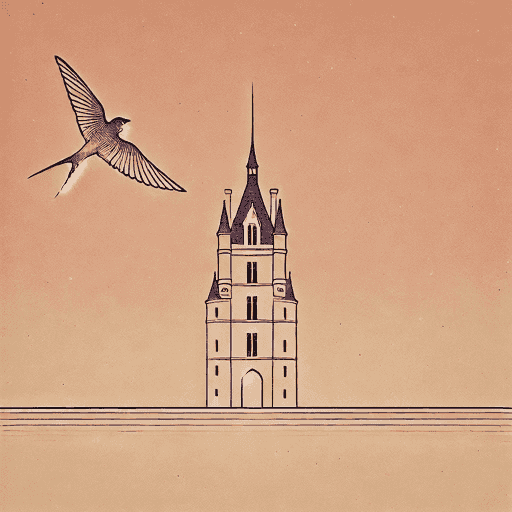
Mallory and Armand race through the upper floors and climb to the tower. Despite Mallory’s fear of heights, Armand coaxes her over the rail and onto the steep, tiled roof. As they crawl toward a dormer, Bastien makes the house shake and the tiles move beneath them, trying to throw them off. They reach the dormer window just above a trellis. The trellis breaks under Armand’s weight, and he falls three stories to the ground. Mallory dangles from a gargoyle with one hand, her strength failing. Bastien speaks through the gargoyle, offering to save her if she ends the spell. She refuses. The gargoyle’s mouth opens with razor teeth. As her grip weakens, the ghosts of Gabrielle and the four wives appear on the roof. Gabrielle rapidly teaches Mallory a transformation spell in the old language. Mallory screams the final word as she falls. Mid-plummet, she transforms into a barn swallow and flies away from the burning house. Remembering Armand, she immediately circles back and lands beside him.
Chapter 48 Summary
Upon landing, Mallory wills herself back into human form. She finds Armand alive but injured; his fall was broken by a lavender bed. With help from Anaïs, Fitcher, and Constantino, they move to a safe distance. They watch as flames consume the House Saphir and the structure collapses. A final burst of blue flame signals that Bastien’s spirit has been destroyed and returned to Verloren. The ghosts of Lucienne, Béatrice, Julie, and Gabrielle appear one last time, smiling, before fading peacefully into nothingness. Only Triphine’s ghost remains, since her murder in Morant was not part of the pentagram that fueled Mallory’s binding spell. The house staff emerge from the woods where they had been sheltered after drinking drugged ceremonial wine, horrified by the destruction. Overwhelmed by relief and exhaustion, Mallory begins to laugh. Armand joins her.
Chapter 49 Summary
Months later, Mallory and Armand live in the House Saphir in Morant. Triphine’s ghost has chosen to stay with them, continuing her constant complaints about various ailments. Mallory’s magical abilities have fully returned, and she and Armand run a legitimate business giving haunted tours and selling apothecary remedies. They have sold the Saphir vineyards in Comorre. Anaïs travels the country hunting monsters with Fitcher and Constantino, sending letters about her adventures. Mallory reads a new letter describing Anaïs’s travels in the country of Stivale, where she is learning to accept her god-gift as a way to bring justice for the dead. Armand arrives home and showers her with loving kisses. She begins writing a reply to share her own news. As she writes, Mallory looks at her engagement ring, a cheap brass beneath silver plating, the sapphire merely blue glass. She reflects that though the ring is fake, her love with Armand is real and their trust is unbreakable.
Chapters 41-49 Analysis
The novel’s conclusion brings Mallory’s primary internal conflict to its resolution, completing her character arc by inverting the central theme of Deception as a Means of Survival. Throughout the narrative, Mallory’s survival has depended on her ability to convincingly fake magical abilities she believes she has lost. This performance is a shield, protecting her from both poverty and the trauma of her past. However, the climax forces her to abandon this shield. To defeat a fully resurrected Bastien, she must move beyond performance and reclaim her authentic identity as a Savoy witch. Her ancestor Gabrielle’s dying words, “He cannot take away what you are. You must […] trust […] yourself” (383), serve as the thematic key, reframing Mallory’s power as something inherent that requires trust to access. The last chapter offers a final commentary on this theme. Mallory’s engagement ring is fake, made of blue glass and plated brass, yet it symbolizes a reality that is genuine. This final, harmless deception demonstrates her newfound security. She no longer needs to perform legitimacy because she has achieved it through her actions and relationships.
The final chapters also provide a definitive statement on the theme of Blurring the Lines Between Human and Monster. Bastien Saphir’s ultimate transformation is not into a more demonic, spectral entity, but back into a man—an immortal and magically powerful one. His monstrosity is most potent when it is contained within a human form, driven by human vices like greed, pride, and a desire for social standing. Upon his resurrection, his first concerns are the restoration of his material estate and the management of his reputation, revealing that his evil is rooted in worldly ambition rather than supernatural malevolence. He dismisses the need to kill Mallory as a public relations necessity, stating, “it will not do to have rumors circulating that could damage my reputation” (387). This mundane motivation suggests that the most dangerous monsters are men who have shed all moral and mortal limitations to pursue their desires. The narrative uses the physical setting to reinforce this idea, as Bastien’s restoration of the château is an act of sorcery that creates a beautiful façade for a monstrous purpose, mirroring his own deceptive human appearance.
The climax links magical power directly to the theme of Vulnerability as a Prerequisite for Trust and Love. Mallory is only able to access her transformative Savoy magic at her moment of absolute vulnerability: dangling from a burning roof, frozen by her acrophobia, and believing Armand has just fallen to his death. This physical and emotional nadir forces her to relinquish control and trust in the power her ancestor offers. Her literal act of letting go of the gargoyle is a metaphor for letting go of her fear and self-doubt, which unlocks her ability to fly. This principle extends to the binding ritual itself, which requires Armand’s Saphir blood, a mark of his own vulnerable lineage, and the collective power of Bastien’s murdered wives. The ghosts, long-rendered powerless, can only fight back when Mallory frees them by seizing their rings, an act of trust in their shared cause. This framework establishes that strength, both magical and emotional, is found in the acceptance of vulnerability and interdependence.
The motif of the house explores concepts of legacy and reclamation. For most of the novel, the House Saphir is a physical manifestation of Bastien’s corrupt and violent patriarchal legacy and a place of female suffering and entrapment. In the climax, Bastien’s control over the architecture turns the domestic space into an active antagonist. Yet, Mallory subverts his power by recontextualizing the estate’s geography. The sites of the five murders, previously markers of trauma, become the anchor points for her “natural pentagram,” transforming locations of victimhood into sources of immense power. This act reclaims the physical space from its history of violence and transforms it into a tool for justice. The subsequent destruction of the house by fire serves as a ritual purification, eradicating the old Saphir legacy. The epilogue completes this symbolic arc by placing Mallory and Armand in the House Saphir in Morant, reclaiming the family name and property for a new legacy built on partnership and legitimate magic rather than on murder and deceit.
Through its engagement with Gothic literary conventions, the text both honors and modernizes the genre. The animated house, the villain who controls the very walls of the heroine’s prison, and the pervasive sense of dread are all hallmarks of classic Gothic fiction. The narrative, however, subverts the traditional damsel-in-distress trope by equipping the heroine with the agency to escape her prison and destroy it. Furthermore, the ghosts of the murdered wives transcend their conventional role as passive, tormented spirits and function as a motif for justice. They become active combatants and, ultimately, mentors who provide Mallory with the key to her own salvation. This collaborative element revises the Gothic formula, suggesting that liberation from patriarchal violence is achieved through female solidarity. The pacing of these final chapters also marks a generic shift, accelerating from the slow-burn suspense of the haunted-house mystery into the explosive action of a high-fantasy confrontation, demonstrating a blending of literary traditions.

Get in-depth, chapter-by-chapter summaries and analysis from our literary experts.
- Grasp challenging concepts with clear, comprehensive explanations
- Revisit key plot points and ideas without rereading the book
- Share impressive insights in classes and book clubs