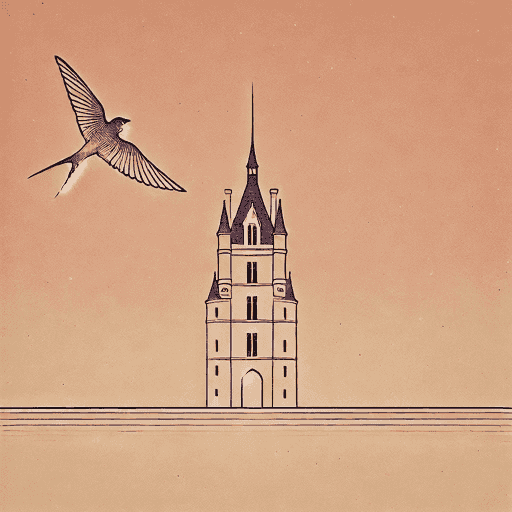
The House Saphir
The House Saphir
A modern alternative to SparkNotes and CliffsNotes, SuperSummary offers high-quality Study Guides with detailed chapter summaries and analysis of major themes, characters, and more.
Summaries & Analyses
Quizzes
NEWReading Tools
Themes
Content Warning: This section of the guide includes discussion of graphic violence and death.
Deception as a Means of Survival
In Marissa Meyer’s The House Saphir, the orphaned Fontaine sisters survive by treating each day as a controlled performance. Under constant threat of eviction and arrest, Mallory and Anaïs depend on small, improvised cons like selling fake god-relics and staging phony séances to navigate a world that denies them power. The book frames this fraudulence as a complicated strategy shaped by fear and scarcity. Mallory’s choices reveal this most clearly. She invents elaborate illusions of magic while hiding the one ability she actually possesses: She sees ghosts.
The sisters’ lies grow out of economic crisis. With neither relatives nor inheritance, they earn their income through these cons. In the opening chapter, they convince a wealthy man to buy a gilded crow feather as a “god-relic” for 12 lys, a sum Mallory quietly celebrates as a “bargain” (4). This early scene grounds their desperation. Mallory’s main project, a ghost tour of the abandoned House Saphir, relies on fabricated stories and mechanical tricks. Their situation feels especially fragile when their landlady, Madame Cellier, threatens eviction, shouting, “I want you both out of here by nightfall” (61). Scenes like this show how their deceptions grow out of the need to stay sheltered, rather than from any wish to harm others.
Mallory’s hidden gift complicates the theme further. She performs the part of a powerful witch, yet she treats her true ability to see and speak with ghosts as something she must hide at all costs. She ignores Triphine during her tours to avoid revealing the truth. When Count Armand Saphir, disguised as Axel Badeaux, seeks her out because of claims that she “can see and speak with the spirits of the deceased” (28), she refuses the idea, calling it “Hearsay and hogwash” (28). She trusts her props instead: a mannequin dressed as a ghost and a system of pulleys. This contrast turns Mallory’s staged identity into a shield that protects her from exposure.
Mallory leans on this fraudulent reputation as a powerful witch to gain a measure of control in a world that offers her none. She accepts Armand’s generous offer to banish the ghost of Bastien Saphir even though she knows she cannot do it. She plans to “figure something out” (71), treating the con as her one chance to secure the independence she and Anaïs need. For the sisters, fraudulence becomes a calculated response to a society with no safety net for young women, and each performance keeps them afloat a little longer.
Blurring the Lines Between Human and Monster
The House Saphir fills its gothic landscape with folkloric beasts and dangerous aristocrats, creating a world where the difference between creature and human feels unstable. Meyer highlights this tension in her worldbuilding by setting the novel post-“fall of the veil” (3), an event that collapsed the formerly separate worlds of mortals and monsters. The novel sets supernatural threats alongside the quieter brutality of people with power. A vengeful ghost, a charming count, and a cursed monster hunter each carry their own kind of menace, which turns the idea of monstrosity into something that depends on behavior rather than species.
The book builds this idea by placing visible supernatural danger next to the older horror of human cruelty. A voirloup attack offers a moment of physical fear. The creature appears with a “wolflike” head and a “jaw that hung open to reveal a row of jagged teeth” (41). Monster hunters kill the beast, which makes its threat feel contained. Bastien Saphir, or Monsieur Le Bleu, casts a longer and darker shadow. His violence left a mark on his family for a century, and stories of his murdered wives turn him into a figure whose legacy outlasts his body. The contrast between the killable voirloup and Bastien’s lingering presence shows how human betrayal can feel more enduring.
Count Armand Saphir complicates this pattern even further. His first appearance carries a sense of unease because he resembles his ancestor, sharing the same “alarmingly blue” eyes (12). That resemblance, paired with the murder of the maid Julie in Bastien’s familiar style, raises doubts about Armand’s innocence. Mallory finds herself caught between her attraction to him and the possibility that he repeats Bastien’s violence. Her repetition of “Armand, or Le Bleu. Le Bleu, or Armand” highlights the blurring of mortal with cursed specter, and to Mallory, “Neither added up. Nothing seemed right” (238). The later reveal that Bastien’s ghost has possessed Armand’s body for years merges the two figures and turns Armand into a blend of man and monster. The possession links human shape with ancient cruelty, erasing the distinction between monster and human.
Even those who hunt creatures face this instability. Fitcher, a member of the monster-hunting troupe, carries a curse that turns him into a giant ice bear during the full moon. The “stoic and serious” (284) boss is also the ferocious bear with “[r]azor claws“ and “fangs” (280). The man who destroys monsters becomes one, which further disrupts attempts to separate human from beast or good from evil. Through these crossings, the book suggests that the most frightening figure may be the one who looks ordinary while hiding something far darker underneath.
Vulnerability as a Prerequisite for Trust and Love
Set against the “Bluebeard” fairytale, The House Saphir frames trust as a dangerous gamble in a world shaped by deceit. Mallory Fontaine enters the novel as a guarded pragmatist whose main goal is survival. Her shift from self-protection to romantic openness turns vulnerability into an act of courage. Her evolving connection with Armand Saphir shows how trust becomes the groundwork for love.
Mallory begins with a sharp distrust of others, especially men who underestimate the power of women. In her interactions with her tour client, Louis, she clocks his “chauvinism” (96) early on and empathizes with Sophia’s plan, albeit fictional, to “run off and join an order that pledged their lives to the god of archery and war, a god who did not care if you were male or female or something else altogether” (8). In this context, Mallory’s distrust of others is not unwarranted, as she consciously rejects the expectation that women’s skills be limited to “embroidering pincushions or playing scales on a harpsichord” (26). Instead, Mallory’s guarded stance reveals her understanding of a world where women are perceived as weak and are physically and emotionally exploited.
Mallory sees caution as essential and prides herself on her talent for “not getting murdered” (1), a skill shaped by constant alertness. When she first meets Armand, she mistakes him for an intruder and throws him to the ground. This moment reveals her instinct to shield herself before any threat materializes. Her suspicion that Armand might repeat Bastien Saphir’s violence grows from this mindset. Trust feels unsafe to her, so she relies on her own judgment to protect herself and Anaïs.
The novel ties this tension to the violent history inside the Saphir family. The ghosts of Bastien’s murdered wives, Lucienne and Béatrice, have echtraus (“trust”) and greischt (“betrayal”) (95) cut into their arms. Their bodies carry a warning about misplaced faith. Julie’s murder repeats these carvings and reinforces the danger surrounding the Saphir name. Her death mirrors Mallory’s worst fears and deepens the stakes of believing in Armand’s innocence.
Mallory and Armand form their bond during crises that require openness. During the voirloup attack, Armand tells her to jump from a second-story window and assures her, “I won’t let you get hurt” (47). This trust grows stronger throughout the novel and culminates in their escape from the burning château tower, an echo of the previous scene where Mallory is again at the metaphoric precipice of trust. As Armand helps her scale the down the building, he comfortingly tells her, “[Y]ou can reach it, I promise. […] I will not let you fall” (409). With no alternatives left, Mallory chooses to believe him, and that choice keeps them alive. Her willingness to accept this risk allows their relationship to deepen and turns trust into the path toward love.

Unlock every key theme and why it matters
Get in-depth breakdowns of the book’s main ideas and how they connect and evolve.
- Explore how themes develop throughout the text
- Connect themes to characters, events, and symbols
- Support essays and discussions with thematic evidence