The Rumor
A modern alternative to SparkNotes and CliffsNotes, SuperSummary offers high-quality Study Guides with detailed chapter summaries and analysis of major themes, characters, and more.
Summaries & Analyses
Quizzes
NEWReading Tools
Symbols & Motifs
Content Warning: This section of the guide includes discussion of sexual content.
The Garden
Grace’s meticulously cultivated garden is a symbol of her desire for an orderly, beautiful life and an identity separate from her roles as wife and mother. Before her affair with Benton, gardening provides Grace with a form of creative expression that belongs distinctly to her. When Benton compliments her “sensibility,” she notes: “[s]he had been a dutiful daughter and granddaughter, tolerant sister, a diligent student, a halfway-decent breakfast waitress. […] But had anyone—including Eddie, including Madeline—appreciated Grace’s sensibility?” (16). In this way, her collaboration with Benton is initially meaningful because he recognizes this neglected part of her identity, sharing her aesthetic sensibilities and treating her interests as worthy of serious attention. The garden therefore helps explain the emotional appeal Benton holds for Grace. He validates abilities and desires that she feels have gone unnoticed.
Her garden, however, slowly becomes a “private Eden” where her affair with Benton flourishes. Their rituals of mint tea and private lunches take place in the garden, while the shed becomes the primarily location for their sexual relationship. Grace gradually begins excluding others from their space, repeatedly refusing Hope’s requests to join and eventually choosing Benton over Madeline to attend the Sunset Soiree. The garden continues to symbolize Grace’s desire for a life that feels personally fulfilling, but her behavior within it reveals how that legitimate desire has become distorted by secrecy and self-absorption. This development connects the symbol to the theme of The Cost of Deception, as Grace attempts to preserve her established family life while simultaneously constructing a separate existence around Benton, but maintaining both eventually becomes impossible.
The Boston Globe feature on Grace’s garden brings this contradiction into public view. Grace receives deserved recognition for a garden that genuinely reflects her talent and collaboration with Benton, but the photograph also captures their intimacy, allowing the community and eventually Eddie to see their affair. The garden cannot remain the secluded world Grace imagined she could control, connecting its public exposure to Reputation as a Collective Construction. As the community gossips about her secret life, the route through which she looked for purpose, recognition, and an identity of her own ultimately proves incapable of providing the lasting fulfillment she imagined. Throughout the novel, the garden reflects Grace’s continuing search for a self-directed life and the increasingly destructive choices she makes when she comes to believe that such a life depends upon Benton.
Spec Houses
The three unfinished spec houses on Eagle Wing Lane are symbol of the unstable foundation beneath Eddie’s carefully maintained image of prosperity. Intended to be monuments to his success as “Fast Eddie,” the stalled construction projects instead underscore his overextended ambition and failure. Madeline observes that the houses are “boarded up and silent” (190), an image that captures their status as empty shells and mirrors the hollowness behind Eddie’s confident facade. As he is eventually forced to sell all three to get out of his financial hole, the houses make visible the financial instability he otherwise works to conceal.
As the novel progresses, Eddie’s attempt to save the properties—and thus his social status—connect their symbolism to the theme of The Cost of Deception. He withholds the severity of his financial problems from Grace, cannot return Madeline and Trevor’s investment, and becomes increasingly willing to cross ethical and legal boundaries rather than allow his prosperous image to collapse. His financial predicament helps explain the pressure under which he operates, but the houses do not excuse the prostitution operation he chooses to establish and expand. Instead, they clarify what Eddie is trying so desperately to preserve: a version of himself whose success has become increasingly disconnected from financial reality. His eventual sale and loss of the properties therefore externalizes a collapse that has been developing throughout the novel. What were intended to demonstrate Eddie’s ability to create wealth instead reveal the risks of constructing an identity around anticipated success, making the unfinished houses a physical counterpart to a lifestyle whose impressive exterior was never truly secure.
Panama Hat
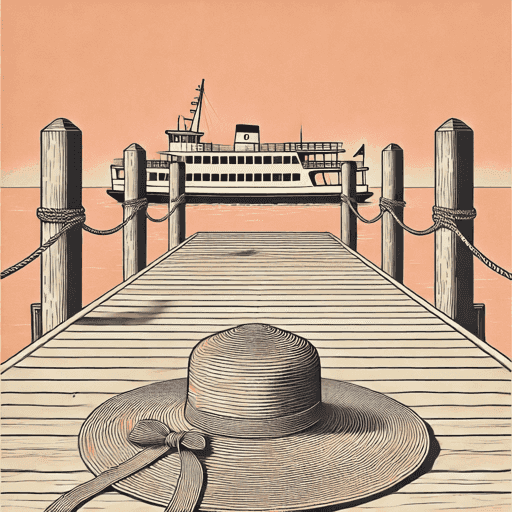
Similar to the spec houses that represent the empty foundation on which his successful projection is built, Eddie’s signature Panama hat symbolizes the confident, prosperous “Fast Eddie identity he constructs and presents to others” (305). The identity is described as follows:
The hat is part of the distinctive image through which Eddie markets himself as a successful Nantucket real estate agent: relaxed, charismatic, and seemingly untouched by financial uncertainty. Its importance to this persona becomes more clear when Eddie admits that he wears it because he is “self-conscious because [he’s] bald (305).
Beneath the professional branding, then, lies a more personal insecurity and a desire to control how others perceive him.
The hat’s repeated loss during moments of extreme stress and moral compromise represent the cracks forming in his carefully constructed facade. When arranging the first illicit deal, the drug-addled client Ronan LNW simply takes the hat off Eddie’s head. Later, as the police chief warns him of the affair rumors, the wind rips another hat away. The final hat is crushed underfoot during his FBI arrest. Each loss strips away another layer of his public identity, revealing the vulnerable man underneath. These losses connect the symbol to the theme of The Cost of Deception, as each occurs while the realities Eddie has concealed increasingly intrude upon the identity he performs. The symbol appears a final time when Grace sends him a new one in prison. In that setting, the hat can no longer convincingly advertise wealth and professional success, so the gift becomes evidence that Grace still recognizes and cares for the person who once wore it. The novel ultimately separates Eddie himself from the public persona the hat originally helped him construct; Fast Eddie has collapsed, but Eddie’s identity and relationships have not disappeared with it.
Madeline’s Manuscript (B/G)
The manuscript for Madeline’s novel, eventually titled B/G, symbolizes the central conflict between her artistic creation and her ethical loyalty. Plagued by writer’s block and financial pressure, Madeline seizes upon Grace’s secret affair as inspiration, and the resulting manuscript becomes the physical embodiment of her betrayal. B/G places two legitimate parts of Madeline’s identity into direct conflict: her desire to succeed as a novelist and her obligation to protect the confidence of her closest friend.
Throughout the novel, this conflict becomes increasingly difficult for Madeline to contain. Her editor and agent respond enthusiastically to the material, while the publisher gives the manuscript its title and begins shaping it into a marketable romance. At the same time, Madeline’s secrecy about the book contributes to Trevor’s suspicions about her supposed affair with Eddie; she cannot fully explain what she is writing without exposing both Grace’s secret and her own use of it. The manuscript connects to the theme of The Cost of Deception, as Madeline’s attempts to keep her professional opportunity separate from her personal relationships becomes more impossible. Her eventual admission to Redd, “I blatantly used my best friend’s affair as the basis for that novel. […] [T]he story is hers, not mine” (331) acknowledges this ethical problem. When Madeline withdraws B/G from publication despite the professional consequences, she finally resolves the manuscript’s central conflict in favor of loyalty rather than ambition.
The unpublished manuscript ultimately acquires a more complicated place within the theme of The Value of Female Friendship when Grace chooses to read it. Rather than responding only to Madeline’s appropriation of her experience, Grace is moved by the fictional ending that G and B receive, admitting that it was the ending she wanted for herself. The manuscript that once threatened their friendship consequently becomes part of their reconciliation. This final development underscores the differences between lived experience and the narratives people construct from it: Madeline can give B and G the satisfying romantic conclusion that Grace and Benton never receive. B/G remains, from beginning to end, caught between art and loyalty, but its withdrawal from the marketplace allows it to become a private exchange between the two women rather than a public commodity created from one friend’s confidence.

Unlock the meaning behind every key symbol & motif
See how recurring imagery, objects, and ideas shape the narrative.
- Explore how the author builds meaning through symbolism
- Understand what symbols & motifs represent in the text
- Connect recurring ideas to themes, characters, and events
Related Titles
By Elin Hilderbrand