Thornbird
A modern alternative to SparkNotes and CliffsNotes, SuperSummary offers high-quality Study Guides with detailed chapter summaries and analysis of major themes, characters, and more.
Summaries & Analyses
Quizzes
NEWReading Tools
Important Quotes
Content Warning: This section of the guide includes discussion of bullying, emotional abuse, graphic violence, death by suicide, cursing, and death.
“Not even eighteen years old, and I’ve already lived so many lives. Been so many girls. Gabrielle Thorn, the broken child who lost two parents in one night. Ryan Mayfair, who spent ten years trying to piece herself back together. And now Ryan Shipley, the shiny, blank-slate girl with no past and absolutely no closet skeletons whatsoever.”
(Chapter 1, Page 7)
Ryan’s summary of her life encapsulates the theme of Self-Discovery in the Shadow of a Dark Family Past. The cataloging of her forced identities conveys the fragmentation of her selfhood as a result of her father’s crimes. The progression from “broken” to “piecing herself back together” to a “shiny, blank-slate” implies progress while emphasizing her lack of a stable identity.
“Are you going to kill me now?”
(Chapter 3, Page 26)
In this nightmare flashback, seven-year-old Ryan’s question to her father encapsulates the story’s core trauma. The simple, direct dialogue reveals the horrific reality of her childhood and the moment her innocence was destroyed. This memory of witnessing her father kill her mother haunts the protagonist, presenting her past as a visceral, recurring terror.
“Let’s see who thinks Thorn should be executed! Not a single person votes for his life to be spared, so I don’t, either.”
(Chapter 4, Page 42)
During a class discussion on capital punishment, Ryan feels forced to vote for her own father’s execution. This act of performative condemnation illustrates her deep isolation, as she must publicly align against her family to protect her secret identity. Her internal conflict is externalized by this impossible choice, showing The Cost of Keeping Secrets.
“There are so many. Some are lying among the dried leaves on the ground, mere splinters. It almost feels like a cemetery. Here lies Gabrielle Thorn’s childhood.”
(Chapter 6, Page 63)
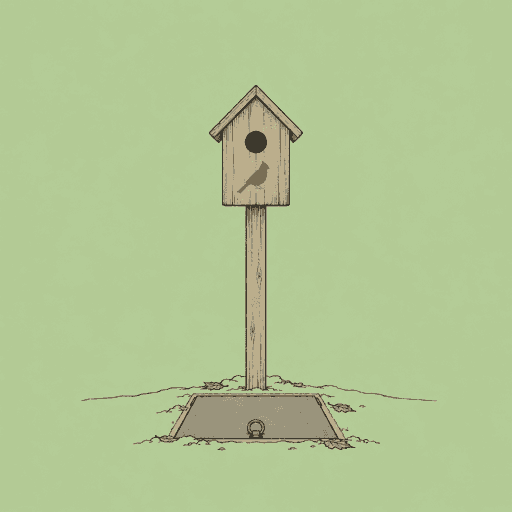
Ryan uses a metaphor to describe the decaying birdhouses she built with her father, directly equating them with a graveyard for her former identity. This imagery connects the central bird motif to the death of her innocence, transforming the woods from a place of childhood creativity into a memorial for her traumatic past.
“Having your eyes on me that night, it felt like my wings were clipped. That’s when I knew I couldn’t keep flying from what I had done. What I’d become. It was you, watching, that made me realize I had to cage myself.”
(Chapter 7, Page 81)
This excerpt from Gabriel Thorn’s prison letter reveals his delusional perspective. Subverting traditional associations of bird imagery with freedom, he uses this symbolism to frame his capture and imprisonment of women. The extension of this imagery to explain his own decision to “cage himself” pinpoints his daughter witnessing her mother’s death as the catalyst for his confession.
“I know she’s dead, but she wasn’t really gone, not as long as I had that necklace. All those other families, they don’t even know where their moms’ remains are, but I had mine around my neck. It sounds horrible and morbid, but it felt comforting. Like she was still with me.”
(Chapter 9, Page 94)
This quote reveals the deep and unique connection Ryan feels to her mother through the cremation diamond necklace. The jewelry is a tangible piece of her mother, offering comfort and a sense of presence. Its disappearance represents a further traumatic loss, forcing Ryan to re-experience her mother’s death.
“He wanted to know if you’d be there for the execution.”
(Chapter 9, Page 106)
Delivered by her aunt, Maggie, this question forces Ryan to confront the impending death of the father she has spent a decade trying to forget. The bureaucratic nature of the request highlights the brutal reality of capital punishment and its impact on families.
“UNKNOWN: Remember…I know who you are, Gabrielle Thorn.”
(Chapter 14, Page 154)
This anonymous text message shifts the narrative from a personal story of grief to a tense thriller. The use of her birth name, Gabrielle, confirms that the threat is not a bluff, shattering Ryan’s sense of security. It externalizes her internal fear of discovery and embodies the theme of the cost of keeping secrets.
“It means when you laugh at his jokes, it never reaches your eyes. And when you stare out the window during every class, it’s not because you’re seeing something peaceful.”
(Chapter 16, Page 166)
Chase’s astute observation cuts through Ryan’s facade, revealing his unique ability to see the pain she hides from others, including Everett. This line establishes him as a perceptive and candid character who is not fooled by her performance of normalcy, hinting at a deeper potential for understanding between them.
“My father killed her.”
(Chapter 17, Page 182)
This short, stark sentence represents the novel’s most significant plot twist up to this point. The realization that Everett’s mother was one of her father’s victims destroys the fragile normalcy Ryan has built. The internal monologue highlights the destructive intersection of their lives, revealing that the past is inescapable and its consequences are deeply intertwined.
“You think this is protection? I’m just supposed to keep dating him knowing my dad murdered his mother? How?”
(Chapter 19, Page 199)
Ryan’s bitter, rhetorical questions expose the pernicious impact of her family’s secret. Her disbelief highlights the deep emotional and ethical dilemma she now faces as Everett’s girlfriend, demonstrating that the Shipleys’ well-intentioned attempt to “protect” her has only created an impossible situation.
“Did you know, Sheriff, that the light doesn’t love everyone? Some subjects, no matter how beautiful, sit in the light like a shadow. Flat and unwilling to reflect any of it back. Leah? The light danced on her. It danced! It skipped down the planes of her face and rested there, like it couldn’t help itself.”
(Chapter 21, Page 219)
Gabriel’s chillingly poetic description of Leah reveals his deep detachment from the violence of his crimes. He frames his desire to capture and imprison beautiful women as an artistic appreciation, justifying his actions through a twisted aesthetic lens. This quote exposes the core of his pathology: He saw his victims not as people but as beautiful objects to be possessed.
“They keep digging and digging, bringing everything back up again. Meanwhile I just want to forget it. My mother’s dead. Nothing will bring her back.”
(Chapter 22, Page 227)
Everett’s blunt, declarative statement, “My mother’s dead,” contrasts sharply with the ongoing public spectacle of the search for her body. His tone of weary resignation critiques the true-crime genre, which can treat personal tragedy as entertainment, and captures the helplessness of those left behind.
“I’ve trusted you with my sparrows. My pretty ones. You’ll watch over them, won’t you? Make sure they are never disturbed. Hold them in your heart as I’ve held you in mine. Keep them close. Keep them safe.”
(Chapter 23, Page 233)
This passage from Gabriel Thorn’s suicide note illustrates the novel’s bird motif, as he twists the imagery of delicate birds into a euphemism for murder victims. The language is deceptively tender, framing his crimes as acts of protection. By asking his daughter to become the guardian of his dark secret, he exerts a final, manipulative act of control.
“‘We’ve had each other’s backs since we were kids.’ His tone is grudging, as if he’d rather pry out his own teeth than utter any of this to me. ‘Might look like an odd friendship to everyone else, but we understand each other.’”
(Chapter 24, Page 241)
Chase’s reluctant admission reveals the deep, misunderstood bond he shares with Everett, challenging superficial high school social hierarchies. His assertion that they “understand each other” hints at a shared history that transcends their different social roles, adding complexity to his otherwise antagonistic character and showing a deep loyalty.
“It means I don’t believe you consciously know the location. However, I think you might know more than you realize. Memories get buried deep, especially if they’re painful.”
(Chapter 28, Page 268)
Agent Foster’s dialogue establishes the concept of repressed memory as a key plot device. This foreshadows the hypnosis sessions that will help Ryan uncover the truth. The line highlights the theme of self-discovery in the shadow of a dark family past, suggesting that Ryan must confront her internal trauma to solve the external mystery.
“Instead of lunging at the cop, Chase turns to me, pulls me flush against him, and kisses me.”
(Chapter 29, Page 280)
The kiss is a key plot point, transforming the dynamic between Ryan and Chase from one of tension to one of romantic intrigue. While initiated as a deception, the act reveals an underlying attraction that complicates both characters’ lives.
“Why was there blood on those sketchbooks? What have you done, Gabriel! What have you fucking done!”
(Chapter 31, Page 298)
This quote marks the climax of the hypnosis scene, revealing the inciting incident that led to Sarah Thorn’s murder. The unearthed memory provides Ryan with the first tangible clue about what her mother knew and why she was killed.
“I want to be here. For the first time since I came to Tennessee, I feel like I’m in the right place.”
(Chapter 33, Page 314)
Ryan’s realization signifies an important turning point in her emotional arc. After constantly feeling alienated and defined by her dark past, her connection with Chase provides a moment of peace and acceptance.
“But there’s one secret, one puzzle, that can finally be solved. And tonight, thanks to Free the Sparrows, it will be.”
(Chapter 36, Page 347)
Zed’s announcement is a climactic moment in the narrative, transforming Ryan’s private struggle with her family history into a public spectacle. Zed’s appropriation of the yearbook video to expose her identity emphasizes the ruthlessness of the true crime industry and the town’s obsessive preoccupation with Gabriel Thorn’s murders.
“His self-satisfied expression barely wavers. No remorse whatsoever for what he’s done. For the way he’s publicly shamed me.”
(Chapter 38, Page 360)
During her confrontation with Zed, Ryan observes his lack of remorse, which emphasizes his role as a self-serving media personality rather than a truth-seeker. His actions, driven by a desire for clicks and followers, highlight the exploitative nature of the true-crime genre, turning personal tragedy into entertainment and profit.
“She doesn’t deserve a cage. I understand that, better than most. She needs freedom, not these walls and chains. I’ve watched her struggle in the trap of her own making—a family, a life she felt tied to.”
(Chapter 41, Page 388)
This excerpt from Gabriel’s journal differentiates his view of Leah from his other victims. He sees her not as a “sparrow” to be caged, but as someone deserving freedom from her self-imposed “trap.” Yet his claim to understand what Leah needs still assumes the authority to define her life for her, exposing the controlling impulse beneath his apparent compassion.
“Then why does it feel like it’s crushing me? Why does it feel like I’m constantly fighting back this wave of darkness?”
(Chapter 43, Page 412)
Everett’s confession culminates in this desperate question, which uses the metaphor of a “wave of darkness” to articulate the psychological toll of his long-held secret. His words illustrate the theme of the cost of keeping secrets, showing how the guilt of believing he killed his mother has defined and tormented him for a decade.
“Someone in that well tried to climb the ladder. Tried to push the lid off, to pry it open. Tried so hard that she ripped her own nails out.”
(Chapter 44, Page 422)
Ryan’s deduction after finding Leah’s fingernails at the top of the well reveals the novel’s final plot twist. The visceral imagery of someone trying to claw their way out of a tomb transforms the narrative from one of accidental death to one of unimaginable cruelty, exposing JP’s monstrous act of burying his wife alive.
“He revs the engine. I wrap my arms around him, a sense of exhilaration brewing under my skin. Chase speeds forward, and we glide down the streets of Starling, leaving everything behind. The grief, the secrets, the past. It all fades into the distance as the horizon opens up to us.”
(Epilogue, Page 430)
The novel’s final scene provides catharsis as Ryan literally rides away from her traumatic past. The imagery of the fading town and the open horizon symbolizes her escape from the shadows of her family history. This act illustrates her successful journey of self-discovery in the shadow of a dark family past, choosing a future of her own making.

Unlock every key quote and its meaning
Get 25 quotes with page numbers and clear analysis to help you reference, write, and discuss with confidence.
- Cite quotes accurately with exact page numbers
- Understand what each quote really means
- Strengthen your analysis in essays or discussions