Summaries & Analyses
Author Insights
Quizzes
NEWReading Tools
Chapters 42-55Chapter Summaries & Analyses
Content Warning: This section of the guide includes discussion of child abuse, emotional abuse, graphic violence, and death.
Chapter 42 Summary: “Leila”
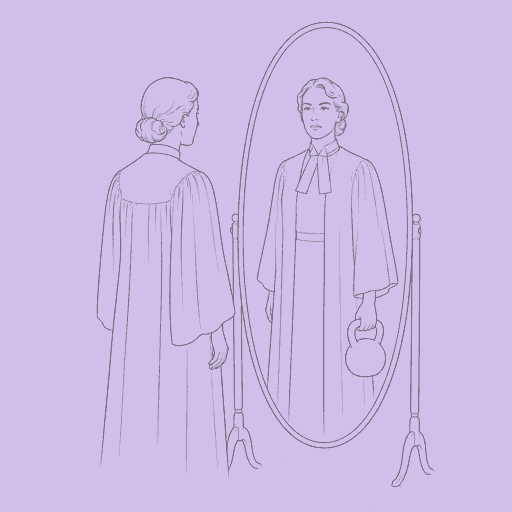
On the first day of Jack Millman’s murder trial, Leila is overcome with nausea and adrenaline. She and Julian now live estranged in the same house, their movements carefully choreographed to avoid contact. In the robing room at Newcastle Crown Court, Leila senses her colleagues’ animosity, who want her to lose because the victim, Judge Anton Smythe, was their friend. She sees her court robes and wig as a form of armor.
Before the trial begins, Leila meets with Jack. She warns him that withholding his defense until trial will allow the judge to direct the jury to draw an “adverse inference” against him. The courtroom is packed with spectators, and the presiding judge is Mrs. Justice Brightman. After the jury is selected, the judge confirms that Jack, against legal advice, has consented to the jury knowing about his prior conviction for grievous bodily harm.
Chapter 43 Summary: “Leila”
Julian begins his opening speech for the prosecution. Leila observes his performance, noting that he is using dramatic, biased language to portray Jack as a cold-blooded killer. She knows Julian is trying to provoke a reaction from her to make her appear unprofessional to the jury. Understanding that trials are often won on likability rather than evidence, she remains impassive.
Julian tells the jury that the Crown does not need to prove a motive; they only need to prove that Jack killed Anton with the intent to cause death or serious harm. As he speaks, Leila reflects on their shared history—how Julian was once her mentor, husband, and greatest supporter, but now stands as her determined adversary. She resolves to use her intimate knowledge of his tactics against him.
Chapter 44 Summary: “Leila”
The prosecution calls its first witness, DCI Brady, the lead detective on the case. Julian questions him about the night of the murder. Brady testifies that Jack made the call to emergency services. Upon arrival at Jack’s flat, police found Anton Smythe lying on the floor being attended to by paramedics, while Jack sat calmly on the sofa, making no attempt to help. Leila objects when Julian leads the witness, which irritates him but makes her appear petty to the jury. The murder weapon is identified as the ten-kilogram kettlebell, which was used as a doorstop. Brady notes it was found wiped clean of fingerprints and returned to its original position by the door. He also states that Jack’s cell phone was never recovered. Brady confirms that Jack gave a “no-comment” interview and was subsequently charged with murder.
Chapter 45 Summary: “Leila”
Leila cross-examines DCI Brady, pointing to a swelling on Jack’s face in his custody photo. Brady dismisses it as unimportant. Leila establishes that the victim, Anton, was left-handed, making Jack’s injury consistent with being struck by him. She emphasizes that the case against Jack is purely circumstantial, with no DNA linking him to the weapon. Leila then highlights oddities Brady failed to investigate: Jack was wearing his T-shirt inside out, there was a smell of women’s perfume in the bedroom, and five glasses—two with different shades of lipstick—were at the scene. She accuses Brady of having tunnel vision and failing to pursue other lines of inquiry, but he remains firm that the police have the right man.
Chapter 46 Summary: “Leila”
The pathologist, Dr. Parker, testifies that Anton Smythe died from a blunt head trauma consistent with being struck by the kettlebell. He states the blow likely came from the side or behind, undermining any potential claim of self-defense. Julian elicits an important piece of testimony: Dr. Parker confirms that survival from such an injury is possible if medical aid is administered quickly, implying Jack fatally delayed calling for help.
On cross-examination, Leila gets Dr. Parker to acknowledge minor injuries on Anton’s body consistent with a physical struggle, but the pathologist minimizes their significance. When Leila suggests that a strong man like Jack would likely have caused more damage to Anton with the kettlebell, Dr. Parker asks how much more injured the victim could be, given that he is dead. Leila ends her questioning, aware the prosecution’s case is now significantly stronger.
Chapter 47 Summary: “Witness X”
The narrative shifts to Witness X, who reminisces about her affair with Jack and her unhappy marriage. Reflecting on how love made her uncharacteristically careless, she regrets allowing Jack to video her on his phone. She fears the exposure of their affair, believing that as a woman, she will be judged far more harshly than a man.
Chapter 48 Summary: “Leila”
The Crown’s next witness is Percy Wyndam, a cell phone forensics expert. Wyndam testifies that he could not retrieve the content of Jack’s missing phone but could analyze its activity logs. Jack’s phone repeatedly texted a single pay-as-you-go number over a period of seven months. Using cell site analysis, Wyndam shows that on the night of the murder, Jack’s phone signal was lost at his apartment at 10:41 pm and reconnected at 11:27 pm in the village where Anton Smythe lived. Analysis of Anton’s phone reveals his last activity was at 10:39 pm, when the FaceTime app was opened for 13 seconds without a call being made. Leila confirms with Wyndam that cell-site analysis is highly accurate at locating subjects within a few meters, then says she has no further questions.
Chapter 49 Summary: “Leila”
Anton’s 18-year-old son, Quinn Smythe, takes the stand. He claims that, before the murder, Jack had been harassing him for weeks because his father had once sent Jack to prison. According to Quinn, Anton went to Jack’s flat that night to tell him to stop the intimidation. During cross-examination, Leila highlights the oddity of a judge confronting a supposed harasser personally instead of involving the police. She gets Quinn to admit his father was “angry” and “agitated” before the meeting. Quinn denies that any other conflict existed between him and Jack, which Leila knows is a lie, based on a secret recording she cannot use in court. Frustrated by her inability to expose Quinn, Leila concludes her questioning as the first day of the trial ends.
Chapter 50 Summary: “Leila”
On the second day of the trial, Leila calls Jack to the witness box. He calmly answers preliminary questions about his work as head of security for Eddie Sorrington. He openly acknowledges his prior conviction for assault, telling the jury he has nothing to hide. When Leila asks him to present his defense against the murder charge, Jack looks directly at the jury and states that he did not kill Anton Smythe.
Chapter 51 Summary: “Witness X”
Witness X recalls the night of the murder. She and Jack were being intimate in his apartment when he suggested recording them. Despite her usual caution, she agreed because Jack made her feel safe enough to break her own rules. As he set up his phone to film the living room, their encounter was interrupted by loud banging on the door. It was Anton Smythe, who shouted that he wanted to be let in and threatened to break the door down if he was not.
Chapter 52 Summary: “Leila”
Jack’s denial causes an uproar in the courtroom. He tells the court he knows who killed Anton but refuses to name the person, stating he is prepared to go to prison to protect them. He reveals he was having an affair with a married woman in an abusive relationship, and she was with him in the flat that night. Jack then declares that Anton came to see him because his son, Quinn, was responsible for the death of Eddie Sorrington’s son, Lewis. Jack claims he witnessed Quinn’s assault on Lewis.
The court erupts, and Eddie lunges at Quinn in the public gallery before being restrained. Jack explains that he videoed an argument between Quinn and Lewis outside the club. Quinn punched Lewis, who collapsed and died. Meanwhile, Quinn fled the scene. Afterward, Jack confronted Quinn with the video, instructing him to confess to the police. Jack told Quinn that if he failed to admit to the crime, he would let Eddie Sorrington know the identity of his son’s killer. When Quinn told his father about his predicament, Anton came to the flat to bribe Jack for the video. When Jack refused, Anton became violent, grabbing a knife. At that point, Jack says his lover, “X,” intervened.
Chapter 53 Summary: “Witness X”
Witness X recalls hiding in Jack’s bedroom as she listened to Anton confront Jack about Quinn. She knew that if Anton discovered her, he had the power to destroy her life. Her fear intensified as she watched Anton lunge at Jack with a knife. Driven by love and instinct, she ran out of the bedroom to intervene. Anton recognized her and sneered. She reflects that allowing herself to love Jack made her abandon the manipulative “rules” for survival she had always followed, leaving her dangerously vulnerable.
Chapter 54 Summary: “Leila”
Jack continues his testimony, explaining that when “X” emerged from the bedroom, Anton panicked, realizing there was another witness to his son’s crime. He lunged at Jack again, and during the struggle, a bottle of Coke spilled on Jack’s T-shirt. Jack states Anton was pinning him down with the knife when X hit Anton on the head with the kettlebell to save his life. He then told her to flee so he could protect her by taking the blame. He also clarifies that his missing phone contains a video that would prove his story about Quinn. He concludes by stating he waited to reveal his defense because he feared powerful people would prevent a fair trial, and he is willing to accept the consequences of this late disclosure to protect the woman he loves.
Chapter 55 Summary: “Witness X”
Witness X continues her account of the final confrontation. After she revealed herself, Anton accused them of a setup. He then took out his own phone and threatened to FaceTime her husband. As she begged him to stop, Jack lunged at Anton, causing the phone to fall to the floor. Checking it, she saw Anton had only reached his contacts in the FaceTime app before dropping the phone. While the two men fought, she grabbed the nearby kettlebell and struck Anton on the head with all her strength. She knew in that instant she had killed him. The chapter ends with Witness X hearing the voice of her abusive father in her mind, approving of her actions.
Chapters 42-55 Analysis
As the trial begins, Murray portrays the courtroom as a theater of social and professional hierarchy rather than a forum for justice, with Leila viewing her court dress as “armor” (242). The narrative establishes how even the physical layout of the courtroom, where King’s Counsel Julian Kesler is afforded a lectern while Leila is not, creates a visual power imbalance for the jury. Julian leverages his superior status to deliver a dramatic opening speech designed to portray Jack Millman as a cold-blooded killer and provoke an unprofessional reaction from Leila. Her awareness that “evidence doesn’t win trials. Lawyers do” (248) emphasizes the performative nature of the legal process. While Leila lacks the gender and class advantages of Julian, she also recognizes that the courtroom is a space where other factors can eclipse factual evidence. Just as Julian attempts to control the narrative through polished performance and appeals to prejudice, Leila utilizes her likeability to sway the jury’s opinion. Both strategies highlight The Limitations of Legal Justice, underscoring how prejudice inevitably plays a role in determining whether an individual is innocent or guilty.
Jack’s testimony directly challenges the integrity of the legal system, reframing his silence as a strategic necessity rather than an admission of guilt. By waiting until he is on the stand to reveal his defense, he seizes control of the narrative in a way that legal procedure would have otherwise denied him. His claim that he withheld the truth because he “feared [he] wouldn’t get a fair trial because of the powerful people involved” (302) positions the court not as an impartial arbiter but as a tool of the elite. Jack sacrifices his credibility under the rules of the court to protect Witness X and force a public reckoning for Quinn, believing that a conventional defense would be suppressed. His dramatic revelation transforms the trial from a murder case into a complex web of blackmail, cover-ups, and competing loyalties, forcing the jury to question the very foundation of the prosecution’s case and the motivations of everyone involved.
In these chapters, the ten-kilogram kettlebell used as the murder weapon becomes a symbol of the trial’s central conflict: the clash between a tidy, circumstantial narrative and a messy, hidden reality. For the prosecution, the kettlebell is a key piece of physical evidence. DCI Brady describes the fact that it was returned to its position as a doorstop as an “amateurish move” (258) by the killer to conceal it after committing the crime. In this context, the kettlebell suggests a deliberate act of murder. However, in Jack’s testimony, the kettlebell is an object of defense, swung by Witness X in a moment of instinct to save Jack from a knife-wielding attacker. The object itself is unchanged, but its significance is wholly dependent on which narrative one believes. The kettlebell thus embodies the trial’s core ambiguity, demonstrating how a single piece of evidence can anchor two irreconcilable versions of the truth. The motif of cell phones emerges as a similar battleground for control over the narrative, representing both objective evidence and hidden, subjective truths. The prosecution represents the disappearance of Jack’s phone as evidence of his guilt. However, the same technology that seems to incriminate Jack may equally exonerate him by proving Quinn’s fatal assault on Lewis and the true circumstances of Anton’s death. The phone thus becomes an emblem of the dual nature of modern evidence—simultaneously a source of verifiable data and a container for clandestine content that can shatter the prosecution’s entire case.
Through the perspective of Witness X, the narrative explores how past events shape present violence, highlighting The Negative Impact of Childhood Trauma on Relationships. She reflects that her affair with Jack made her break the cynical rules for survival taught by her abusive father, making her feel “vulnerable” and “more human” (269). This internal conflict reveals that her actions are not those of a calculated killer but of someone whose capacity for trust and emotional connection has been deeply damaged. Despite her indoctrinated perception of relationships as transactional power games, her love for Jack compels her to act impulsively and emotionally. The complete abandonment of her detached strategies ultimately results in Anton’s death. The final line of her account, where she hears her father’s approving whisper, reveals the deeply entrenched legacy of abuse, aligning this act of violence with the cruelty she was taught to value.

Get in-depth, chapter-by-chapter summaries and analysis from our literary experts.
- Grasp challenging concepts with clear, comprehensive explanations
- Revisit key plot points and ideas without rereading the book
- Share impressive insights in classes and book clubs