Summaries & Analyses
Author Insights
Quizzes
NEWReading Tools
Symbols & Motifs
Content Warning: This section of the guide includes discussion of child abuse, emotional abuse, graphic violence, and death.
The Rules
The “Rules” are a recurring motif that represents the psychological framework of survival taught to Leila by her abusive father. Presented as epigraphs in the “Witness X” sections, these twelve maxims for manipulation form the backbone of Leila’s ruthless, cynical worldview and her primary method for navigating a hostile world. The first and most important rule, “Don’t Get Caught” (333), encapsulates the philosophy that survival depends on deceiving others and avoiding accountability at all costs. This internal code illustrates The Negative Impact of Childhood Trauma on Relationships, conditioning Leila to view all relationships as transactional power dynamics rather than sources of genuine connection.
The rules are Leila’s armor, but they are also her prison. They represent a legacy of abuse that prevents her from forming authentic bonds and forces her to live a life of constant performance and vigilance. Ultimately, her journey is defined by her struggle with this inheritance. In choosing to sacrifice herself for Jack by confessing to Anton’s murder, she deliberately breaks her father’s primary directive, signaling a shift away from his toxic influence and toward a new code based on love and self-sacrifice. This final act suggests that escaping trauma requires actively rejecting the very rules that once ensured one’s survival.
The Ten-Kilogram Kettlebell
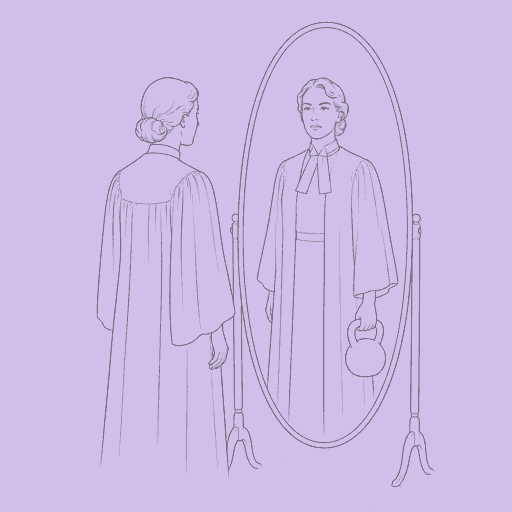
The ten-kilogram kettlebell, the weapon used to kill Anton Smythe, is a symbol of calculated deception. As an object, the kettlebell is mundane—a piece of exercise equipment repurposed as a doorstop in Jack’s flat. This banality contrasts sharply with the brutal, fatal violence it is used to inflict. Leila’s deliberate placement of the kettlebell back in its original position after she uses it to murder Anton is the cornerstone of Leila’s cover-up. As she masterminds the crime scene, Leila anticipates that investigators will see it as an “amateurish” error on the part of the murderer. As she notes in her closing speech of the trial, “DCI Brady himself said it was used by someone who had ‘no knowledge of evidence or criminal law’ and that replacing it by the door was a ‘poor attempt to manipulate a crime scene’” (339). This misdirection plants the idea that the killer was a panicked, unsophisticated woman—the mysterious “Witness X”—diverting attention away from both Jack as a seasoned criminal, and herself. Leila’s use of the kettlebell to create “reasonable doubt” in the jurors’ minds symbolizes The Limitations of Legal Justice, as the trial’s result hinges on a clash of narratives, achieved through the artful manipulation of physical evidence.
Cell Phones
Cell phones function as a recurring motif, representing the near impossibility of keeping secrets in a technologically connected world. Throughout the novel, they capture, reveal, and transmit hidden truths, driving the plot and exposing the characters’ deceptions.
Jack’s phone is the most significant example of the inescapable permanence of digital evidence, as it becomes an impartial witness to two crimes. The video of Quinn Smyth’s killing of Lewis Sorrington transforms a private act of violence into undeniable evidence, triggering the chain of events that culminates in Anton’s confrontation with Jack and his subsequent death. Later, the recording of Anton’s murder similarly preserves a version of events that exists independently of Leila’s carefully constructed legal narratives, demonstrating that technology can undermine even the most skilled attempts at deception. Unlike witnesses, whose memories can be challenged or manipulated in court, the phone stores an objective record that resists reinterpretation. After Anton’s murder, Leila attempts to manipulate cell site analysis by taking Jack’s “stolen” phone to the victim’s village, thereby casting suspicion on Quinn while providing a fake alibi for Jack. However, Leila’s admission, “My downfall was the phone” (395), acknowledges the role it ultimately plays in exposing the web of lies she spins. Her control over the digital narrative is lost once Elise Vernon steals the phone and sends its contents to her mother.
Beyond Jack’s phone, the motif recurs in the characters’ personal lives, exposing their transgressions. Anton Smythe’s phone records undermine his reputation as a respected judge, revealing his attempts to pervert the course of justice and save his son from murder charges. Meanwhile, Leila’s clandestine search of Demi’s WhatsApp messages reveals her affair with Julian. In each instance, the cell phone acts as an archive of wrongdoing. This motif emphasizes the theme of Deception as a Mechanism of Power, suggesting that the pervasive nature of modern technology makes such deception a perilous and often unsustainable strategy.

Unlock the meaning behind every key symbol & motif
See how recurring imagery, objects, and ideas shape the narrative.
- Explore how the author builds meaning through symbolism
- Understand what symbols & motifs represent in the text
- Connect recurring ideas to themes, characters, and events