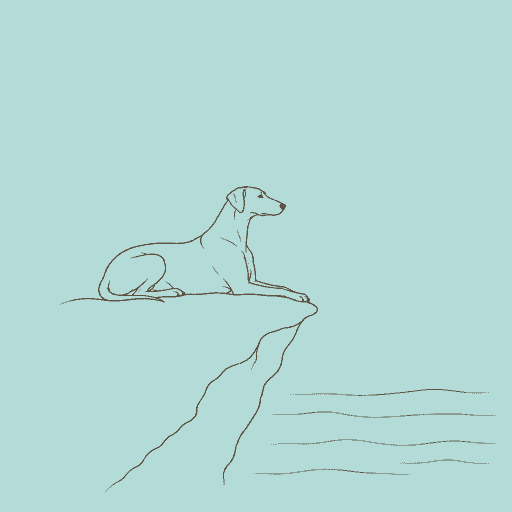
Etna
A modern alternative to SparkNotes and CliffsNotes, SuperSummary offers high-quality Study Guides with detailed chapter summaries and analysis of major themes, characters, and more.
Summaries & Analyses
Quizzes
NEWReading Tools
Part 1Chapter Summaries & Analyses
Content Warning: This section of the guide includes discussion of death, animal death, animal cruelty, and graphic violence.
Part 1 Summary: “The Field”
The narrator, a young dog, recalls his early life with his mother and siblings on a farm near the coast in an unnamed country. His peaceful existence ends when Soojin, a military doctor in uniform, arrives to recruit dogs for an escalating war. She selects the narrator because she can tell that he will grow to be very fast and strong and because they can “speak to each other” (11), meaning that they can communicate with each other telepathically, which isn’t the case with every dog. She assures the dog that he will get used to the strange sensation of communicating with her in this way.
Soojin explains that she is a doctor in the army who has been hired temporarily by the Americans because of her skills at communicating with dogs. This talent is unique to her, she claims, and only allows her to talk to dogs. The narrator is scared by this talk.
In her truck, where another dog is already asleep in the back seat, Soojin gives the narrator the name Etna and later tells him that the other dog’s name is Fuji. These are the dogs’ “war names.” Soojin explains that they are now war dogs who will save many lives. Her rambling conversation about Sicily and hermits confuses Etna as he watches the many cars heading in the opposite direction, loaded with furniture and filled with people heading “toward the sea” (17). Soojin makes the dogs promise to survive and find her after the conflict in her “very own hermit kingdom” (18).
Soojin notes that Etna is a 12-month-old mixed-breed shepherd weighing 67 pounds. His legs and paws are sensitive to being handled, she notes. Eventually they arrive at a gas station, where Soojin hands Etna and Fuji over to other soldiers, telling them to look after one another. Etna will see her only one more time, he notes.
One day, Etna explains, Fuji will become “larger and stronger” than Etna (20). She will lead many operations and show great bravery. On this day, however, she is much more frightened than him. She asks whether she and Etna are “a pack” now.
At an American base, Etna and Fuji endure five months of grueling training. They learn commands in German and French, as well as in English. Etna is paired with a kind handler named Jason, and Fuji is assigned to a man named Brian. They learn to follow commands, identify smells, track these smells, run fast, locate running men, and apprehend men at their handlers’ instruction. Etna grows used to people touching his paws. After every training exercise, he returns to Jason as the other dogs return to their handlers. Though Etna grows larger and faster, not all the dogs survive. He watches them fall from exhaustion or drown.
Their unit, composed of sappers and engineers who clear explosives, is sent into the “regions that ha[ve] been bombed or that the country ha[s] fought to take back” (25). They fight and kill alongside their handlers. They lose friends and allies as the war drags on longer than anyone expected.
For four years, they travel the war-torn country, clearing mines and fighting. Both Etna and Fuji receive injuries, some of which require treatment away from the front lines. Etna witnesses the way in which Fuji, whenever she gets hurt, becomes more determined to hurt others as the blue in her eyes grows “less blue.”
In the third year of the war, Fuji vanishes without explanation. The following year, Brian makes a fatal mistake attempting to defuse anti-tank mines; Jason then grabs Etna, runs, and throws him to safety just before the explosion kills Jason.
Eventually, Etna is the only dog left from his original unit. One evening, he listens to the soldiers discussing the destruction caused by the war. As some people celebrate the end of the war, others think about the cost of the fighting. They think about returning home but fear the burned-out buildings that are all that’s left of the country, which has now become “a total wasteland” (30). After hearing one soldier suggest killing him while the other proposes taking him to California, Etna realizes that he needs to get home and later slips away while everyone is sleeping. The sentries watch him go. While studying his scarred, injured body, they look on him with pity and label him a “zombie dog.” Etna leaves the barracks, determined to go home.
Etna walks alone through the destroyed landscape. He drinks odd-tasting water from a soldier’s discarded helmet and, to his relief, doesn’t get sick. With the sound of engines in the distance, he sleeps and dreams. He eats a mouse and then sees a man dragging a cart. The man is covered in wounds, and Etna smells “what the empty cart had been carrying” (35). Disturbed by the smell, he ignores the man’s beckoning calls and runs away.
While traveling through the desolate landscape, Etna finds a thatched building and hears a strange sound coming from within. He cautiously approaches, and inside the abandoned way station, he meets a blind, elderly dog. The dog claims not to have a name; he’s unwilling to share his private name. There is a city nearby, the old dog says, beyond the mountains that burned. Etna remembers the burning mountains; he will always “remember the sound of the burning” of everything (44).
After noticing that Etna is hungry, the old dog sends him out to a train car to find “a surprise.” Inside, he finds crackers and tinned meat. The old dog, he realizes, has many wounds from biting open the tins. Etna does likewise and then shares the meat with the old dog. That night, Etna reluctantly tells his story to the old dog. The old dog explains that he was once a guard dog for this way station and that his human family—a man, woman, and child—disappeared into the surrounding field during an attack years ago. He begs Etna to find their remains.
Etna searches all night and finds the bones of only two people, which he brings to the old dog. Grateful, the old dog encourages Etna to continue his journey. In a melancholy tone, the old dog shares his thoughts that there is “no place for [them] here anymore” (67). Before leaving, Etna stocks the way station with tins of meat from the wrecked train car. He then departs, following the old dog’s directions along the train tracks toward a city, still hoping to find his way home to the coast.
Part 1 Analysis
When Soojin arrives at the farm, she introduces a new form of communication that challenges the traditional hierarchy between humans and animals. In this radically different dynamic, the relationship is one of utility and control. When she speaks to the narrator (whom she later names Etna) telepathically, he experiences the intrusion physically, feeling as if “the air [i]s pressing against [his] ears, and then a small door open[s] in [his] head into a corner [he] ha[s] never been inside before” (14). This means of communication establishes the motif of voices and communication as a force that both connects and exploits. This unique ability is the reason why Soojin chooses Etna, but it also marks him for military service, instrumentalizing his consciousness for the war effort. What makes Etna and Soojin unique also pushes Etna into the brutal war.
The silent understanding between Etna and Soojin is notably different from the “softness” of the farm owners’ spoken words. In contrast, Soojin’s communication is direct and invasive, a tool for recruitment and command that is new and uncomfortable for Etna. It’s thrust upon him without warning; he has no idea what his talent for understanding Soojin will do to his life. This shared channel of thought highlights the theme of The Shared Vulnerability of Humans and Animals, suggesting that in the context of war, all conscious beings are subject to the same forces of coercion. The novel, as in Yoon’s other work, explores the experiences of those caught in conflicts they didn’t choose. By centering a non-human perspective, Yoon examines the universal nature of this vulnerability, detached from specific human politics or ideologies.
Part 1 charts Etna’s transformation from a farm dog into a weapon by contrasting the sensory richness of his early life with the brutalizing stimuli of war. His prewar memories are defined by gentle, organic sensations: He shares his appreciation of the “den of pale noses” of his siblings and the “smell of the coast” on his mother’s ears, as well as the “salt on [their] tongues” (9). During his training, however, this idyllic sensory environment is completely replaced. This recalibrates Etna’s senses in service of violence. He learns to associate the sweet smell of toothpaste with explosives, to listen for the “hum of an electrical current” from a SIM card (23), and to grow accustomed to the constant chaos of gunfire. Even after he runs away from the military, he constantly scans the skyline for jets, hearing engines in the distance. This sensory re-education illustrates the theme of The Lasting Toll of War, which operates on those same faculties through which the world is perceived. The farm’s diverse sounds and smells give way to a monotonous landscape of fuel, gunpowder, and human detritus, reflecting a world reduced to its most basic elements of survival and destruction. This shift in perception is so complete that Etna no longer dreams of home but of “fields. And small islands across those fields” (24), the geography of his trauma.
Etna’s physical body becomes a living record of his violent experiences, marked by the recurring motif of scars. He registers the “stripes of scars like old worms” that grow across his forehead and sides as an external manifestation of his internal change (26), as well as a visible show of the toll of the war. Each injury, whether from shrapnel or a bullet, is a moment of survival that also reinforces his function as a tool of war. This physical toll is mirrored by the psychological hardening required to endure the conflict. Jason’s final, selfless act—lifting Etna “like [he] [i]s a puppy again” before throwing him to safety from an exploding mine (27)—is a moment of sincere affection that is juxtaposed against the horrific violence surrounding it. Jason’s body blowing apart leaves a physical wound but also an emotional one, as Etna carries “small pieces of [Jason’s] bones that had shot into [his] skin” (37). These fragments serve as a permanent, visceral reminder of his handler’s sacrifice and the intimate, inseparable bond between violence and affection that defined their relationship. The scars are an ongoing, physical archive of loss.
The relationship between Etna and Fuji explores the nature of companionship as both a necessity for survival and another casualty of the conflict. Their bond begins in a shared state of fear and disorientation, with Fuji’s nervous question, “Are we a pack now?” (20), establishing their reliance on each other in a hostile new world. Taken from their mothers at a young age, both Etna and Fuji try desperately to latch onto any kind of social understanding that seems familiar. At the training base, they form a unit, working and resting side by side, their shared presence a silent bulwark against the overwhelming chaos. Yet as the war progresses, Fuji changes, her growing ferocity reflected in Etna’s observation that “the more hurt she [i]s, the more she want[s] to hurt” (26). Trauma and violence become locked into a cycle of recurrence. Her unexplained disappearance in the third year of the war introduces another deep and unresolved loss to Etna’s life, but this loss can’t be explained by the tangible violence of the battlefield. Her vanishing suggests that some losses in war aren’t the result of a direct blast or bullet; rather, they’re a quiet erosion of self, a private surrender to trauma that can’t be explained through logic or experience. Her absence haunts Etna, complicating his own survival and leaving him truly alone for the first time since leaving the farm.
Following the end of the war, Etna’s decision to leave the American base is prompted by his desire to “go away. To go home” (31), a choice that sets his solitary journey in motion and establishes The Illusory Nature of Home as a central theme. This desire is triggered when he overhears a soldier describe California as a place with a coast and farms, a description that elicits memories of the farm on which he was born. The idea of home becomes his primary driver. However, Etna understands on an intuitive level that a true return is “impossible,” suggesting that this idea of home functions less as a physical destination and more as an internal sanctuary. It is, in effect, a motivating memory of peace and belonging that no longer exists in reality. His subsequent journey through a “total wasteland” reinforces this; the landscape of bombed-out roads and burned forests mirrors his own internal state and the external destruction of his past. Like the country itself, Etna has been violently changed by recent history. This quest aligns with the themes of displacement common in Yoon’s work, where characters search for a sense of place after destructive conflict. For survivors like Etna, the physical world has been irrevocably altered, making the search for home an allegorical journey to reconcile a traumatic past with a desolate present.
At the abandoned way station, Etna’s encounter with the old, blind dog reframes his war-honed skills as tools for remembrance rather than violence. The old dog, trapped by the memory of his lost family, asks Etna to locate their remains in the overgrown field. In fulfilling this request, Etna repurposes his training; the senses he used to detect land mines are now employed in a somber search for bones. This act becomes a ritual of grieving and closure in a world devoid of such ceremonies, offering a moment of catharsis for an old dog who seems unable to provide such catharsis or closure for himself. His focus on the task provides a temporary respite from his own trauma, allowing him to feel “the pleasure” of work as he sifts through the landscape’s chaotic history to unearth the truth about what has happened. This truth doesn’t help Etna understand the war or the situation, but it means something significant to the old dog, allowing Etna to help a new acquaintance. The absence of the third body adds a layer of ambiguity, suggesting that some losses can never be fully accounted for, functioning as a quiet echo of Fuji’s own unresolved disappearance. In helping another survivor find a measure of peace, Etna discovers a new, restorative purpose for the abilities that war forced upon him, transforming his violent conditioning into a means of bearing witness.

Get in-depth, chapter-by-chapter summaries and analysis from our literary experts.
- Grasp challenging concepts with clear, comprehensive explanations
- Revisit key plot points and ideas without rereading the book
- Share impressive insights in classes and book clubs