Five on a Treasure Island
A modern alternative to SparkNotes and CliffsNotes, SuperSummary offers high-quality Study Guides with detailed chapter summaries and analysis of major themes, characters, and more.
Summaries & Analyses
Quizzes
NEWReading Tools
Chapters 1-5Chapter Summaries & Analyses
Content Warning: This section of the guide includes discussion of gender discrimination.
Chapter 1 Summary: “A Great Surprise”
At breakfast, Julian asks his mother if they can go on their usual vacation to Polseath on the English coast. She explains that Polseath is fully booked and that she and their father plan to travel to Scotland alone this year. Their father suggests that the three children—Julian, Dick, and Anne—stay with his brother Quentin, a scientist whom the children have met only once and found intimidating.
Their father explains that Quentin’s wife, Aunt Fanny, could use some boarders to help financially and that their daughter, Georgina, is around 11, the same age as Dick. The prospect of meeting their unknown cousin excites the children. Their father describes Kirrin Bay as adventurous, confirms the plan with Aunt Fanny by telephone, and warns the children not to disturb Uncle Quentin while he works.
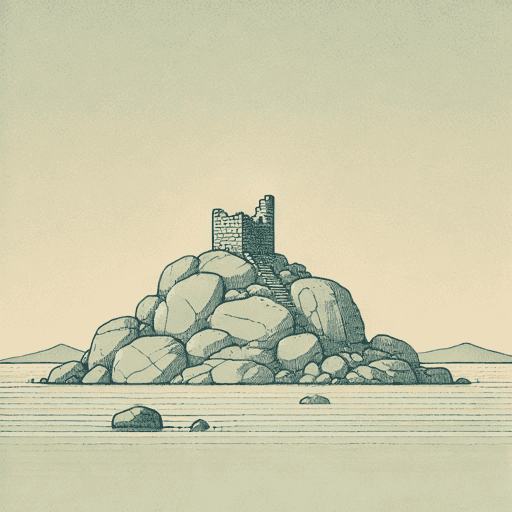
They depart the following Tuesday, driving from London through the countryside and stopping for a hilltop picnic. Late in the afternoon, they spot the sea and Kirrin Bay, with its small rocky island, and arrive at Kirrin Cottage—an old white stone house on a cliff overlooking the bay.
Chapter 2 Summary: “The Strange Cousin”
Aunt Fanny welcomes the children warmly but explains that Georgina has wandered off despite being told to wait. She warns them that Georgina can be difficult and insists on being called “George.” Uncle Quentin appears briefly, greets the children stiffly, and retreats to his study.
With the children now staying in the cottage, their parents leave for a hotel and return to London the next morning. Aunt Fanny shows the boys to a room with a bay view, while Anne will share a room with George. All three fall asleep before George arrives.
The next morning, Anne wakes to find a suntanned girl with short, curly hair and bright blue eyes in the other bed. George insists that she’ll only answer to her nickname and is pleased when Anne says she looks like a boy. When Anne admits that she likes dresses and dolls, George calls her “a baby.” Anne counters that her brothers are “real boys” who won’t tolerate someone who acts superior.
At breakfast, Uncle Quentin orders George to take her cousins to the bay. Afterward, the four children walk to the beach, where Anne spots a rocky island with its ruined castle. George claims that it belongs to her.
Chapter 3 Summary: “A Peculiar Story—and a New Friend”
The siblings are stunned by George’s claim of ownership. Dick accuses her of boasting, but George insists that she tells only the truth. She explains that her mother’s family once owned most of the local land but sold it when they became poor, keeping only Kirrin Cottage, a nearby farm, and Kirrin Island, which nobody wanted to buy. Her mother has since given the island to George.
The island is accessible only by boat due to deep water and dangerous rocks. There is also a shipwreck on the far side belonging to one of George’s ancestors, who was transporting gold bars when the ship went down. The gold was never recovered despite professional searches. George offers to row them out to see the wreck that afternoon.
First, George fetches Timothy, or “Tim,” her secret dog who’s kept hidden from her parents. She found him as a puppy, but her father, angered by his destructive habits, forced her to give him up. She now pays a fisher-boy named Alf all her pocket money to keep him, which is why she refuses to accept treats she can’t reciprocate.
When Julian buys ice cream, George declines. Julian proposes that if she shares her dog, island, and wreck with them, they will share their treats with her. Tim’s enthusiastic response helps persuade George to agree, and she confirms their afternoon trip.
Chapter 4 Summary: “An Exciting Afternoon”
That morning, the children swim, and the boys discover that George is a far stronger swimmer than they are. At lunch, Anne nearly mentions Tim, but George kicks her sharply under the table. Aunt Fanny, seeing Anne’s pained reaction, sends George from the table. Anne later brings George’s bread and cheese to the garden and apologizes. George initially threatens not to take her to the island but is moved when Anne selflessly suggests that George take only the boys. George hugs Anne and forgives her.
At the beach, Alf warns them that a storm is approaching. George rows expertly to the island. Julian wishes that they could land and stay the night in the castle, an idea that thrills George, though she explains that there isn’t time for both the island and the wreck today.
They row around the island to find the wreck. George positions the boat by aligning with a church tower and hilltop on the mainland between the castle’s two towers. In the clear water below, they can see the dark outline of the sunken ship. George and Julian dive down; George nearly reaches the wreck but can’t get inside, while Julian views the deck from above. Julian talks about finding the gold, but George dismisses this, noting that professional divers have already searched without success. They arrive home slightly late for tea, and that evening, George admits that she’s glad her cousins came.
Chapter 5 Summary: “A Visit to the Island”
The next day, Aunt Fanny takes the children for a picnic at a nearby cove. George is unhappy because her mother’s presence means no Tim. She confides to Julian that her father’s financial troubles make him bad-tempered and that he wants to send her to boarding school, which she dreads because it would mean parting with Tim.
During a swim, George teaches Anne proper technique. On the way home, George asks Julian to create a diversion so that she can slip away for a quick reunion with Tim. As thanks, she offers to take them all to her island the next day.
Aunt Fanny overhears and suggests that they make a day of it with a picnic, adding that she won’t come. The next morning dawns sunny, but George, reading the weather signs, fears a storm is approaching. Anne persuades her to go anyway by pointing out that staying home means a day without Tim. George agrees but warns Anne not to be frightened if a storm arrives.
They pack food and collect Tim from the fisher-boy—who also warns of the storm. George rows them to Kirrin Island, navigating through dangerous rocks to a hidden cove on the east side. She pulls the boat well up the sand as a precaution.
They explore the island, which is full of tame rabbits. Tim obeys George’s command to leave them alone. Inside the ruined castle, they find a central yard overgrown with grass, one intact stone room, and crumbling stairs that block access to the upper floors. George mentions that there may be dungeons, but overgrowth makes them impossible to find. On the far side of the island, cormorants suddenly take flight from the rocks, and moments later, thunder rumbles as the storm arrives sooner than George expected.
Chapters 1-5 Analysis
The early chapters juxtapose the constraints of urban life and the idealized freedom of the rural coast. The children’s journey from London to Kirrin Bay marks their transition to a world far removed from the realities of 1940s wartime Britain. As the children settle into their holiday, they engage in a carefree existence characterized by plentiful resources, enjoying enormous meals such as “[c]old meat and salad, plum-pie and custard, and cheese afterwards” (30). This focus on unrestricted consumption provides a stark contrast to the historical realities of rationing and scarcity. The narrative shifts the children away from parental oversight and urban danger to a setting where the primary challenges are adventurous. Kirrin Cottage and its surrounding bay are depicted as a sanctuary where childhood independence can flourish. The remote rural setting establishes the spirit of escapism that defines the ensuing mystery. The children’s relocation away from their parents also allows them to act independently, free from the constraints of adult rules and supervision.
The introduction of George’s character establishes Gender Expression in a Patriarchal Society as a central theme. From her first appearance, George actively rejects the domestic passivity expected of mid-20th-century girls, declaring, “I hate being a girl. I won’t be” (13). She insists on using a male name, wears boyish clothing, and openly mocks Anne’s interest in dolls. The narrative links George’s refusal to be defined by conventional gender roles to her superior physical competence and mastery of the environment. By outpacing her male cousins in swimming and demonstrating expertise in rowing through the dangerous, rock-strewn waters, she demonstrates that these skills aren’t inherently masculine or feminine. By anchoring her identity in tangible capabilities, the text validates her unconventional self-definition. George’s nonconformity creates an initial friction with her cousins, yet it also positions her as an indispensable guide to the region’s mysteries and essential to the group’s survival and success. Her characterization demonstrates that authority and capability aren’t exclusively male domains, offering a firm challenge to the traditional gender expectations of the era.
The developing relationship between George and her cousins highlights the theme of Forging Identity Through Shared Adventure. Initially fiercely territorial, George guards her independence through two primary possessions: Kirrin Island and Tim the dog. Kirrin Island symbolizes George’s isolation and autonomy, a private domain where she can escape the domestic constraints imposed by her parents. Meanwhile, Tim represents her untamed instinct and loyalty. Julian bridges the emotional barrier that George initially constructs against her cousins through a practical bargain. He proposes to share his treats if George will share her dog and her island. George’s acceptance of this trade marks a significant shift in the group dynamic. By permitting her cousins to participate in her private world, she relinquishes her solitary defiance in favor of collaborative trust. The children’s foundational bond is therefore constructed on mutual exchange and the shared stewardship of George’s most cherished possessions. This reciprocal arrangement demonstrates that true partnership requires vulnerability and trust.
The children’s newly formed alliance relies on secrecy, a recurring motif that establishes a clear boundary between the children and the adult world. The primary secret uniting the cousins is the existence of Tim, whom George hides with the help of a local fisher-boy due to her father’s temper. When Anne nearly mentions the dog at lunch, George’s swift physical retaliation and Anne’s subsequent apology solidify the children’s unified front against adult oversight. Uncle Quentin’s stern, irritable demeanor and Aunt Fanny’s distraction render the adults either hostile or oblivious to the children’s priorities. By maintaining strict silence regarding Tim and their island explorations, the cousins carve out an independent sphere. This shared conspiracy illustrates the theme of Childhood Competence in an Adult-Dominated World, as the children’s self-reliance proves their capacity to manage risks and relationships without parental intervention.
The introduction of the submerged shipwreck turns the narrative from a domestic holiday story into an active mystery. Although Julian dives down to view the deck, the ship’s interior remains inaccessible, establishing a physical obstacle that the main characters must overcome. Narrative tension increases in the fifth chapter when George reads the wind and waves, predicting an approaching storm. The dramatic change in weather conditions introduces an external pressure that isolates the children on the island, testing their newly forged alliance with an environmental challenge. The gathering thunder creates an ominous atmosphere, foreshadowing imminent danger.

Get in-depth, chapter-by-chapter summaries and analysis from our literary experts.
- Grasp challenging concepts with clear, comprehensive explanations
- Revisit key plot points and ideas without rereading the book
- Share impressive insights in classes and book clubs