Five on a Treasure Island
A modern alternative to SparkNotes and CliffsNotes, SuperSummary offers high-quality Study Guides with detailed chapter summaries and analysis of major themes, characters, and more.
Summaries & Analyses
Quizzes
NEWReading Tools
Chapters 6-9Chapter Summaries & Analyses
Content Warning: This section of the guide includes discussion of gender discrimination.
Chapter 6 Summary: “What the Storm Did”
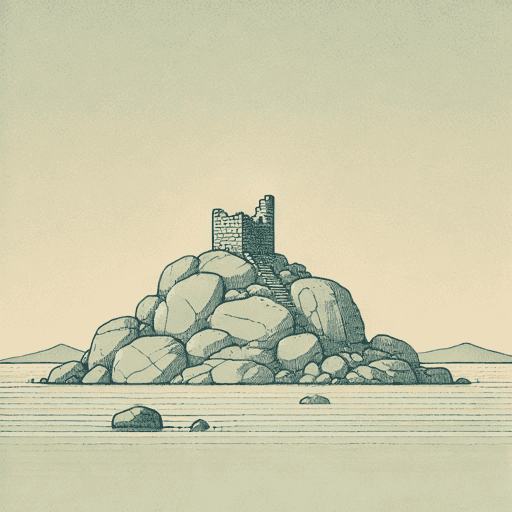
While exploring the ruined castle on Kirrin Island, the children notice a severe storm approaching. George declares that they can’t return to the mainland in time. She and Julian run to secure the boat, pulling it to the top of the cliff and tying it to a bush.
The drenched pair return to find Dick and Anne sheltering in the castle’s only intact room. Julian gathers dry sticks from beneath the jackdaws’ nests in the tower, and they build a fire using their sandwich wrappings. As the storm rages, the children eat their picnic.
When Julian ventures out for more sticks, he spots a large, dark object lurching in the waves near the rocks. Fearing that it’s a ship with people aboard, he alerts the others. They watch as the vessel is driven onto the southwest rocks with a tremendous crash. As the storm subsides, George realizes that the storm has lifted her family’s old wreck from the seabed and deposited it on the rocks. Julian exclaims that they can now explore it and search for the lost gold.
Chapter 7 Summary: “Back to Kirrin Cottage”
The children stare at the raised wreck in stunned excitement. George worries that it may no longer legally belong to her now that it has surfaced. Dick suggests keeping it secret, but George knows that fishermen will soon spot it. They agree to explore the wreck at dawn before anyone else can.
As their clothes dry in the returning sun, the children walk around the island before rowing home against the tide. Upon landing, George takes Tim to stay with Alf, the fisher-boy.
At tea, Anne nearly reveals their secret twice. The other children kick her and talk loudly to cover her words, and Julian later scolds her. When Julian overturns a table while playing, an angry Uncle Quentin threatens to keep them indoors the next day. Terrified of missing their chance to explore the wreck, the children go to bed early. George is determined to bring Tim on tomorrow’s adventure.
Chapter 8 Summary: “Exploring the Wreck”
Julian wakes at sunrise and rouses the others. They slip silently from the house, collect Tim from Alf, and row to the island. The wreck sits on the rocks and is larger and more battered than expected, covered in shellfish and seaweed. They climb the slippery deck and descend into the dark interior but find only water and empty barrels in the hold and nothing of interest in the sailors’ quarters.
In the largest cabin, Julian spots a small cupboard set into the wall. George forces the rotten lock open with her pocketknife. Inside, they find a swollen wooden box stamped with the initials “H.J.K.,” along with pulpy books and other water-damaged objects. George identifies the initials as those of her ancestor Henry John Kirrin and declares that the box must have contained his private papers. Unable to open it, they take it with them.
When the children emerge on deck, they find that fishing boats have gathered to view the wreck. They row home quickly, arriving late for breakfast. Uncle Quentin scolds them and restricts them to toast and marmalade. They hide the box under the boys’ bed.
Chapter 9 Summary: “The Box From the Wreck”
In the toolshed, the children try unsuccessfully to open the box. Julian throws it from the attic window, and it crashes onto the pavement, bursting open to reveal a waterproof tin lining. The noise brings Uncle Quentin outside, and a frightened Anne reveals where the box came from. He confiscates it, dismissing their hopes of finding gold and suggesting that the cargo was likely delivered before the ship was wrecked.
Julian vows to retrieve the box. That afternoon, he finds his uncle asleep in his study with the box on a table behind him. As Julian takes it, a piece of broken wood falls off, briefly waking his uncle. Julian crouches behind the chair until he falls back asleep and then escapes with the box.
On the beach, George scrapes away rust until the tin lid comes off. The box contains old papers and a ship’s log kept by George’s ancestor. George then examines a yellowed parchment and realizes that it’s a map showing the original layout of Kirrin Castle, including its dungeons—with the dungeon area labeled “Ingots.” The boys recognize this as the term for metal bars, meaning that the map shows where the gold is hidden.
They copy the three-part map in the toolshed, and Julian returns the original to his uncle’s study. When a telephone call announces that reporters want to interview Uncle Quentin about the wreck, the children fear that he may show them the box and reveal their secret. Julian is relieved that they made a copy but regrets leaving the original where others might find it.
Chapters 6-9 Analysis
The sudden storm in Chapter 6 foregrounds the theme of Forging Identity Through Shared Adventure. As the weather violently shifts, the children must work collectively to survive the immediate elements, pooling their limited resources to build a fire and find shelter in the ruined stone room of the castle. This collaborative effort integrates George into a cohesive unit with her cousins. The storm also physically alters their environment by lifting the sunken ship onto the rocks, an event that provides the children with a shared, tangible goal: exploring the wreck. By navigating this sudden crisis together, the children establish mutual reliance. The island becomes a shared space that insulates the group from the outside world, setting the foundation for their collective identity as a team.
Following the discovery of the waterlogged box, the narrative explores the theme of Childhood Competence in an Adult-Dominated World by contrasting the protagonists’ resourcefulness with adult short-sightedness. Uncle Quentin functions primarily as an obstacle to discovery. When the children burst the box open by dropping it from an attic window, he confiscates it, dismissing their hopes of finding treasure. The swift removal demonstrates how adult authority in the novel often relies on rigid rules and assumptions rather than investigation or knowledge. His failure to examine the box’s contents carefully results from his preoccupation with his own work and his refusal to take the children’s observations seriously. In response, Julian demonstrates agency by sneaking into his sleeping uncle’s study to retrieve the box and subsequently tracing a copy of the treasure map. This strategy demonstrates secrecy as an essential, proactive measure against unhelpful adults. Julian’s declaration, “To be on the safe side, let’s take a copy of the map” (94), marks a calculated decision that outmaneuvers his uncle. By operating covertly, the children maintain control over their investigation, proving that their independent judgment is far more effective than the dismissive oversight provided by the adults in their lives.
George’s physical actions throughout the exploration of the newly surfaced wreck further illustrate the theme of Gender Expression in a Patriarchal Society. She’s consistently depicted in leadership roles requiring physical strength, courage, and mechanical aptitude, challenging the domestic and passive expectations for girls in mid-20th-century Britain. When the storm first approaches, George recognizes the immediate danger and acts decisively, running with Julian to haul their heavy boat up the cliff and secure it to a gorse bush. During the exploration of the ship, she demonstrates superior agility by clambering up the slippery, seaweed-covered deck and leading the descent down a rusted iron ladder into the dark interior. When the group discovers a locked wooden cupboard in the captain’s cabin, George takes charge, using her pocketknife to snap the rotten lock and reveal the ancestral box. By making her physical competence the driving force behind the group’s progress, the narrative presents George’s masculine-coded expression as a vital asset. The cousins rely on her practical abilities, reinforcing that her unique strengths are fundamental to their collective success. Her mechanical aptitude with locks and her fearlessness in navigating the wreck’s hazards position her as the group’s de facto leader in moments requiring decisive physical intervention.
The unearthing of the shipwreck and the subsequent discovery of a secret treasure map steep the narrative in a fantasy that reflects the historical context of its publication. While real-world British children in 1942 faced the pervasive anxieties of World War II, including the trauma of evacuations and strict rationing, the environment of Kirrin Bay offers an idyllic alternative. Although the storm introduces a note of danger, it yields exciting historical artifacts rather than genuine peril. Even amid the violent weather, the children enjoy a picnic of ham sandwiches and ginger beer in the ruined castle, an abundance that contrasts with the severe food limitations facing the novel’s original readers. The map itself, printed with the old-fashioned word “Ingots” to indicate hidden gold bars, promises thrilling historical discovery. By presenting a world where danger is localized to stormy seas and ancient mysteries, the novel creates an atmosphere of nostalgia and escapism. Blyton’s child characters navigate exciting challenges with complete autonomy and safety, insulated from the contemporary global conflict reshaping the adult world outside the text.

Get in-depth, chapter-by-chapter summaries and analysis from our literary experts.
- Grasp challenging concepts with clear, comprehensive explanations
- Revisit key plot points and ideas without rereading the book
- Share impressive insights in classes and book clubs