Five on a Treasure Island
A modern alternative to SparkNotes and CliffsNotes, SuperSummary offers high-quality Study Guides with detailed chapter summaries and analysis of major themes, characters, and more.
Summaries & Analyses
Quizzes
NEWReading Tools
Chapters 10-13Chapter Summaries & Analyses
Content Warning: This section of the guide includes discussion of gender discrimination.
Chapter 10 Summary: “An Astonishing Offer”
The morning after the storm, newspapers widely report the story of the old wreck and the lost gold. Uncle Quentin has shared the tale with reporters, and sightseers arrive by boat to view the wreck. George is furious that her private island has become a tourist attraction, but Julian reminds her that the whereabouts of the treasure remain unknown.
A few days later, Uncle Quentin announces that he has sold the old box from the wreck to an antiques collector for an excellent price. The man was particularly interested in the map and diary inside. The children are horrified, realizing that the buyer will likely deduce the location of the gold, but they don’t dare tell Uncle Quentin what they have already discovered. They decide to ask permission to spend the weekend on the island to search for the treasure themselves.
When they make their request, Uncle Quentin reveals even worse news: He has received an offer to sell Kirrin Island itself. The prospective buyer plans to rebuild the castle as a hotel. George protests bitterly, accusing her mother of taking back the island now that it has value, but her father dismisses her objections, saying that the family needs the money. The deeds will be signed in a week. Julian confirms that the buyer is the same man who purchased the box and realizes that he must already know about the treasure. After George storms out, Julian finds her in the toolshed and reminds her that they still have their traced map and a chance to find the ingots first.
Chapter 11 Summary: “Off to Kirrin Island”
Julian and George find Dick and Anne, who express sympathy over the island sale. The children compile a supply list for their expedition—food, drink, spades, ropes, torches, rugs, and tools—planning to bring everything they’ll need to work underground. George privately reflects that her cousins have made her a better, less solitary person. Julian reassures her that she’s interesting and can’t help being an only child, and he promises that they’ll stand by her.
The next morning, they load the boat and set off. During the journey, a gust of wind blows the map into the sea. Tim immediately dives in, retrieves it in his mouth, and swims back—the map survives undamaged. George then skillfully navigates through the dangerous reefs to the island’s small inlet.
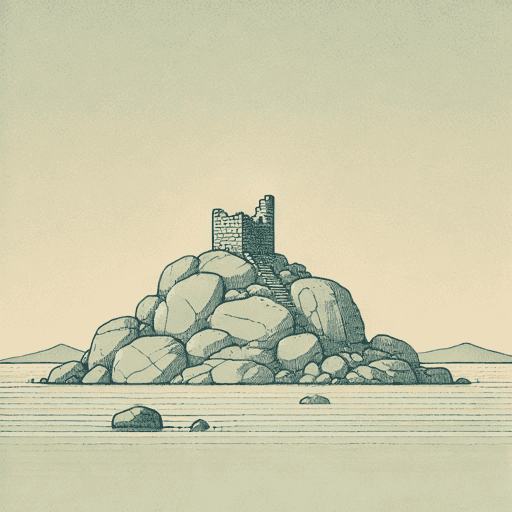
The children carry their supplies to the ruined castle and arrange sleeping areas in the little stone room. Julian studies the plan and identifies two possible dungeon entrances: one near their room and another under the tower. They also notice markings for an old well on both the ground floor and dungeon plans. They decide to search for the entrance near the little room first, using spades to clear weeds and earth from the stone floor while Tim digs enthusiastically alongside them.
Chapter 12 Summary: “Exciting Discoveries”
After clearing the floor, the children examine every stone but find no ring or movable piece. Three hours of searching yield nothing, and the steady tapping wears on their patience. During a meal break, George suggests finding the well first since the map shows a dungeon entrance nearby. They move to the overgrown central courtyard, where they encounter several unusually tame rabbits. When Tim spots one, he chases it under a large gorse bush and follows, digging frantically—until the digging stops, and they hear a scared yelp. Tim has disappeared underground.
Julian realizes that Tim has fallen into the old well. They chop down the gorse bush and uncover the well opening, which had been blocked by a fallen slab and a rotten wooden cover. George climbs down an old iron ladder inside the shaft, retrieves Tim from a stone ledge partway down, and brings him safely to the surface.
Now knowing the well’s location, the children resume searching nearby. Anne discovers an iron ring buried in the sand. They tie a rope through it and pull together until the heavy stone lifts away, revealing steep rock-cut steps descending into darkness. They descend into the dungeons in single file, torches raised, where Tim slips and tumbles several steps. The caves are vast and musty, and powerful echoes frighten Anne by multiplying every sound. As they explore, Dick spots a large wooden door studded with iron nails.
Chapter 13 Summary: “Down in the Dungeons”
The children examine the locked wooden door but can’t open it. Julian decides that they need their axe. While attempting to return to the surface, they become lost in the mazelike dungeons until they encounter the brick shaft of the well, which helps them find their way back to the entrance. Julian discovers that it’s already half past six o’clock. Tired and hungry, they postpone further work until morning, make a fire, eat a large meal, and sleep in the little stone room.
The next morning, they return to the dungeons with the axe. To avoid getting lost again, Julian marks the walls at each turn with white chalk. They relocate the wooden door, and Julian begins chopping at it—but the axe strikes an iron nail and sends a large splinter into Dick’s cheek, cutting him badly. Julian takes Dick and Anne to the surface, where Anne treats the wound, and then he returns to the dungeons alone.
George has continued chopping in his absence. Julian delivers several more blows that loosen the lock, and together they push the door open into a cave-like room. Inside, they find piles of gold ingots—the lost treasure.
Chapters 10-13 Analysis
The narrative advances the theme of Childhood Competence in an Adult-Dominated World by contrasting Uncle Quentin’s commodification of the past with the children’s proactive engagement with it. In Chapter 10, Uncle Quentin sells the historic wooden box and its enclosed map to an antiques dealer for immediate financial gain; shortly afterward, he announces a pending offer to sell Kirrin Island for hotel development. He views the island and its artifacts in terms of immediate monetary relief, demonstrating a shortsightedness that ironically endangers his own family’s potential wealth. The children, conversely, grasp the true stakes of the map and take strategic action without seeking adult permission or validation. This dynamic recurs throughout the novel: Adults are consistently depicted as obstacles, liabilities, or ignorant bystanders, leaving the child protagonists to interpret evidence and resolve crises through their own autonomy and judgment. The sale of the box proves particularly disastrous because the buyer, possessing the original map, can deduce the treasure’s location and claim it first. Uncle Quentin’s dismissive attitude toward the children’s discovery reflects a broader pattern in which adults undervalue youthful insight, forcing the children to operate in secrecy to protect their interests.
The impending sale of Kirrin Island shifts it from a private sanctuary to a contested space, reinforcing the necessity of concealment as a recurring pattern. Once the island is slated to become a commercial hotel, George reacts with fury at the adult intrusion. Consequently, Julian counsels her to conceal their knowledge of the ingots and proposes a covert weekend expedition to excavate the dungeons before the buyer takes possession. The threat of adult encroachment and commercial development disrupts the island’s function as a realm of unfettered childhood independence. The looming transaction creates narrative urgency, forcing the children to act swiftly and covertly to preserve their claims to the treasure and the island.
The physical challenges of the expedition further highlight the theme of Forging Identity Through Shared Adventure. While preparing for the trip, George privately reflects that her cousins’ companionship has made her less solitary, noting that her anxieties “seem more bearable and ordinary” when shared (107). This realization marks a distinct shift from her initial hostility to a willing integration into the group. Tim’s interventions then bridge the gap between human logic and natural instinct, advancing the plot precisely when the children’s methodical planning reaches its limits. When a sudden gust blows the traced map into the sea, Tim retrieves it undamaged; later, his instinctual pursuit of a rabbit uncovers the hidden well shaft, leading the group to the dungeon entrance. Tim operates as the essential fifth member of the team, proving that the group’s success relies on the pooled, unique contributions of all its participants.
The physical labor required to penetrate the dungeons underscores the theme of Gender Expression in a Patriarchal Society by equalizing the children’s roles. During the expedition, George continues to perform tasks traditionally coded as masculine. She expertly navigates the rowboat through the dangerous coastal reefs, descends a precarious iron ladder to rescue Tim, and wields the axe to chop down the heavy wooden door when Julian escorts an injured Dick to the surface. She doesn’t merely help the boys but often performs the heaviest or most perilous tasks instead of them. In the historical context of 1940s Britain, where girls were heavily pressured into domesticity, George’s characterization offers a model of female self-definition built on strength and action, proving that these traits transcend gender.
The detailed cataloging of the children’s preparation and navigation anchors the escapist adventure story in methodical realism. Before departing, Julian compiles an inventory including spades, ropes, tools, and substantial food supplies. Underground, the children systematically search the stones, and Julian later marks the mazelike dungeon walls with chalk to ensure that they don’t lose the entrance again. Instead of magically stumbling upon the treasure, the children engage in sustained, grueling effort and rational problem-solving, facing setbacks like hidden entrances, labyrinthine caves, and physical injuries. By depicting an environment where challenges are conquered through clear planning, teamwork, and resilience rather than arbitrary luck, the narrative constructs a controllable, orderly world in contrast to the unpredictable anxieties facing British children during WWII.

Get in-depth, chapter-by-chapter summaries and analysis from our literary experts.
- Grasp challenging concepts with clear, comprehensive explanations
- Revisit key plot points and ideas without rereading the book
- Share impressive insights in classes and book clubs