Five on a Treasure Island
A modern alternative to SparkNotes and CliffsNotes, SuperSummary offers high-quality Study Guides with detailed chapter summaries and analysis of major themes, characters, and more.
Summaries & Analyses
Quizzes
NEWReading Tools
Important Quotes
“‘I’m George,’ said the girl. ‘I shall only answer if you call me George. I hate being a girl. I won’t be. I don’t like doing the things that girls do. I like doing the things that boys do. […] You’re to call me George. Then I’ll speak to you. But I shan’t if you don’t.’”
(Chapter 2, Page 13)
This quote establishes the novel’s exploration of Gender Expression in a Patriarchal Society through George’s direct, declarative statements. The repetition of her chosen name and the emphatic short sentence “I won’t be” underscores her unwavering self-definition in opposition to societal norms. Her identity is presented not as a preference but as a fundamental condition of her existence.
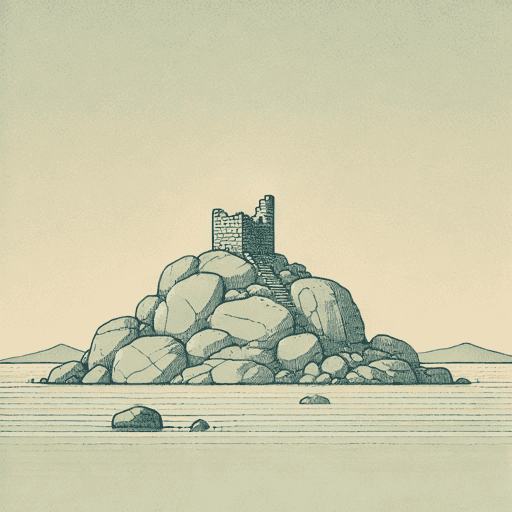
“At the entrance to it lay a curious rocky island with what looked like an old ruined castle on the top of it. […] ‘It’s called Kirrin Island,’ said George, her eyes as blue as the sea as she turned to look at it. ‘It belongs to me,’ she said.”
(Chapter 2, Pages 17-18)
This passage introduces Kirrin Island, a key symbol of independence and mystery. The island is immediately established as George’s personal domain, and this ownership is a defining element of her power and isolation. The simile comparing George’s eyes to the sea connects her character intrinsically to the natural, untamed setting, reinforcing her authority over a world unsupervised by adults.
“‘I went to Alf, a fisher-boy I know,’ said George, ‘and I asked him if he’d keep Tim for me, if I paid him all the pocket-money I get. He said he would, and so he does. That’s why I never have any money to spend—it all has to go on Tim.’”
(Chapter 3, Page 26)
George’s explanation of her arrangement for Tim demonstrates her resourcefulness and capacity for self-sacrifice, highlighting the theme of Childhood Competence in an Adult-Dominated World. Her choice to forgo all personal luxuries for her dog reveals a profound loyalty that contrasts with the seemingly selfish attitude she initially presents. This act of secrecy and financial independence establishes her ability to solve complex problems without adult intervention, a recurring pattern in the narrative.
“‘Listen,’ he said, ‘you’ve got something we badly want to share […] You’ve got a dog,’ said Julian, patting the big brown mongrel. ‘We’d love to share him with you, he’s such a darling. And you’ve got a lovely island. […] And you’ve got a wreck. […] Ices and sweets aren’t so good as those things—but it would be nice to make a bargain and share with each other.’”
(Chapter 3, Page 28)
This moment marks the formal beginning of the group’s bond, illustrating the theme of Forging Identity Through Shared Adventure. Julian’s proposition reframes the cousins’ relationship from one of familial obligation to a partnership based on mutual exchange and respect. By equating George’s non-material possessions—her dog, island, and wreck—with greater value than sweets, Julian validates her world and establishes the principle of reciprocity that will define the “Famous Five.”
“‘Well, do you see that church tower on the mainland?’ asked George. ‘And do you see the tip of that hill over there? Well, when you get them exactly in line with one another, between the two towers of the castle on the island, you are pretty well over the wreck! I found that out ages ago.’”
(Chapter 4, Pages 36-37)
This piece of dialogue showcases George’s practical intelligence and deep, intuitive connection to her environment. Her ability to navigate using landmarks demonstrates a competence that surpasses that of her cousins, positioning her as the group’s natural guide. This skill, which transforms the landscape into a functional map, foreshadows the discovery of the actual treasure map and reinforces the idea that the children possess all the necessary tools for their adventure.
“The girl cleverly worked her boat in and out of the rocks, and suddenly, as it rounded a low wall of sharp rocks, the children saw the cove she had spoken of. It was like a natural little harbour, and was a smooth inlet of water running up to a stretch of sand, sheltered between high rocks.”
(Chapter 5, Pages 47-48)
The children’s arrival at Kirrin Island is described using imagery that emphasizes its status as a sanctuary. The contrast between the “sharp rocks” and the “smooth inlet of water” highlights the cove as a hidden, protected space accessible only to those with specialized knowledge. This depiction reinforces the island’s symbolic role as a world of childhood independence, physically separated and shielded from the dangers of the outside world.
“They trooped through a doorway and found themselves in a dark, stone-walled, stone-roofed room, with a space at one end where a fireplace must have been. Two slit-like windows lit the room. It felt very strange and mysterious. […] from the south-west there suddenly came an ominous rumble. ‘Thunder!’ said George. ‘That’s the storm. It’s coming sooner than I thought!’”
(Chapter 5, Pages 51-52)
This sequence juxtaposes the security of the ancient castle room with the external threat of the storm, creating narrative tension. The description of the room—the only one left “quite whole”—establishes it as a focal point of mystery and a potential refuge. The “ominous rumble” of thunder serves as foreshadowing, suggesting that this natural force will catalyze the central plot by unearthing the shipwreck.
“‘Julian—oh, Julian—it’s my wreck!’ she cried, in a high excited voice. ‘Don’t you see what’s happened? The storm has lifted the ship up from the bottom of the sea, and has lodged it on those rocks. It’s my wreck!’”
(Chapter 6, Page 62)
George’s exclamatory dialogue and the repetition of the phrase “my wreck” underscore her deep, personal connection to Kirrin Island and its history. Her possessiveness emphasizes that the shipwreck is a tangible link to her family legacy and a core part of her identity. The wreck’s unexpected appearance transforms a legend into a physical reality that the children can explore.
“For the first time George began to understand that sharing pleasures doubles their joy.”
(Chapter 7, Pages 66-67)
This sentence marks a significant turning point in George’s character development and illuminates the theme of forging identity through shared adventure. The use of direct narration to state George’s internal realization shows her evolution from a solitary, guarded figure to one who recognizes the value of companionship. This transformation is crucial for the formation of the Famous Five as a cohesive group.
“‘I’d rather you gave the secret of the wreck away than my secret about Tim,’ she said. ‘I do think you’ve got a careless tongue.’”
(Chapter 7, Page 69)
George’s remark to Anne establishes a hierarchy of secrets, revealing that her loyalty to Tim outweighs her desire for treasure. This moment defines her character’s priorities, emphasizing emotional connection and loyalty over material gain. The quote also highlights the motif of secrecy, framing it as a necessary shield to protect what’s personally valuable from the judgment of the adult world.
“He and George tried their best to force the lock of the old wooden box. On the top of it were stamped initials—H.J.K. […] ‘No, they were the initials of my great-great-great-grandfather!’ said George, her eyes shining suddenly.”
(Chapter 8, Page 81)
The discovery of the initials transforms the box that the children find in the wreck from an interesting discovery into a direct artifact of George’s family history. The stamped initials, “H.J.K.,” ground the adventure in a specific lineage, thereby increasing the personal stakes for George. This moment reinforces the idea that the treasure hunt is also a journey into George’s own heritage and identity.
“‘Well, this box may contain something important,’ he said, and he took it from Dick’s hands. ‘You’ve no right to go prying about in that old wreck. You might take something that mattered.’”
(Chapter 9, Page 86)
Uncle Quentin’s dialogue exemplifies the theme of childhood competence in an adult-dominated world, as his actions obstruct the children’s progress. His condescending tone and assumption of authority create a clear conflict between the adult and child spheres. While he holds all the power, it’s the children who correctly sense the box’s importance, proving their intuition superior to his shortsighted judgment.
“‘So you only gave me the island when you thought it wasn’t worth anything,’ said George, her face white and angry. ‘As soon as it is worth money you take it away again. I think that’s horrid. It—it isn’t honourable.’”
(Chapter 10, Page 102)
In this confrontation with her parents, George’s dialogue contrasts her clear, unwavering moral code with the adults’ situational ethics. The stark accusation highlights a key aspect of the theme of childhood competence in an adult-dominated world, where the child’s perspective is presented as more principled than the parents’ practicality. The physical description of George’s “white and angry” face and her halting delivery of “It—it isn’t honourable” convey the depth of her sense of betrayal and disillusionment with adult authority.
“He’s read that map—and has jumped to the same idea that we did—the store of hidden ingots is somewhere on that island—and he’s going to get it! He doesn’t want to build a hotel! He’s after the treasure!”
(Chapter 10, Page 103)
Julian’s deduction demonstrates his reasoning, positioning him as the group’s strategist. The rapid succession of exclamatory sentences creates a tone of urgent realization, establishing the primary conflict and raising the adventure’s stakes. Julian’s insight as he anticipates the motivations and plans of the antagonists underscores the children’s superior perception and competence compared to the oblivious adults around them.
“‘I think I’d have been much nicer if I hadn’t been on my own so much,’ thought George to herself […] ‘Talking about things to other people does help a lot. […] They are making me more like I ought to be.’”
(Chapter 11, Page 107)
This passage of interior monologue marks a pivotal moment in George’s character arc, revealing a newfound self-awareness brought about by her cousins’ companionship. George’s thoughts address the theme of forging identity through shared adventure, as she explicitly connects her personal growth to the presence of others. Her reflection shows a shift from a solitary, defensive identity to one that recognizes the value of community and emotional vulnerability.
“He gave a shout of surprise. ‘I know what’s happened! The old well is here! The rabbits had a hole at the side of it—and Tim scraped away to make it bigger and uncovered a bit of the well-hole—and he’s fallen down the well!’”
(Chapter 12, Page 119)
Julian’s exclamation follows the discovery of the well initiated by Tim. The sequence of events leading to this point—a rabbit chase culminating in an accidental fall—serves as a crucial plot device, advancing the children’s quest through chance rather than deliberate planning. This reinforces Tim’s symbolic role as a creature of instinct, whose actions lead to breakthroughs that the children’s logic alone could not achieve.
“The stone stirred again and then suddenly gave way. It moved upwards—and the children fell over on top of one another like a row of dominoes suddenly pushed down!”
(Chapter 12, Page 123)
The simile of “a row of dominoes” knocking one another over visually captures the children’s collective effort and its climactic result. Their physical unity in pulling the rope to move the heavy stone symbolizes their cohesive group identity, while their tumbling collapse injects a moment of comedy into the tense discovery. The revelation of the dungeon entrance through successful teamwork represents a tangible victory achieved through their combined strength.
“Julian had a bright idea. He had a piece of white chalk in his pocket, and he took it out. […] [H]e began to put chalk-marks along the passages as they walked in the musty darkness.”
(Chapter 13, Page 132)
Faced with the disorienting maze of the dungeons, Julian devises a simple, logical solution. This action highlights his role as the pragmatic leader and serves as a clear example of childhood ingenuity and resourcefulness. The chalk marks function as a symbol of order and reason imposed on the disorienting and unsettling “musty darkness” of the underground world, enabling the children to navigate and master their environment.
“‘You’re only a child,’ he said. ‘You surely don’t think you can keep us from getting our way? We’re going to buy this island—and everything in it—and we shall take the gold when the deeds are signed.’”
(Chapter 14, Page 141)
The armed man’s condescending dialogue establishes the central conflict of the narrative as a direct confrontation between childhood agency and adult authority. This moment epitomizes the theme of childhood competence in an adult-dominated world, as the villain’s underestimation of the children becomes the basis for his eventual defeat.
“George wrote what the man had said. Then she signed her name. But instead of writing ‘George’ she put ‘Georgina.’ She knew that the others would feel certain she would never sign herself that—and she hoped it would warn them that something odd was up.”
(Chapter 14, Page 144)
Forced by the villains to write a note luring her cousins into a trap, George employs a subtle act of resistance. This action is a pivotal moment in the exploration of her identity; she strategically uses the name she detests as a coded message, demonstrating cleverness and her ability to manipulate societal expectations. The act highlights the theme of gender expression in a patriarchal society, turning a symbol of conflict into a tool for their survival.
“‘Well, don’t you think it’s funny that George should suddenly sign herself “Georgina”?’ said Dick, slowly. ‘You know how she hates being a girl, and having a girl’s name. […] It does seem a bit funny to me. Almost as if it’s a kind of warning that there’s something wrong.’”
(Chapter 14, Page 145)
Upon receiving George’s note, Dick immediately questions the signature, demonstrating the depth of understanding that the cousins have developed. His dialogue confirms the success of George’s coded warning, proving that the children’s bond is built on a nuanced perception of one another’s character. This moment of analytical deduction shows how their shared experiences have forged a collective intuition, supporting the theme of forging identity through shared adventure.
“‘Dick! I suppose—I suppose we couldn’t possibly climb down the well, could we?’ she asked. ‘You know it goes past the dungeons—and there’s an opening on the dungeon floor from the well-shaft […] Could we get past that slab, do you think?’”
(Chapter 15, Page 152)
After discovering the main dungeon entrance blocked, Anne proposes a dangerous but ingenious plan to rescue Julian and George. Anne’s suggestion utilizes a piece of knowledge gained from Tim’s earlier fall into the well, transforming an accidental discovery into a rescue strategy. Anne’s idea displays the children’s collaborative problem-solving and resourcefulness in the absence of adult guidance.
“George jumped into it and gave a yell of delight. ‘Here are our oars!’ she shouted. ‘Take them, Julian, I’ve got a job to do here! Get the boat down to the water, quick!’ […] All kinds of crashing sounds came from the motor-boat!”
(Chapter 16, Pages 169-170)
In the final moments of their escape, George takes decisive action, destroying the villains’ motorboat. Her commanding dialogue and the auditory imagery of “crashing sounds” depict a moment of proactive and violent self-preservation. This act is the culmination of the children’s competence, as George single-handedly ensures that the men can’t pursue them, seizing control of the situation in a way that no adult in the story has.
“Uncle Quentin listened in the utmost amazement. He had never had much liking or admiration for any children—he always thought they were noisy, tiresome, and silly. But now, as he listened to Julian’s tale, he changed his mind about these four children at once!”
(Chapter 17, Page 175)
This passage marks the turning point in the children’s relationship with Uncle Quentin. His perspective shifts from disdain for the children to genuine admiration as he learns of the Famous Five’s impressive achievements. His change of mind is the ultimate validation of the children’s adventure and their capabilities, resolving the novel’s generational conflict.
“‘It belongs to three other people too,’ said George. ‘It belongs to me—and to you and Julian and Dick. I’ve discovered that it’s fun to share things. […] Kirrin Island and Castle shall belong to us all!’”
(Chapter 17, Page 183)
In the book’s resolution, George voluntarily offers to share ownership of her most prized possession. This declaration completes her character arc, showing her transformation from a solitary and guarded individual into one who values companionship and community. By choosing to share Kirrin Island, a symbol of her fierce independence, George demonstrates that the adventure has taught her the value of a collective identity, finalizing the creation of the Famous Five.

Unlock every key quote and its meaning
Get 25 quotes with page numbers and clear analysis to help you reference, write, and discuss with confidence.
- Cite quotes accurately with exact page numbers
- Understand what each quote really means
- Strengthen your analysis in essays or discussions