Five on a Treasure Island
A modern alternative to SparkNotes and CliffsNotes, SuperSummary offers high-quality Study Guides with detailed chapter summaries and analysis of major themes, characters, and more.
Summaries & Analyses
Quizzes
NEWReading Tools
Symbols & Motifs
Kirrin Island
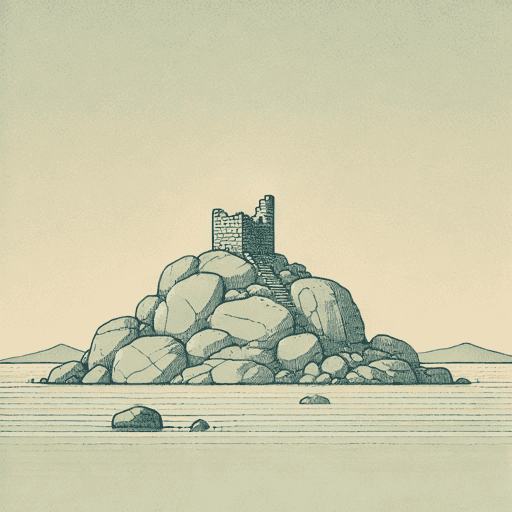
Initially, Kirrin Island is presented as a symbol of autonomy and escape. Before George bonds with her cousins, the island echoes her independence and emotional isolation. It’s her “private kingdom,” mirroring her guarded personality and reluctance to trust others. This exclusivity is reinforced through its restricted access, which only she can navigate. At this point, it symbolizes self-reliance and resistance to a world that doesn’t understand her. As an extension of her identity, it embodies her rejection of imposed domesticity and patriarchal expectations. The island’s ruined castle and hidden dungeons reinforce George’s autonomy: They are spaces untouched by adult regulation, where George can exist entirely on her own terms.
Once George allows her cousins onto the island, its symbolism shifts, becoming the site where the group’s identity is forged. The storm forces the children to cooperate for survival on the island, binding them through shared adversity. Meanwhile, the discovery of the shipwreck and treasure map transforms the island into a site of joint purpose. In this phase, Kirrin Island symbolizes collaborative effort, illustrating the theme of Forging Identity Through Shared Adventure. The children’s success depends on pooling distinct strengths—George’s physical mastery, Julian’s leadership, Dick’s adaptability, Anne’s support, and Tim’s instinct. In this way, the island becomes a microcosm of an idealized social structure: egalitarian, merit based, and, most importantly, independent of adult authority.
The threat of Uncle Quentin selling the island introduces a critical shift in its symbolic meaning. Kirrin Island becomes a contested space, representing the tension between childhood autonomy and adult commodification. From an adult perspective, the island is reduced to its economic value, in contrast to the children’s view of it as a site connected to identity and adventure. The looming commercialization symbolizes the intrusion of adult priorities—profit, control, and short-term thinking—into the imaginative sphere of childhood. This conflict generates urgency and reinforces the necessity of secrecy.
Throughout the narrative, Kirrin Island underscores the theme of Childhood Competence in an Adult-Dominated World. Its geography, featuring hidden entrances, submerged wrecks, and labyrinthine tunnels, demands practical intelligence and resilience to navigate. Importantly, the children succeed where adults fail, using their knowledge of the island as a form of power to successfully defend it. By the novel’s conclusion, Kirrin Island undergoes its most significant transformation as George legally divides ownership among her cousins. Her declaration, “Kirrin Island and Castle shall belong to us all!” (183), is the ultimate expression of trust and belonging, formalizing the group’s unity.
Ingots
The ingots of gold hidden beneath Kirrin Castle symbolize latent worth that only reveals itself to those willing to look beyond surfaces. Throughout the novel, the gold exists as rumor and family lore, dismissed by adults as either irretrievable or nonexistent. The fact that the treasure takes the form of ingots rather than coins or jewels is significant. The description of the gold as “brick-shaped things of dull yellow-brown metal” emphasizes the raw, unrefined nature of the ingots (135), which are valuable for their essence rather than for how they appear. This quality mirrors George herself, whose gruff manner conceals a fierce loyalty and capability that her cousins come to treasure.
The ingots also highlight the divide between those who earn rewards and those who attempt to seize them undeservingly. The children locate the gold through sustained collaboration, pooling physical effort at the iron ring, navigating the dungeons together, and relying on one another's courage underground. Julian’s declaration, “[T]here’s a small fortune here in this cellar—and it’s yours!” (136), affirms that George’s rightful ownership of the treasure flows from heritage and honest effort rather than from cunning or force. The villains, by contrast, learn of the ingots through a purchased map and try to claim them through intimidation, revolvers, and imprisonment.
The gold’s ultimate effect on the family completes its symbolic meaning. Once recovered, the ingots solve Uncle Quentin’s financial worries and grant George what she most desires—to keep Tim and attend school with her cousin Anne. The treasure confirms what the children’s adventure has already proven: that loyalty and shared purpose hold a priceless value.
The Shipwreck
The shipwreck lodged in the waters off Kirrin Island is a symbol of a buried legacy, illustrating how the past can resurface to reshape the present. For most of the novel, it lies hidden beneath the sea, visible only as a faint outline, much like the family history that George is aware of but can’t fully access. The ship’s sudden emergence during the storm transforms it from a remote curiosity into the catalyst for the entire adventure, linking the children’s present actions to the fortunes of George’s ancestors.
The wreck’s reappearance is unexpected and involuntary, forced to the sea’s surface by a storm. This detail matters because the treasure hunt that follows depends on the children’s readiness to act spontaneously, contrasting with the world of adult planning. When George sees the dark shape on the rocks before anyone else, she recognizes both her personal inheritance and opportunity. Julian captures the collective thrill when he exclaims, “We shall be able to row out and get into the wreck now! […] We may find the boxes of gold” (63). His words frame the wreck as a doorway into possibility.
Ultimately, the shipwreck ties together the themes of Childhood Competence in an Adult-Dominated World and Forging Identity Through Shared Adventure. It’s the children who explore the wreck first, recover the box, and ultimately protect the legacy that the adults around them either ignore or attempt to steal. Despite dangerous challenges from men who would exploit it, George demonstrates her resolve by repeatedly insisting that the ship belongs to her family and therefore to her.
The Treasure Map
The treasure map that the children keep secret after finding it on the shipwreck symbolizes the gap between adult and childhood perception. While the map is a literal navigational tool, its deeper significance lies in what each character sees or fails to see when confronted with it. The map tests whether a person can look beyond surface value to recognize hidden worth, and it’s the children, not the adults, who pass this test. Uncle Quentin illustrates this point when he finds the map and sells it to an antiques dealer for what he considers “a very good price” (98). Only assessing it for its monetary worth in the present moment, he never examines the map closely enough to connect it to his own family’s history or to the lost gold. His dismissal reflects a pattern of adult misjudgment that runs throughout the novel: The grown-ups hold power yet consistently misread the evidence in front of them.
The children, by contrast, immediately grasp the map’s implications. Their ability to decode the map’s meaning exemplifies Childhood Competence in an Adult-Dominated World. Julian’s plan to create a copy of the map before returning the box to his uncle is a calculated and mature act of foresight. He reasons, “To be on the safe side, let’s take a copy of the map” (94). The map thus becomes a measure of who truly has the clearest insights: the adults, who possess authority but squander information, or the children, whose attentiveness and collaboration transform a piece of parchment into the key to a fortune.

Unlock the meaning behind every key symbol & motif
See how recurring imagery, objects, and ideas shape the narrative.
- Explore how the author builds meaning through symbolism
- Understand what symbols & motifs represent in the text
- Connect recurring ideas to themes, characters, and events