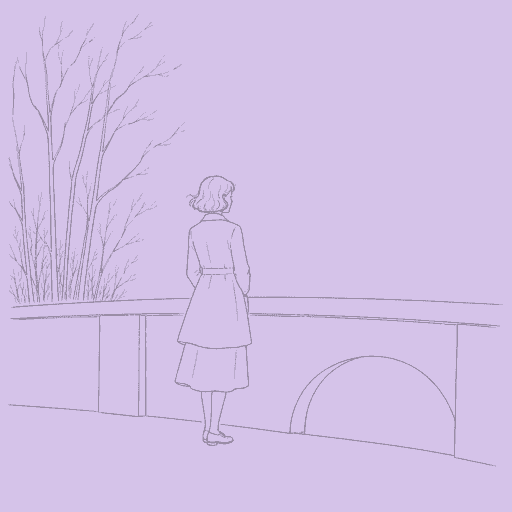
Hangsaman
Hangsaman
A modern alternative to SparkNotes and CliffsNotes, SuperSummary offers high-quality Study Guides with detailed chapter summaries and analysis of major themes, characters, and more.
Summaries & Analyses
Quizzes
NEWReading Tools
Chapter 1Chapter Summaries & Analyses
Content Warning: This section of the guide includes discussion of death, gender discrimination, emotional abuse, substance use, and sexual violence.
Chapter 1 Summary
On a Sunday morning, the dysfunctional Waite family has breakfast. Mr. Arnold Waite, a writer, ritually needles his wife, Mrs. Charity Waite, about her religious faith. Their 17-year-old daughter, Natalie Waite, is anxious about leaving for college and mentally retreats into a fantasy where a police detective interrogates her about a murder. Her brother, Bud, is sullen. After breakfast, Natalie has her daily writing tutorial with her father. He condescendingly critiques her assignment as a character sketch of him, and dismisses her insights as part of a predictable developmental phase in which daughters come to hate their fathers.
Natalie then helps Mrs. Waite prepare for a literary cocktail party Arnold is hosting. Mrs. Waite delivers a bitter, rambling monologue about her unhappy marriage. When Bud finds Natalie in the garden, he offers to take her swimming to escape the party, but she declines.
The first party guests arrive, including a large, eccentric, and overbearing woman named Verna Hansen and her brother, Arthur. Verna corners Natalie. During the party, Arnold publicly humiliates Natalie by telling a crude story about her as a baby to the assembled crowd. Natalie later finds her mother drunk and crying in her bedroom. Mrs. Waite warns Natalie that her father will turn on her as soon as she gets “too big,” but she promises to always protect her.
Feeling a strange intoxication that causes her to think once again about the detective interrogating her, Natalie returns to the party and is approached by an older man. He leads her away from the crowd and into a dark grove of trees, questioning her about a comment she made about thinking herself wonderful. Natalie becomes overcome with the fear that he is going to touch her.
The next morning, Natalie wakes up with a bruised face, loathing her own body, and chanting that nothing happened, the narrative implying she was sexually assaulted by the older man in the trees. At a tense breakfast, Arnold is red-eyed and frowning, Mrs. Waite is tired, though Bud’s voice is “outrageously fresh.” Arnold remarks that it is a “black and rotten day” (46).
Chapter 1 Analysis
Jackson’s novel begins by piercing the myth of the happy suburban nuclear family, presenting it as a nucleus of dysfunction in which the various family members either assert or resist each other’s wills. Natalie Waite’s internal conversation with an imaginary “police detective” establishes her primary method for lasting the psychological hostility of her family. As her father mocks her mother and her brother sits in sullen silence, Natalie retreats into a fantasy where she is the central figure in a murder investigation, a drama that grants her the agency and significance her real life lacks. This inner narrative, presented with the same weight as the external breakfast scene, exemplifies how the third-person narration is “infected” by Natalie’s perspective, blurring the line between objective reality and subjective experience. Her creation of this elaborate scenario is a clear instance of Fragmentation of Identity as a Survival Mechanism, a defense against the mundane cruelties of her home. By casting herself as a suspect under interrogation, she transforms her feelings of powerlessness and silent terror into a performance of defiant control. This coping strategy, however, is precarious; it requires her to dissociate from her surroundings and inhabit a world governed by danger and suspicion, prefiguring the more intense psychological crises to come.
The daily writing tutorial between Natalie and her father demonstrates the intellectual and emotional abuse that shapes her development. When Arnold critiques Natalie’s character sketch of him, he dismisses her sharp insights by diagnosing them as a predictable symptom of adolescent rebellion. He claims she is in a stage where “hatred of the parents is inevitable” (14), framing her intellectual labor as a biological impulse rather than a creative act. This condescending psychoanalysis is a clear manifestation of The Harmful Effects of Sexism in Academia and the Arts, as he uses his authority as a male writer and father to invalidate her perspective and maintain his own superiority. His power play continues at the cocktail party, where he publicly recounts a humiliating story about her as a baby, a tactic designed to infantilize her in front of his peers. For Natalie, intellectual expression becomes a battleground where her perceptions are systematically delegitimized by the very person meant to be her mentor, teaching her that her voice is a tool for patriarchal censure.
Mrs. Waite’s drunken monologue characterizes her as a bleak cautionary tale, offering Natalie a glimpse into a potential future shaped by the same oppressive forces. Confined to her bedroom during the party, Mrs. Waite confesses that she feels “tricked” by the promises of marriage and that her life has been a deep disappointment. Her despair reflects the cultural condition of many educated women in mid-century America, who were expected to abandon personal ambition for domesticity. She embodies the destructive outcome of living with a man like Arnold, whose intellectual ego leaves no room for a wife’s autonomy. Her desperate warning that Arnold “picks out the one way he can frighten you most” and will eventually turn on Natalie too is a rare moment of attempted maternal solidarity (36). However, her message is undermined by a “lifetime of whimsy and lies” (34), leaving Natalie predisposed to resist any attempts at effective guidance from her. Charity exists as a ghost of Natalie’s future, a woman whose identity has been so thoroughly eroded that she can only articulate her tragic experience as a rambling, incoherent warning.
The cocktail party culminates in a violent encounter that shifts the novel’s focus from psychological oppression to physical violation, deploying the motif of the woods as a classic Gothic space of simultaneous danger and transgression. When an older man leads Natalie from the lawn into a dark, silent grove of trees, the setting transforms from a childhood playground of “knight in armor” into a site of adult terror (22). The narrative’s abrupt transition from the loud party to the “great terrifying silence” of the woods mirrors Natalie’s own dislocation and fear (42). The implied sexual assault is rendered through Natalie’s disoriented and fragmentary consciousness, consistent with the Female Gothic tradition’s focus on internalized horror rather than explicit violence. This event brutally actualizes the latent threat that has permeated Natalie’s family life, confirming her mother’s warnings and her own vague fantasies of danger. The woods become the space where the abstract cruelty of her father’s world takes on a tangible, predatory form, irrevocably shattering her adolescent sense of safety.
In the aftermath, Natalie’s confrontation with her own image introduces the symbol of mirrors and reflections to signify alienation from her own identity. Waking with a “bruised face and her pitiful, erring body” (44), she can no longer see herself as a coherent whole. The mirror reflects a stranger, prompting her to immediately deny the reality of what has happened, chanting, “[N]othing happened, nothing happened” (43). This desperate denial is an expression of Fragmentation of Identity as a Survival Mechanism, as she attempts to sever her consciousness from the trauma her body now holds. The chapter’s final scene projects this internal schism onto the family unit. The tense silence at the breakfast table is thick with unspoken knowledge and shared corruption. Mr. Waite’s concluding pronouncement that it is “a black and rotten day” suggests a shared, if unacknowledged, stain on the household (46), cementing the idea that the violence done to Natalie has poisoned them all.

Get in-depth, chapter-by-chapter summaries and analysis from our literary experts.
- Grasp challenging concepts with clear, comprehensive explanations
- Revisit key plot points and ideas without rereading the book
- Share impressive insights in classes and book clubs