Hangsaman
Hangsaman
A modern alternative to SparkNotes and CliffsNotes, SuperSummary offers high-quality Study Guides with detailed chapter summaries and analysis of major themes, characters, and more.
Summaries & Analyses
Quizzes
NEWReading Tools
Character Analysis
Content Warning: This section of the guide includes discussion of mental illness, gender discrimination, emotional abuse, bullying, sexual violence, substance use, and addiction.
Natalie Waite
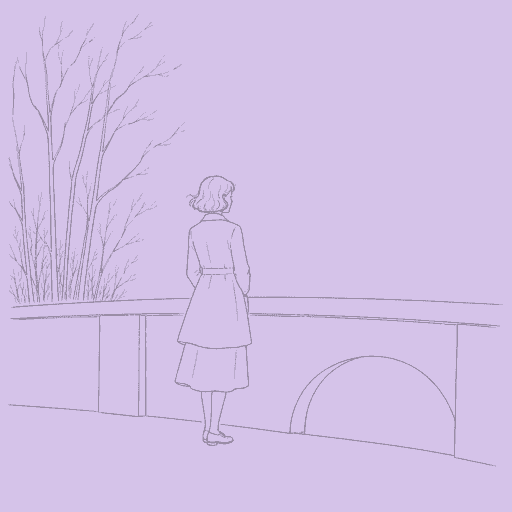
As the novel’s 17-year-old protagonist, Natalie Waite is a deeply interior and psychologically complex character whose perceptions shape the narrative. Her journey from an oppressive home to a socially hostile college environment is marked by deep alienation and an increasingly fragmented sense of self. To cope with her reality, Natalie retreats into her rich imagination, creating elaborate internal dialogues with figures like police detectives who help her process the negative feelings of her living environments. This interior world is both a sanctuary and a prison, blurring the lines between reality and fantasy. Her habit of dissociating is an important defense mechanism, allowing her to survive the emotional abuse of her father and the bewildering social pressures of college. This tendency is central to the theme of Fragmentation of Identity as a Survival Mechanism, as her mind works to protect her from unbearable external forces.
Natalie’s identity is also defined by her artistic sensibility and her struggle for creative autonomy. An aspiring writer, she is initially under the thumb of her father, Arnold, whose condescending morning “tutorials” are exercises in intellectual domination rather than mentorship. At college, she transfers this dynamic to her English professor, Arthur Langdon, seeking an intellectual connection that replicates her fraught relationship with her father. Her observational skills are sharp and satirical, yet her own voice is suppressed by the patriarchal figures who seek to mold her. Her journey involves the gradual, painful process of separating her own perceptions from those imposed upon her, a struggle that is externalized in her relationships and internalized in her psychic turmoil. She is a dynamic and round character, whose development hinges on her ability to integrate the disparate parts of her personality.
Socially, Natalie is an outcast. She fears and fails to comprehend the rigid hierarchies of her college, epitomized by popular girls like Vicki and Anne. Her refusal to conform during the freshman hazing ritual, where she is labeled a “bad sport,” cements her status as an outsider. This isolation precipitates the full emergence of her alter-ego, Tony, who provides the confidence and companionship Natalie cannot find elsewhere. The novel’s climax, in which Natalie confronts and rejects Tony in the woods, marks a critical turning point in her character arc. It is a violent and terrifying act of self-integration, where she sacrifices a part of herself to emerge as a new, singular entity. In the end, Natalie is “alone, and grown-up, and powerful, and not at all afraid” (218), suggesting that she has assimilated the strength of her created double and is prepared to face the world on her own terms.
Tony
Though presented as a fellow student at the college, Tony is heavily implied to be a manifestation of Natalie’s experience of dissociation, an alter-ego or tulpa created to help her navigate overwhelming psychological distress. Tony represents the confident, rebellious, and assertive parts of Natalie’s personality that have been suppressed by her oppressive upbringing. Tony appears when Natalie is at her most isolated and vulnerable, offering the friendship and validation she desperately needs. Her very presence is a defense mechanism, embodying the novel’s exploration of Fragmentation of Identity as a Survival Mechanism. She is, in effect, Natalie’s psychological double and foil, acting out the impulses Natalie cannot. Tony’s connection to the Tarot cards, particularly her association with the Page of Swords, symbolizes her role as a vigilant, secretive, and sometimes combative guardian of Natalie’s psyche.
As Natalie’s companion, Tony enables her to withdraw from the toxic social and academic pressures of the college. She encourages Natalie to skip classes, disregard rules, and defy the expectations of both her peers and professors. While this rebellion offers temporary relief and a sense of empowerment, it also leads Natalie into deeper isolation and peril. The journey Tony leads Natalie on, culminating in the surreal trip to the abandoned Paradise Park and the dark woods, is a metaphor for a descent into the subconscious. In this liminal space, Tony’s protective nature becomes menacing, representing the allure of a complete and permanent retreat from reality. She tempts Natalie with visions of godlike power and escape, threatening to consume her identity entirely.
The novel’s climax is Natalie’s confrontation with and ultimate rejection of Tony. In the clearing in the woods, Tony’s purpose as a guide and protector shifts to that of an antagonist whom Natalie must overcome to achieve wholeness. When Natalie refuses Tony’s final, threatening advance, reenacting the event of Natalie’s sexual assault at the end of Chapter 1, she reclaims her own agency. Tony’s disappearance is, in this sense, the painful integration of a splintered part of the self. By leaving Tony behind, Natalie absorbs her strength and resilience, completing a harrowing but necessary step in her psychological development.
Arnold Waite
Arnold Waite, Natalie’s father, is a major antagonist of the novel. A vain and egotistical writer, he wields his intellect as a tool for psychological domination over his family. He treats his daughter as a creative and intellectual project, subjecting her to morning “tutorials” that serve to reinforce his superiority and undermine her confidence. He intellectualizes and pathologizes her normal adolescent development, telling her, “[I]t is natural for girls to hate their fathers at some point in their growth” (14), thereby dismissing her legitimate feelings and re-centering the narrative on himself. This emotional manipulation is a core source of Natalie’s psychological distress and a powerful critique of The Harmful Effects of Sexism in Academia and the Arts, where male authority figures abuse their power.
A static and round character, Arnold is deeply performative, constantly curating his image as a brilliant, if misunderstood, man of letters. This public persona conceals a deep insecurity and cruelty, which becomes evident in social situations like the cocktail party, where he uses his family members as props in his self-aggrandizing anecdotes. His long, self-pitying monologue about his own supposed “failings” is a calculated performance of humility designed to command Natalie’s attention and sympathy. His hypocrisy is total; he champions intellectual honesty while using language to obscure truth and control those around him.
Arnold’s relationship with his wife is the starkest illustration of his tyranny. He systematically belittles her, mocks her religious faith, and strips her of her agency and identity over the course of their marriage. He has reduced her to a woman who experiences anxiety and alcohol addiction, forcing her to express her misery in drunken, incoherent outbursts. This dynamic is a chilling foreshadowing of the fate that awaits Natalie if she were to remain under his influence or enter a similar relationship, making Arnold a symbol of the destructive potential of patriarchal intellectualism.
Mrs. Charity Waite
Mrs. Charity Waite is a tragic figure who embodies the consequences of female intellectual and emotional subjugation. Trapped in a marriage to a domineering man, her identity has been eroded, leaving her a nervous, unhappy woman who uses alcohol to cope with her powerlessness. Her domain is the kitchen, a traditionally female space where she can exercise some control and briefly finds her voice. It is here that she delivers her weekly “chant” to Natalie, a stream-of-consciousness monologue blending domestic concerns with fragmented memories and desperate warnings. Her character is a constant, if painful, reminder of the potential outcome for women who are silenced and controlled.
Despite her deep love for her daughter, Mrs. Waite is largely unable to communicate effectively with her. Her most sincere expressions of fear and wisdom are often delivered in a “girlish whimsy” or a drunken rage, defense mechanisms she has developed to protect herself from her husband’s dismissal. This mode of communication prevents Natalie from fully grasping the gravity of her warnings about men like her father. Charity’s failure to connect with Natalie emphasizes the tragic isolation of each woman in the family and the difficulty of breaking generational cycles of oppression.
Elizabeth Langdon
Elizabeth Langdon, the young wife of Professor Arthur Langdon, is an important foil and cautionary figure for Natalie. A former student who married her teacher, she represents a possible and terrifying future for Natalie. Trapped in an unhappy marriage and a liminal social position, she is isolated from both the students she once belonged with and the faculty wives she is now supposed to join. Her loneliness and desperation influence her experience of alcohol addiction and her self-destructive behavior, such as the fires she accidentally starts. She reaches out to Natalie for friendship, seeing a reflection of her younger self and seeking an ally in a hostile environment.
Elizabeth is a survivor of both the casual cruelty of her husband and the rigid social hierarchies of the college. She is openly tormented by Vicki and Anne, privileged students who use their social standing to humiliate her, showing how Class-Based Social Hierarchies as an Obstacle to Solidarity can pit women against each other. Her transformation from a promising student to a desperate faculty wife is a stark illustration of the destructive impact of the patriarchal academic world on women who are absorbed into it.
Arthur Langdon
Arthur Langdon is an English professor at Natalie’s college and a subtler but equally insidious antagonist compared to Arnold Waite. He projects the image of a charming, accessible intellectual, but uses this persona to exploit his authority and manipulate his female students. His interest in Natalie is predicated on her connection to her famous father and his own desire to cultivate promising young women. He shows a new generation of the same patriarchal toxicity embodied by Mr. Waite, one that cloaks its predation in the guise of modern, informal mentorship.
His cruelty is most evident in his treatment of his wife, Elizabeth. He is neglectful and emotionally abusive, openly flirting with his students Vicki and Anne in Elizabeth’s presence and showing contempt for her emotional distress. He abandons her when she is drunk and vulnerable, demonstrating a complete lack of empathy and responsibility. Arthur’s character exposes the dark underbelly of the progressive college, revealing it to be a place where male professors can abuse their power with impunity.
Vicki and Anne
Vicki and Anne function as a single antagonistic entity, representing the oppressive social hierarchy of the college. They are wealthy, beautiful, and supremely confident, using their privileged status to enforce conformity and police social boundaries. Their behavior is characterized by a sense of entitlement, most clearly demonstrated when they casually invade Natalie’s room to satisfy their curiosity about her. They are the gatekeepers of social acceptance, and their clique is both alluring and terrifying to outsiders like Natalie.
Despite being women in a male-dominated academic world, Vicki and Anne actively uphold the patriarchal structure by participating in the humiliation of Elizabeth Langdon. Their cruelty toward the professor’s wife is inflected with class snobbery and a complete lack of gender solidarity. They are static, flat characters who serve to illustrate the theme of Class-Based Social Hierarchies as an Obstacle to Solidarity, showing how social power can be used by women to oppress other women, thereby preventing any unified resistance to the system that confines them all.
Rosalind
Rosalind is a minor but significant character who shows a path of social survival that Natalie ultimately rejects. Initially, she appears as a fellow outcast, seeking an alliance with Natalie based on their shared exclusion from the popular cliques. However, her friendship is rooted in negativity, gossip, and a resentful desire for vindication. Natalie senses the superficiality of this bond and chooses the deeper, more complex isolation of her relationship with Tony instead. Rosalind’s later transformation into a popular girl, seemingly after instigating theft accusations against another student, reinforces the moral vacuity of the college’s social system and validates Natalie’s choice to remain apart from it.

Unlock analysis of every major character
Get a detailed breakdown of each character’s role, motivations, and development.
- Explore in-depth profiles for every important character
- Trace character arcs, turning points, and relationships
- Connect characters to key themes and plot points