Horizon
Horizon
A modern alternative to SparkNotes and CliffsNotes, SuperSummary offers high-quality Study Guides with detailed chapter summaries and analysis of major themes, characters, and more.
Summaries & Analyses
Quizzes
NEWReading Tools
Symbols & Motifs
Content Warning: This section of the guide includes discussion of child death and animal death.
The Gravity Device
The donut-shaped gravity device symbolizes the unnatural, manipulable laws of the survivors’ new environment. Discovered in the plane’s wreckage, it quickly becomes the central tool through which the characters apply their problem-solving skills. The device isn’t intuitive—it requires experimentation, logical deduction, and collaboration to operate, turning abstract principles of physics into life-or-death decisions. As the team deciphers its functions, it shifts from a wondrous object that allows them to fly into a dangerous piece of technology that attracts predators and inadvertently causes Caleb’s death. Anna marvels at its power, noting that gravity is a “fundamental force, and this thing turns it off like a light switch” (62). That observation captures how the device shatters their understanding of the universe and forces them to adapt to a reality where the rules are subject to change.
The survivors’ perception of the device evolves alongside their discovery of the jungle, theorized to be everything from an engineered shadow that blocks the planet’s gravity field, to “just a remote control” connected to a spaceship (95), to one of many such devices embedded throughout the rift valley, to a multipurpose tool affecting not only gravity but also electricity. This ongoing reinterpretation is an important series of intellectual leaps that shows how important the flexibility to change one’s view of the situation is. Their increasing mastery of the device symbolizes their growing sense that they can learn to control the system they’re in through rational inquiry rather than just be its victims.
Yoshi’s Katana
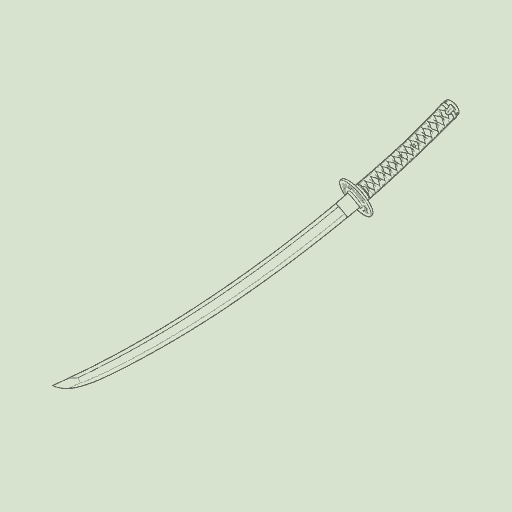
Yoshi’s 400-year-old katana is a symbol of personal conflict, practiced skill, and gradual integration into the group. Before the crash, Yoshi considers his act of stealing the blade from his father back in Japan an act of rebellion that now haunts him. In the jungle, far from that familial context, the katana stops being a symbol of internal tension and becomes a weapon that gives Yoshi a distinct and essential role among the survivors.
Yoshi’s years of dedicated swordplay practice give him capabilities that the other teens don’t have. He rescues Molly and Javi from the tanglevine with precise cuts that no knife or flare could manage, and he stands his ground against the giant bird when the others have run out of options. His hunting, however, is not a solitary achievement. When Yoshi kills a “slide-whistle bird” for food, it’s only possible because Akiko has lured it close by mimicking its call on her flute—her musical skill and his swordsmanship work together to put food on the fire. That moment quietly reframes Yoshi’s katana as one piece of a larger collaborative effort.
At the start of the story, Yoshi draws the blade just enough to show “a few inches of bright, razor-sharp metal” before heading into the jungle alone (40), projecting confidence he isn’t sure he has. By the end, his role as a protector is something that the group has come to depend on and that he has genuinely grown into. The sword marks his transformation from feeling like a bicultural outlier, as a guarded, isolated teenager finds his place among people who need him.
The Shredder Birds
These aggressive birds with razor-sharp beaks are a recurring symbol of the jungle ecosystem’s active and organized hostility to the survivors. Their ferocious attack on Javi establishes them as a serious danger early on: He “barely ha[s] time to cover his face before the whole flock sho[ots] past in a roar of feathers and shrieks” (53), signaling that the jungle is capable of coordinated attack.
The birds’ most important feature is their inexplicable attraction to the gravity device. This connection reveals to Anna a synthesis of biology and technology within the world, suggesting that the fauna has evolved alongside—or been engineered to interact with—its advanced physics: “They’re alien birds. […] It’s alien technology. They fit together somehow” (107). Her insight pushes the survivors to think of the jungle as a system with its own internal logic.
The birds are also a problem to be solved. Javi’s use of Newton’s third law to escape mid-air and Anna’s tactical gravity pulses to repel the flock show the group applying scientific principles under pressure. The shredder birds impose strict limits on the group’s most powerful tool and force them to think carefully about every advantage they gain—because in this world, every advantage comes with a corresponding danger.
Circular Formations of Trees
The perfectly circular tree formations are a persistent and unnerving clue that the survivors’ environment is artificial. These recurring geometric patterns are a stark visual anomaly in an otherwise chaotic jungle. When the survivors first spot one from the air, its unnatural perfection immediately signals that something is wrong. Anna notes that it “looks like someone planted them that way” (75), introducing the idea of intentional design into their understanding of their surroundings. The circles of trees are pieces of environmental data that demand a hypothesis.
As the narrative progresses, the motif gains deeper meaning when the survivors discover that the formations mark the locations of gravity-distortion zones—with low-gravity circles producing unnaturally tall trees and high-gravity zones producing stunted ones. As specific markers of the world’s underlying technology, the tree circles are thus revealed to be functional and “a sign of intelligent life” (105). The circular formations are an important element of world building, symbolizing the hidden order and deliberate architecture of the seemingly wild jungle.
The Killbots
Team Killbot’s soccer-playing robots, called “the Killbots,” are a running motif that reflects the group’s approach to building and, by extension, to survival. The Killbots are deliberately simple—Javi describes them as “toasters on wheels” (6), or mindless machines that swarm the ball and knock other robots aside. One judge dismissed their style as how “five-year-olds play soccer” (6), but the team’s philosophy is deliberate: Robust, practical function beats fragile complexity. Molly notes, “You could ship the Killbots a thousand miles in the back of a bouncy UPS truck, and they’d probably work just fine” (14).
That same instinct shapes how Team Killbot handles survival challenges. When faced with the unknown, they look for solutions that are direct and testable rather than elegant or elaborate. Anna’s berry-testing method is systematic and simple. Javi’s escape from the shredder birds relies on a single, well-understood physical law. Molly’s leadership style is built on clear priorities and immediate action. The Killbots themselves don’t reappear as useful tools in the jungle, but the mindset behind them does—a preference for solutions that hold up under pressure, built by people who trust each other enough to work as a unit.

Unlock the meaning behind every key symbol & motif
See how recurring imagery, objects, and ideas shape the narrative.
- Explore how the author builds meaning through symbolism
- Understand what symbols & motifs represent in the text
- Connect recurring ideas to themes, characters, and events