Little House on the Prairie
A modern alternative to SparkNotes and CliffsNotes, SuperSummary offers high-quality Study Guides with detailed chapter summaries and analysis of major themes, characters, and more. For select classroom titles, we also provide Teaching Guides with discussion and quiz questions to prompt student engagement.
Summaries & Analyses
Quizzes
NEWReading Tools
Games
Chapters 1-4Chapter Summaries & Analyses
Content Warning: This section of the guide features depictions of racism.
Chapter 1 Summary: “Going West”
At the end of one winter during the late 1860s, Pa decides that Wisconsin, where the Ingalls family lives, is getting too crowded for him, so he moves his family to Kansas, which is less settled. He has heard that the US government will soon be displacing the Indigenous Americans from their territory in Kansas and opening up the land to white settlers, and he is determined to get an early claim on good farming land.
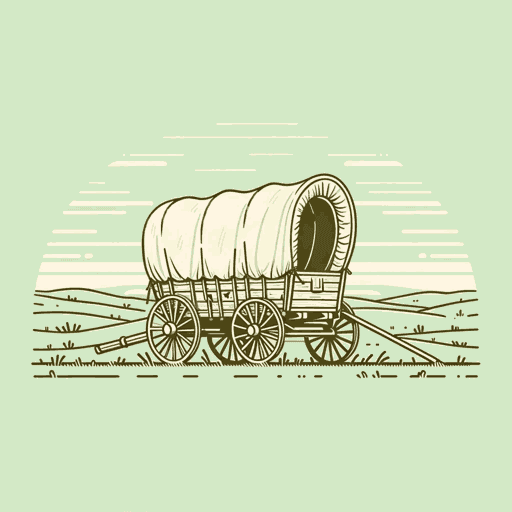
The family sells their house and makes the trip in a covered wagon, leaving early one morning and crossing the frozen Mississippi River at the town of Pepin, on the Wisconsin-Minnesota border. Once on the Minnesota side, the family spends the first night at a deserted cabin used by travelers. In the night, Laura hears the ice on the river breaking up, realizing that the family crossed it just in time.
From Minnesota, the family goes south through Iowa and Missouri, then turns west to reach the plains of Kansas. They must cross many streams and rivers as they travel, some of which are flooded from the winter’s snowmelt. They wait until the water drops down and buy new horses to pull their wagon while they wait. The horses are strong mustangs (native wild horses that have been domesticated), that Laura and Mary name Pet and Patty.
As they travel, the landscape changes from forest to open prairie, which Laura finds disorienting. She muses, “In a perfect circle the sky curved down to the level land, and the wagon was in the circle’s exact middle. All day long Pet and Patty […] couldn’t get out of the middle of that circle” (13). She and Mary are bored by the unchanging landscape and lethargic from the tedious trip in the wagon. Finally, Pa sees trees on the horizon, which are likely to indicate water, and he decides that the family will camp in the creek bottom for the night.
Chapter 2 Summary: “Crossing the Creek”
The family reaches the creek, which is in a wide canyon below the rest of the prairie. Pa decides to ford the creek, which unexpectedly gets deeper midway through, forcing him to get out of the wagon and swim alongside the horses to guide them. Mary and Laura are frightened, but Laura stands up in the wagon to look out and watch. Ma holds the reins of the wagon while Pa gets the team to the far bank. The family is relieved to be safe after the difficult crossing, but then realizes that their dog Jack—whom they thought could swim alongside the wagon—is missing. Laura is upset and worried about Jack. Pa too, is regretful that they have lost such a good dog and says that he would have put Jack in the wagon if he’d known the water would get so deep. Later, Laura asks her parents if Jack will go to heaven, and Pa says that he will.
Chapter 3 Summary: “Camp on the High Prairie”
That evening, the family camps on the high prairie a short way from the creek, and the chapter describes the camp-making process. Pa puts the horses on picket lines—stakes driven into the ground with ropes attached to them that let the horses graze while keeping them in a fixed area. He starts a fire after carefully clearing an area of dead grass, so he doesn’t accidentally set the whole prairie on fire. He brings water from the creek, and Laura and Mary help their mother make a simple dinner of cornmeal cakes, fried slices of salted pork, and coffee for Ma and Pa. As they’re cleaning up the dinner dishes, they hear wolves howling not far away.
Pa and Ma discuss the possibility of staying permanently in the area and building a house there. The family prepares to go to bed, and Laura sees two eyes in the firelight. Thinking it’s a wolf, Pa gets his gun, but the “wolf” turns out to be Jack, who has survived crossing the creek and found his way to their campsite. The family rejoices, and Laura feels safer with Jack guarding them that night.
Chapter 4 Summary: “Prairie Day”
The Ingallses have decided to stay at their camp for at least a day, so the next morning, Pa goes hunting for fresh game for the family, and Ma washes and irons their clothes and linens. Laura and Mary play on the prairie all morning and come back to the wagon for their lunch.
Laura and Mary are both apprehensive and curious about the Indigenous people, and Ma tries to reassure them that they will be safe. However, the Indigenous people still legally own that area of Kansas, and the Ingallses are resettling there based on rumors that the territory will soon be opened up by the US government to white settlers. Ma isn’t sure when the territory will be opened and admits that “I just don’t like them [Indigenous people]” (47).
After this conversation, Laura and Mary fall asleep in the shade. When Laura wakes up, Pa is coming back with two prairie hens and a rabbit for their dinner. After dinner, Pa plays the fiddle, which gently lulls Laura to sleep for a while. She wakes up thinking that the sound of Pa’s fiddle is really coming from the stars as they sing to her. Laura and Mary go to bed, happy with their surroundings.
Chapters 1-4 Analysis
These early chapters, and later ones that describe the family’s routines and settling-down process in Kansas, are characterized by descriptions of concrete everyday activities that young readers in the 1930s may not have been familiar with, such as making camp for the night in a covered wagon. These details would have illustrated the sensory experiences of the pioneers, preserving the minutiae of a lifestyle that has long since been lost to time. This pattern is typical of Wilder’s work, as her series is often credited with promoting the romanticized image of white settlers’ westward expansion as a constant adventure undertaken by uniquely brave people. However, many such narratives—the Little House series among them—also gloss over the fact that the lands the settlers sought to occupy were not “empty.” In this light, the young Laura’s undiluted wonder at the wide-open prairies creates the distorted impression that such land was free to all comers.
As the narrative progresses and the family members process their first visceral reactions to the prairie, it is telling that Laura at first dislikes the wide, open spaces that makes her feel as if the wagon isn’t moving. She has lived her whole life in Wisconsin’s heavy forests, and the untamed feel of the grasslands makes her distinctly uneasy. However, her feelings about the prairie changes once she has a chance to explore it, and Wilder dwells upon the sensory experiences of this moment, writing, “The wind sang a low, rustling song in the grass. […] But all these sounds made a great, warm, happy silence. Laura had never seen a place she liked so much as this place” (48-49). Here, Laura is exhibiting both the adaptability that some children demonstrate and a distinct preference for the promise of freedom that the land seems to hold for her; from this point, the wide-open spaces of the prairie become a recurring symbol for this idea. Thus, the family’s isolation gives Laura a very real freedom and a sense of vulnerability, and this theme continues throughout the book as the family builds a new home on the prairie.
These chapters introduce key dynamics within the family as well. Ma tends to defer to Pa in most matters, and this pattern reflects the patriarchal norms of 19th-century white society, in which men were the family decision-makers, while women were expected to remain passive and subservient to male authority figures. While Pa and Ma clearly like and respect one another, Pa’s decisions are always the driving force behind the family’s moves, while Ma restricts her own authority to the domestic realm, working to instill the same traits in Laura and Mary by urging them to help her with caring for their younger sister Carrie, cooking, cleaning, laundering, and decorating the family’s living spaces. It is Ma who makes things “snug” and “tidy” while Pa protects and directs the family and takes charge of outdoor tasks.
The family’s early conversations indirectly reflect the historical reality of 19th-century white Americans’ prejudices against Indigenous people. It is apparent from Ma’s conversation with Laura and Mary in Chapter 4 that she is fearful of the local Indigenous people. She will later make several comments that emphasize this fear, although the racist implications of her mindset largely go unexamined in the book itself. Wilder also foreshadows the homestead’s eventual downfall when she makes it clear that Ma, unlike Pa, is less confident that the government really will relocate the Indigenous people and allow white settlers to claim the land. Even so, she echoes Pa’s reassurances about the possibility of being able to keep the land, and her acquiescence reflects her conformity to his patriarchal authority over the family’s collective decisions.

Get in-depth, chapter-by-chapter summaries and analysis from our literary experts.
- Grasp challenging concepts with clear, comprehensive explanations
- Revisit key plot points and ideas without rereading the book
- Share impressive insights in classes and book clubs