Little House on the Prairie
A modern alternative to SparkNotes and CliffsNotes, SuperSummary offers high-quality Study Guides with detailed chapter summaries and analysis of major themes, characters, and more. For select classroom titles, we also provide Teaching Guides with discussion and quiz questions to prompt student engagement.
Summaries & Analyses
Quizzes
NEWReading Tools
Games
Chapters 21-26Chapter Summaries & Analyses
Content Warning: This section of the guide features depictions of racism.
Chapter 21 Summary: “Indian Jamboree”
As spring begins, Pa has to go back to Independence to trade his furs for supplies. While he’s gone, the Indigenous Americans gather in their camps and sing-chant so loudly that Ma and the girls can hear them the entire time that Pa is gone. It clearly makes Ma nervous, and Laura is both frightened and fascinated by the noises. Pa finally comes home and brings Ma and the girls presents—crackers and pickles for everyone, calico fabric for a new dress for Ma, and headbands for Laura and Mary. Pa tells Ma he heard rumors in Independence that the government would soon be ordering white settlers in the area to leave the Indigenous people’s territory, but he doesn’t put much faith in such reports.
Chapter 22 Summary: “Prairie Fire”
Pa begins plowing to create the family’s farm fields. Indigenous people frequently pass by the house, using the existing trail that the Ingallses built their house next to. The Indigenous people begin to come into the house as well, and Ma gives them food and tobacco whenever they indicate they want some. The family begins to lock up most of their food to conserve it.
A wildfire comes through the prairie, and Pa and Ma quickly protect the house by plowing up the grass around it and then setting a fire on the other side of the plowed strip. The intentional fire meets the wildfire and creates a burned zone, diverting the wildfire away from the house. Later, Mr. Edwards and Mr. Scott visit Pa and speculate that the Indigenous people set the fire in an effort to drive out the settlers. Pa says he doesn’t think so, and he tells the other men that the Indigenous people frequently use fire to manage the prairie grasses. Pa also says that the Indigenous people are gathering for their spring buffalo hunt: “By George! I’d like to go on a hunt like that, myself. It must be a sight to see” (285).
Chapter 23 Summary: “Indian War-Cry”
The Indigenous people continue to gather in their camps and begin shouting/chanting at night. Occasionally, a loud “war-cry” comes from the camp, frightening Laura and her sisters. The whole family is watchful and guarded during those nights, and they’re uneasy during the day when the camps are completely silent. Pa stops plowing and stays near the house with all the animals locked up. He also makes more bullets for his gun and stands guard with it at night in the window of the house. On one of the nights, Pa sees Du Chêne riding alone from elsewhere toward the camps.
The whooping from the camps eventually reaches a fevered pitch, terrifying the entire family. The next day, they see two groups of Indigenous people riding away in different directions. Pa goes to the creek to investigate and finds the camps all emptied, except for the Osage tribe. He finds an Osage who speaks English, who tells him that the camps were made up of several tribes. All the other tribes, except the Osage, wanted to kill the white settlers in the territory, but the Osage persuaded them not to, and the tribes all dispersed. Du Chêne is the one who persuaded the other tribes and his own not to kill the white people, causing Pa to say approvingly, “That’s one good Indian!” (301). Because of the Indigenous people’ disagreement, they will not hunt buffalo together that year.
Chapter 24 Summary: “Indians Ride Away”
A long line of Indigenous people rides away to the west and pass by the family’s house for hours. As Du Chêne rides by at the head of the line, Pa salutes him. Laura sees a “papoose” (Indigenous baby—note that this term is a generic Caucasian term for an Indigenous child) on one of the horses with its mother and begs Pa to get it for her. Pa chides her, saying that the mother “wants to keep her baby” (308), while Laura insists that “[i]t wants to stay with me” (308-309). Ma tells her, “You don’t want another baby. We have a baby [Carrie], our own baby” (310), but Laura insists, “I want the other one, too!” (310). Laura is so upset she bursts into tears and has trouble calming herself until Pa distracts her by telling her to look at the long line of riders. When the line of riders finally disappears off to the west, the family feels forlorn and disoriented.
Chapter 25 Summary: “Soldiers”
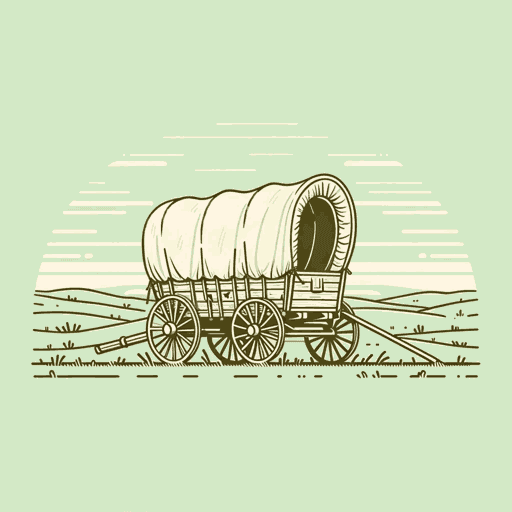
Pa resumes his farm work, and the whole family helps put in a vegetable garden for the coming year. The family’s enterprise comes to a sudden halt when Mr. Edwards and Mr. Scott come to tell Pa that US soldiers will be coming to remove white settlers from the area. Pa is furious that he received faulty information while the family was in Wisconsin, but he’s determined that he won’t wait until the soldiers come to tell the family to leave. He wants to relocate immediately, although he doesn’t know where the family will go. Pa gives Mr. Scott the family’s cow and calf, since they won’t be able to take the animals with them, and he and Ma re-assemble the covered wagon to for their journey the next morning.
Chapter 26 Summary: “Going Out”
The next day, Ma and Pa quickly pack up the family’s belongings and load them into the covered wagon. They’re able to fit everything they brought with them except for the plow and the built-in furniture in the cabin. The family drives down into the creek bottoms for a while, then climb back up to the high prairie. That afternoon, they come upon a man and woman in a covered wagon who are stranded in the prairie because their horses were stolen in the night. Pa offers to take them to Independence, but all the couple’s possessions are in the wagon, and they don’t want to leave it. No amount of persuasion from Pa can convince them to leave. As the Ingallses drive off, Pa scornfully says to Ma, “Tenderfeet! Everything they own, and no dog to watch it. Didn’t keep watch himself. And tied his horses with ropes! […] Shouldn’t be allowed loose west of the Mississippi!” (330-331). Pa resolves to send the soldiers in Independence out to help the couple.
The family camps that night at an old homesite whose house has burned down, and they make camp in the familiar routine they experienced when they were travelling from Wisconsin to Kansas. Pa plays the fiddle as the girls are going to bed, and Laura drifts off to sleep, comforted by the sound and by the security of her parents nearby.
Chapters 21-26 Analysis
As in the last group of chapters, tensions in this section of the book heighten and finally conclude with the Ingalls family leaving their house and setting off away from the Indigenous territory. The rumors Pa hears while he’s in Independence in Chapter 21 are a foreshadowing of the final events of the book that drive the family away. Similarly, the “war-cries” they hear from their house in Chapter 23 are the final blow to their sense of safety and security; their temporary relief at the end of the jamboree is followed by dismay that the Indigenous people are leaving, then by the disappointment and upheaval of their own departure from the area. Both the Indigenous people’s presence and their absence are unbearable to the family, in keeping with the deep ambiguity with which Wilder depicts Indigenous Americans.
These chapters also highlight the divisions that white settlers create in the local Indigenous communities. Pa says that the Indigenous people have put aside any enmity they have for each and gathered to hunt buffalo together, in keeping with tradition. However, the question of how to treat the white settlers, whom they regard as invading their land, creates hostility and discord between the Indigenous tribes, and they end up parting ways rather than hunting together. The white settlers’ presence certainly did have direct adverse effects on Indigenous communities in the form of mandatory removals and displacement by the U.S. government during the 19th century. However, this incident demonstrates that the presence of individual, non-governmental settlers also negatively affected those Indigenous communities by creating internal discord in them and fragmenting relationships within and between them. The Indigenous people’s departure at the end of the book reinforces the idea that the two groups could not live together, and even though the white settlers are also being displaced from the area, the Indigenous people are forced to uproot entire communities and cultures by leaving their ancestral lands.

Get in-depth, chapter-by-chapter summaries and analysis from our literary experts.
- Grasp challenging concepts with clear, comprehensive explanations
- Revisit key plot points and ideas without rereading the book
- Share impressive insights in classes and book clubs