Possession
Possession
A modern alternative to SparkNotes and CliffsNotes, SuperSummary offers high-quality Study Guides with detailed chapter summaries and analysis of major themes, characters, and more.
Summaries & Analyses
Quizzes
NEWReading Tools
Games
Chapters 1-5Chapter Summaries & Analyses
Content Warning: This section of the guide includes discussion of gender discrimination and death.
Chapter 1 Summary
The novel begins with an epigraph taken from The Garden of Prosperina by Randolph Henry Ash, describing the state of the garden before Herakles intrudes to plunder its supply of golden apples.
In September 1986, Roland Michell, a young academic, is at the London Library studying a book once owned by the Victorian poet Randolph Henry Ash. The book, a copy of Vico’s Principi di una Scienza Nuova, is filled with Ash’s loose manuscript notes, which appear to have been untouched for decades. As Roland sifts through the papers, he discovers two unfinished draft letters from Ash to an unidentified woman. Written with a tone of intellectual excitement and personal urgency, the letters refer to a recent conversation at a breakfast party and plead for another meeting. From references to poems in the 1856 collection Gods, Men and Heroes, which the woman is described as understanding, Roland deduces the letters postdate that publication. In a sudden, uncharacteristic impulse, Roland steals the two drafts, hiding them in his own book before leaving the library. On the bus ride home to his apartment in Putney, he begins to worry about his partner, Val.
Chapter 2 Summary
Roland Michell is a 29-year-old scholar struggling with underemployment. He works part-time as a research assistant for his former supervisor, Professor Blackadder, in a dreary British Museum office nicknamed the “Ash Factory” because of Blackadder’s scholarly focus on Randolph Henry Ash. Roland lives with his long-term partner, Val, a former academic who financially supports them through a series of temporary jobs she resents, calling them “menial.” Their relationship is strained by her bitterness and his academic preoccupation.
When Roland arrives at their basement apartment, Val is in a hostile mood. He tells her about his discovery of Ash’s notes in the Vico book, hoping to share his excitement, but he conceals the fact that he also found and stole two personal letters. Unimpressed, Val contrasts his academic pursuits with the grim realities she encounters at work and their own precarious financial situation. After a tense dinner, they reconcile physically. Late that night, unable to sleep, Roland secretly re-reads the stolen letters in the bathroom, consumed by the need to identify the woman Ash addressed.
Chapter 3 Summary
The next morning, Roland photocopies the stolen letters before going to Dr. Williams’s Library. Consulting the diary of Crabb Robinson, Ash’s contemporary, he finds a June 1858 entry describing a breakfast party attended by Randolph Henry Ash, a Miss Christabel LaMotte, and her companion Miss Blanche Glover, described as “somewhat taciturn.”
Later, at the British Museum, Roland tells Professor Blackadder about the Vico annotations, but withholds the letters. Blackadder, fearful that his American rival, Mortimer Cropper, will acquire the materials, rushes off to the London Library. Roland asks about LaMotte, whom Blackadder identifies as the daughter of Isidore LaMotte the mythographer and a minor Victorian writer, naming her works: the religious poems Last Things, the children’s stories Tales Told in November, and an unreadable epic. Roland then runs into his colleague, Fergus Wolff. When Roland mentions LaMotte, Fergus reveals that there are two experts on her: Professor Leonora Stern in Tallahassee and Dr. Maud Bailey at Lincoln University. Fergus himself became an involuntary expert on LaMotte through a recent affair with Maud, who oversees an archive of LaMotte’s unpublished papers. Fergus recalls LaMotte’s retelling of the Tale of Melusina.
Chapter 4 Summary
Roland travels by train to Lincoln University to meet Dr. Maud Bailey, a tall and strikingly composed academic. Maud confirms that she is Christabel LaMotte’s great-great-great-niece, descended from Christabel’s niece, May Bailey, and supervises a collection of her papers. Initially skeptical of Roland’s theory that Ash and LaMotte corresponded, she gives him access to the diary of Blanche Glover, LaMotte’s live-in companion.
Roland discovers entries from 1858 in which Blanche expresses jealousy over a new, secret correspondence LaMotte has begun. Blanche refers to the unseen letter-writer as a threatening “Prowler.” Convinced he is on the right track, Roland shows Maud the photocopies of Ash’s letters in her office and confesses that he kept the originals. Her scholarly curiosity overcomes her shock. Since changing Roland’s Day Return ticket would cost money he does not have, Maud invites him to stay the night at her apartment. There, he shows her the original letters. Moved by the evidence, Maud suggests they drive to Seal Court the next day, the country estate where LaMotte spent her final years. Before going to sleep, Roland reads LaMotte’s story, “The Glass Coffin,” in which a tailor goes on a quest to discover the titular coffin, which contains a beautiful young woman who has been preserved in suspended animation. The tailor releases the woman, who mistakes him for a prince and offers her hand in marriage.
Chapter 5 Summary
The next day, Maud and Roland drive to the village of Croysant le Wold and visit Christabel LaMotte’s grave. On a hill overlooking the estate of Seal Court, they find Lady Joan Bailey, an elderly woman whose wheelchair is stuck in the mud. After Roland helps her, Lady Bailey’s husband, Sir George Bailey, appears. Maud reveals that she is a distant relative from a different branch of the Bailey family.
Lady Bailey invites them for tea, and despite Sir George’s gruffness, they accept. Sir George expresses contempt for LaMotte’s poetry, contrasting her unfavorably with Randolph Henry Ash, whom he calls a “real poet.” He mentions recently chasing away a persistent American scholar, Leonora Stern, with a shotgun. Maud eventually persuades him to let them see Christabel’s room, which has been locked and unused for decades.
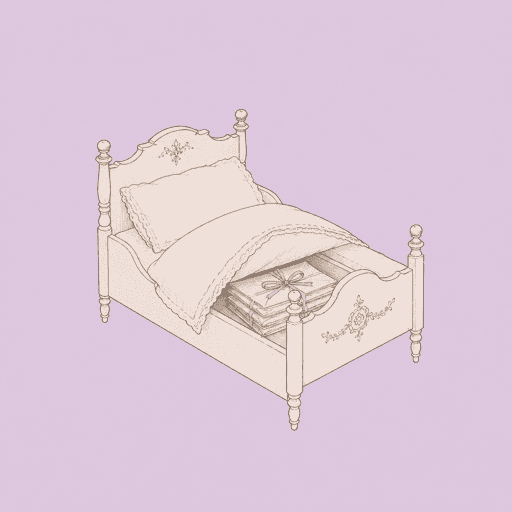
In the dusty room, a poem by LaMotte about a doll keeping secrets inspires Maud to search a doll’s bed. She discovers a hidden compartment containing a linen-wrapped package. Inside are two bundles of letters. They comprise the entire, previously undiscovered correspondence between Ash and LaMotte.
Sir George takes possession of the letters and allows his wife to read the first letter from each bundle aloud: Ash’s polite initial note requesting to call on LaMotte, and Christabel’s witty reply accepting correspondence. Lady Bailey then reads the final letters, which show the relationship ended by Christabel’s decision, with Ash’s last letter sorrowful but respectful greeting: Go in peace. Write well” (99). Sir George refuses to let Roland and Maud read any more, stating he must seek his lawyer’s advice on what to do with them. As they drive back to Lincoln, Roland and Maud make a pact to keep their discovery a secret and work together to gain access to the letters.
Chapters 1-5 Analysis
Roland Michell’s encounter with Randolph Henry Ash’s secret letters frames the novel’s central quest as an archaeological act of excavation. The book in which the letters are hidden is in itself an artifact, “thick and black and covered with dust,” and bound with “dirty white tape” (3). When opened, it springs apart “like a box, disgorging leaf after leaf of faded paper” (5), suggesting a tomb being unsealed. When Roland subsequently steals the draft letters from the book, he is intuitively responding to the “living words” he cannot bear to reinter in the archive. This private act of taking the letters into his possession is immediately contrasted with the professionalized, competitive ownership of his superiors. Professor Blackadder’s primary concern is protecting any new discoveries from his American rival, Mortimer Cropper, framing historical knowledge as a resource to be hoarded or plundered. Sir George Bailey later echoes this proprietary stance when he confiscates the discovered letters, declaring he must “take advice” before allowing access. This dynamic introduces the theme of Possession as Academic Exploitation, in which the past is a territory to be claimed and controlled. Roland’s impulsive, emotional connection to the letters sets him apart from this world, positioning his quest as a search for intimate understanding rather than professional conquest.
The stark contrast between Roland’s dreary 1980s life with his partner, Val, and the intellectual vitality of the Victorian letters dramatizes a conflict between modern disillusionment and a Romantic faith in genuine connection. Val’s worldview is shaped by the grim, senseless realities she encounters in her “menial” jobs, like processing the records of a man stabbed to death on a business trip. Her cynical conclusion is that these horrors do not cohere into any meaningful story, and she dismisses Roland’s work as an irrelevant escape, telling him, “[F]orgive me if I don’t care what he wrote in his Vico” (24). Her perspective reflects the fragmented, anxious mood of an era whose academic theories, like deconstruction, questioned the stability of meaning and the existence of a unified self. In opposition, Ash’s letters burn with an urgent belief in shared understanding and “ferocious vitality,” representing a Victorian confidence in passion and intellect. For Roland, whose relationship with Val is strained and whose career is stalled under Blackadder’s supervision, the pursuit of this correspondence becomes a search for a more potent and coherent reality, showing The Triumph of Romance Over Modern Cynicism by offering a narrative of passion and purpose that the contemporary world lacks.
The novel’s structure, which weaves poems, diary entries, and fairy tales into the main narrative, argues that imaginative texts provide the most reliable maps for navigating the past. The opening epigraph, from Ash’s poem The Garden of Proserpina, describes the mythic theft of golden apples, framing Roland’s own act of theft as a heroic quest for a hidden treasure. This pattern continues as embedded literary texts repeatedly foreshadow or interpret the plot’s action. Roland reads Christabel LaMotte’s fairy tale “The Glass Coffin” the night before he and Maud discover the hidden letters at Seal Court, transforming the story into a prophetic guide for their real-world treasure hunt. This layered, intertextual method creates a “palimpsest” effect, mirroring the Victorian sense of history as a series of overlapping narratives that obscure an original truth. More importantly, it validates Roland and Maud’s intuitive approach to their research, suggesting that unlocking history requires both archival rigor and an imaginative empathy capable of reading the poetic truth concealed within the facts.
Through her witty, self-protective correspondence and her choice of literary subject, Christabel LaMotte emerges as a figure who uses her creative work to command her own space. When Ash requests a personal visit, she deflects him by offering a poem instead of “cucumber sandwiches” and comparing herself to a “self-satisfied Spider in the centre of her shining Web” (97). This metaphor portrays her secluded life as one of active, artistic control, a clear instance of Art as a Shield for Female Autonomy. This strategy of self-concealment is deepened by the Tale of Melusina motif. Fergus Wolff’s summary of the legend, which centers on a powerful fairy woman with a monstrous secret, whose true nature is tragically revealed by her husband’s forbidden gaze, establishes a framework for understanding the dangers of female self-revelation. By choosing Melusina for her epic poem, LaMotte engages with a story about the necessity and risk of a woman maintaining a private, powerful self that a patriarchal world cannot fully witness or accept. Her art is thus both a shield and a coded exploration of an identity too complex for her society to contain.
The discovery of the letters at Seal Court is staged as a symbolic unearthing, where literary intuition unlocks a secret that empirical research cannot. Maud finds the correspondence by interpreting LaMotte’s poem, “Dolly keeps a Secret” (92), as a literal treasure map pointing to a doll’s bed. The setting of this scene, a space of female childhood, domesticity, and secrets, reinforces the private nature of the history being uncovered. This scene gives concrete form to the symbol of the glass coffin, the fairy tale Roland reads the night before. In the story, a princess lies in a state of suspended animation, her vitality preserved but isolated from the world. The letters, wrapped “like a mummy” in linen and oiled silk (93), function similarly as a passionate life sealed away in time, awaiting the “key” of imaginative reading to release their story. The motif of letters and diaries as tangible links to the past culminates here, as the documents become the repository of a lost emotional reality, one that is immediately threatened by Sir George’s confiscation of the bundles, which reasserts a patriarchal authority over a powerful female narrative.

Get in-depth, chapter-by-chapter summaries and analysis from our literary experts.
- Grasp challenging concepts with clear, comprehensive explanations
- Revisit key plot points and ideas without rereading the book
- Share impressive insights in classes and book clubs