Possession
Possession
A modern alternative to SparkNotes and CliffsNotes, SuperSummary offers high-quality Study Guides with detailed chapter summaries and analysis of major themes, characters, and more.
Summaries & Analyses
Quizzes
NEWReading Tools
Games
Themes
Content Warning: This section of the guide includes discussion of death and gender discrimination.
Possession as Academic Exploitation
The very title of A. S. Byatt’s novel suggests a central tension between ownership and understanding, a conflict the narrative locates squarely in the world of modern literary scholarship. Through the competing ambitions of its academic characters, Possession argues that the scholarly pursuit of the past often devolves into a destructive form of intellectual appropriation, where historical figures are reduced to commodities and their lives mined for career-advancing data. This sterile, competitive form of “possession” is embodied most extremely by the American collector Mortimer Cropper, whose methods stand in sharp contrast to the empathetic, imaginative engagement that the novel ultimately champions. While Roland Michell’s quest begins with his own act of appropriation, his journey with Maud Bailey evolves into a different kind of relationship with the past, one that seeks connection rather than mere ownership.
The most rapacious form of academic possession is personified by Mortimer Cropper, a biographer who treats Randolph Henry Ash as a set of artifacts to be acquired for his collection. Cropper’s ambition is to physically own every object Ash touched, from his watch to the desk depicted in the Manet portrait, creating a sterile reconstruction in the Stant Collection. His philosophy is one of tangible ownership, a belief that he can possess history by holding it “in [his] hand” (112). This desire for physical control reaches its logical and grotesque conclusion in his plan to rob Ash’s grave. Driven by the need to acquire a box of letters Ellen Ash buried with her husband, Cropper is willing to commit an act of desecration, demonstrating that his obsession is focused on the hoarding of relics. For Cropper, the past is a finite resource to be captured, catalogued, and locked away under his exclusive control.
This possessive impulse, while perfected by Cropper, infects the entire academic enterprise. The field is defined by institutional rivalry, such as the competition between Professor Blackadder’s London-based “Ash Factory” and Cropper’s well-funded American collection. Blackadder is consumed by the fear that Cropper will spirit away manuscripts from the British Library, framing the pursuit of knowledge as a zero-sum territorial battle. This possessiveness extends to the realm of ideas, as scholars seek to “own” authors by fitting them into their preferred theoretical frameworks. Fergus Wolff sees the poets as material for a deconstructive paper, while Leonora Stern attempts to claim Christabel LaMotte for a specific feminist agenda. Even Roland Michell, the novel’s protagonist, begins his journey with an illicit act of possession: He steals Ash’s draft letters from the London Library, driven by a desire to have this discovery for himself. These actions show a scholarly world more interested in claiming ownership of texts, authors, and theories than in genuine understanding of their research subjects.
However, the novel proposes an alternative through the evolving quest of Roland and Maud. Though it begins with theft, their secret collaboration shifts from a professional hunt for evidence to an emotional and imaginative engagement with the human story of Ash and LaMotte. They are driven by a powerful “narrative curiosity” to learn what happened to the poets. Their journey becomes a dialogue with the past, rather than a dissection of it. Unlike Cropper, they seek to listen to the dead, instead of possessing them. This empathetic approach allows them to connect with the emotional reality of the poets’ lives, culminating in their own romance. In this way, the novel suggests that the only meaningful way to “possess” the past is to allow it to possess the reader, through an act of imaginative sympathy that transcends the cold acquisition of facts.
Art as a Shield for Female Autonomy
In a Victorian society that sought to confine women to the domestic sphere, Christabel LaMotte’s art is an essential realm for intellectual and emotional independence. A. S. Byatt portrays LaMotte’s creative life as a carefully constructed fortress, built from coded poetry, fairy tales, and repurposed myths, which serves to protect her inner world from patriarchal intrusion. This artistic sanctuary allows her to cultivate a rich intellectual life in private and to conceal radical acts of self-determination, including a passionate love affair and the birth of an illegitimate child. Through Christabel, the novel demonstrates how female artists used their work as a tool of self-preservation, creating a space of autonomy that was unavailable to them in the public world.
Christabel explicitly frames her secluded domestic life as a protective bastion essential to her creative work. In a letter to Randolph Ash, she describes her solitude as a “Treasure” and refers to her shared home with Blanche Glover as a “donjon” that keeps her “very safe” (152). This imagery of a medieval keep suggests a space that is both a prison and a sanctuary, reflecting the paradoxical position of the female artist. Within these walls, she is free from the societal expectations and intrusions that would stifle her work, though she is also isolated. Blanche Glover’s diary reinforces this sense of a threatened refuge, describing their home as a “small retreat” and imagining a “Prowler” circling its walls. This constant sense of being under siege emphasizes the necessity of the fortress Christabel has built, both physically in her home and metaphorically in her art.
Christabel’s poetry and tales are populated with powerful, self-sufficient, and often isolated female figures who serve as allegories for her own guarded existence. Her epic poem centers on the fairy Melusina, a mythical woman who is part serpent and requires the private space of her bath, where her husband must never see her. This secret, dual nature symbolizes a form of female power and identity that exists independently of male knowledge or control. Similarly, Christabel’s fairy tale “The Glass Coffin” tells of a beautiful princess preserved but untouchable within a sealed casket, an apt metaphor for the female artist who maintains her integrity through isolation. Through these figures, Christabel explores the conditions of her own autonomy, celebrating the power of female privacy while also acknowledging its inherent loneliness and vulnerability. Her art becomes the space where she can examine the complexities of her own bid for freedom.
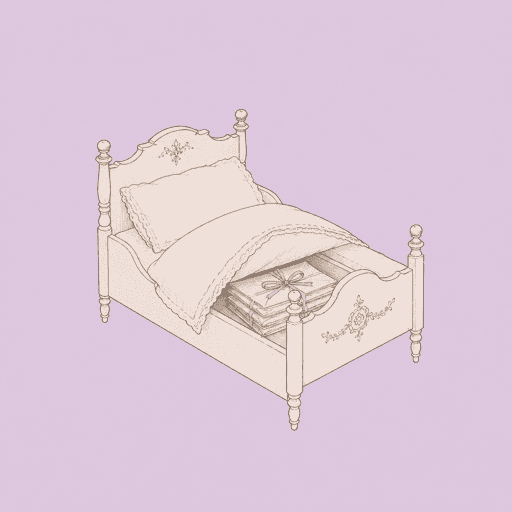
The use of art as a protective shield extends across generations, becoming a legacy of concealed female knowledge. The hiding place of the Ash-LaMotte correspondence is revealed to Maud Bailey through a poem, “Dolly keeps a Secret” (92). This poem, with its lines about a doll watching over the “shreds and relics / Of our lost Love” (92), acts as a direct clue, a map left by one woman for another. When Maud follows its instructions and discovers the letters hidden in a doll’s bed, the act confirms that Christabel’s art was more than just a personal defense; it was a deliberate act of communication intended for a future, sympathetic reader. This connection between the Victorian poet and the modern scholar affirms the power of women’s art to create a lineage of understanding outside of patriarchal history, ensuring that the secrets of female autonomy are preserved and passed on.
The Triumph of Romance Over Modern Cynicism
By subtitling her novel A Romance, A. S. Byatt issues a direct challenge to the detached cynicism of postmodern academic thought. Possession argues that the earnest emotional connections and coherent narratives associated with romance offer a more complete and humane way of understanding the world than the deconstructive analysis prevalent in contemporary literary theory. This argument unfolds through the journey of Roland Michell and Maud Bailey, two wary modern scholars who begin by studying a Victorian love affair and end by participating in one of their own. Their transformation suggests that embracing the passions and plots of a “romance” allows them to transcend the constricting skepticism of their training and achieve a deeper connection to the past, their work, and each other.
The novel draws a sharp contrast between the cynical, theory-driven analysis of most of its academics and the empathetic, narrative-focused quest that Roland and Maud undertake. Scholars like Fergus Wolff view literature as a system of codes to be dismantled for professional gain; he plans a paper on Melusina’s castle as a Lacanian symbol and sees Maud as a sexual conquest, reducing both art and people to objects for his own intellectual or physical gratification. In contrast, Roland and Maud become increasingly invested in the human story behind the poems and letters they discover. Driven by a simple, powerful desire to know “what happened next” (57), they pursue the narrative less as detached critics than as emotionally engaged readers. Their quest is motivated by a longing for the very narrative closure and romantic resolution that much of modern theory dismisses as naive.
The parallel structure of the novel, which interweaves the Victorian correspondence with Roland and Maud’s developing relationship, reinforces the idea that the past romance enables the modern one. The two scholars begin their journey as emotionally guarded individuals, described by one character as “chilly mortal[s].” Their interactions are formal, cautious, and defined by professional suspicion. However, as they immerse themselves in the passionate, vulnerable letters of Randolph Ash and Christabel LaMotte, their personal defenses begin to crumble. They move from a professional alliance to a secret, shared intimacy, culminating in their own love affair by the novel’s end. Their transformation suggests that engaging with the earnest emotions of the past provides a model for connection that was unavailable to them within the ironic, detached framework of their own time.
The novel’s conclusion ultimately validates romance by providing a final, moving resolution that lies beyond the reach of empirical research. After the scholars have gathered at Ash’s grave, having pieced together the story from the documents in the exhumed box, the narrative offers a “Postscript.” This final chapter depicts a scene the academics could never have discovered: Ash, on a walk, meeting his young daughter, May, in a field of wildflowers. This quiet moment of connection is a gift to the reader, a purely “romantic” closure that exists outside the historical record. In offering this imaginative truth, the novel affirms that some aspects of the past can only be accessed through empathy and storytelling, cementing its argument that a full engagement with history and life requires embracing the very passions that modern cynicism seeks to dismiss.

Unlock every key theme and why it matters
Get in-depth breakdowns of the book’s main ideas and how they connect and evolve.
- Explore how themes develop throughout the text
- Connect themes to characters, events, and symbols
- Support essays and discussions with thematic evidence