The Burning Side
The Burning Side
A modern alternative to SparkNotes and CliffsNotes, SuperSummary offers high-quality Study Guides with detailed chapter summaries and analysis of major themes, characters, and more.
Summaries & Analyses
Author Insights
Quizzes
NEWReading Tools
Sarah Damoff on The Burning Side
In her own words: quotes and insights from the author.Why she wrote it
A story that began beside someone else’s endingThe book’s origin is a specific year and a half of Damoff’s own life, not a general interest in marriage or aging. As newlyweds expecting their first child, she and her husband moved in with his grandparents so his grandfather could keep the household running while his grandmother was dying. That compression of life stages, a marriage just beginning and one in its final chapter, occupying the same house at the same time, became the structural DNA of the novel.
When my husband and I were newlyweds expecting our first child, we moved in with his grandparents to help care for his ailing grandmother. So our story began beside a couple whose story was ending. We became parents in a house with people who had a dozen grandchildren. I can’t overstate how taxing, heartbreaking, or profoundly beautiful that season was. The love of a young couple compared to the love of a couple who has weathered life together should almost have a different word or be in a different category.
Once she had the setup, she needed a mechanism to force the younger couple through the door at exactly the wrong moment in their marriage. The fire she chose for that purpose refused to stay merely functional. Then, mid-draft, the January 2025 Los Angeles wildfires happened and changed what the fire meant to her entirely.
At first, the fire was little more than a tool. I needed April and Leo to suddenly be forced into the parents’/in-laws’ home at a time when they were already at a breaking point. I wanted both the elder and younger couple to need each other. Once I started writing a house fire as the inciting incident, the metaphor was obvious. Also after I started writing, the January 2025 L.A. wildfires happened. I watched interviews with survivors and spent time really sitting with how utterly devastating it can be to lose a home, how much more a home is than a house. So what began as a device became more meaningful to me, and to the story as a whole.
At a Dallas author event, she described the relationship between her biography and her fiction. The claim is both a disclaimer and a creative principle: personal experience is the raw material, but it gets remade into something the character owns, not the author.
Nothing is exactly autobiographical, but everything is personal.
How she wrote it
Discovery first, architecture laterDamoff works without an outline, and she frames this not as a personality quirk but as a feature of how she reads the story into existence. The comparison to reading captures something specific: the drafting feels like suspense, not construction.
I’m a pantser for sure. I love hearing about people who write really intellectual mysteries, and they have to plot it all out. To me, that kind of brain is amazing. But I always describe my writing experience as like reading, but amplified, because I am sitting down thinking what’s going to happen next. And there’s a propulsion to that, like I’ve got to discover it.
The novel’s title holds a structural logic that Damoff built into the book’s architecture: the same object, looked at from opposite sides, tells completely different stories. In a YouTube conversation about the book, she explained how that physical detail of the house extends directly into what the marriage plot is doing.
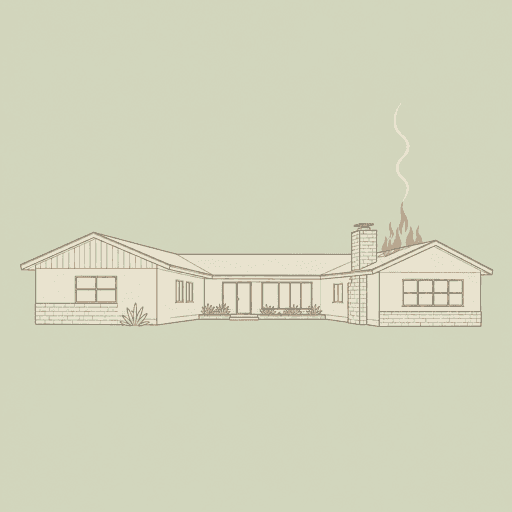
The Burning Side is a layered title... when you look at the house from one side, it doesn’t look damaged at all. And then when you look from the other side, it’s complete destruction. And so just taking that layer into the interior of what’s going on in their relationship... [paraphrased from audio]
Leo, the younger husband, resisted Damoff’s expectations throughout drafting. She had planned a parallel to April’s family story, but Leo’s family of origin arrived with more weight than she had anticipated and pulled the book somewhere she had not mapped. Her comment that he is the closest she has come to writing an autobiographical character is rooted in her own cross-cultural marriage, with very different economic and family histories on each side.
Leo’s story! When I started writing, I didn’t realize we would get to know his family of origin as much as we do. But through the drafting process I realized it would feel strange not to explore this given how well we get to know April’s family. While the details of Leo’s story are definitely not autobiographical, he’s the closest I’ve ever come to writing an autobiographical character.
Writing a second novel meant writing under conditions that did not exist for the first. The Bright Years, her debut, was written in private with no contract and no deadline. The Burning Side was sold on proposal, meaning her publisher was waiting for a specific book. The pressure that followed was largely something she created for herself.
I had sold ‘The Burning Side’ on proposal, which means my publisher was expecting it. I was on a deadline. That was different from my first experience.
The personal thread
Receiving the stories she set out to tellDamoff included an acknowledgment for caregivers at the back of the novel. Her own relationship with caregiving spans decades: raised by a disabled mother, a former foster parent, and the year and a half she spent alongside her husband’s dying grandmother. At the Dallas event where she spoke about emotional seeds, she described what happened after the book went out into the world.
To be a storyteller is to set myself up to be a story receiver.
Readers who had been through divorce found the book. Readers who had lost homes to fire found it. Some had experienced both on the same night. The acknowledgment she wrote for caregivers came back to her in the form of people who recognized themselves in it.
The multigenerational pattern in The Burning Side, where three generations share a house and each pair in that house changes because of the others, is not an experiment she ran once. It is the consistent preoccupation across her fiction, named plainly here.
I always include multigenerational dynamics in my books: how parents impact children, children impact parents, and grandparents change and are changed by grandchildren — all for better or worse.
What she wants us to sit with
Hard, and worth itDamoff resists writing toward a thesis. The book’s emotional argument arrived the way she says her best material always does: through the characters, not ahead of them. What emerged was a claim about love that she found she could not have planned.
I never start writing with an underlying theme or message, but rather let that reveal itself as the characters come to life. For this book, I think the heart of it is something like: Struggle is a necessary part of love, and how beautiful when someone can come to the end of that wild journey and say, ‘I would do it all again.’
When pressed by the Southern Review of Books to name the feeling she wanted the ending to leave, she answered in a single sentence. The compression is deliberate: she separates the difficulty from the verdict, and insists both are true at once.
I didn’t write for a message, but the feeling at the end is, this was and is hard, and I would do it again.
The house fire that opens the novel is also an argument about what a home actually is. When the physical containers of a family’s shared history burn, the loss is not logistical. Speaking to Texas Standard, she explained what material objects do that makes their destruction feel like something more than property damage.
Our material possessions are a gateway to memory. You know, anything we might touch or feel sensorially is evoking something in us — memory, identity. So material things mean more than just what they are, and a home is maybe the epitome of that.