This Inevitable Ruin
This Inevitable Ruin
A modern alternative to SparkNotes and CliffsNotes, SuperSummary offers high-quality Study Guides with detailed chapter summaries and analysis of major themes, characters, and more.
Summaries & Analyses
Author Insights
Quizzes
NEWReading Tools
Matt Dinniman on This Inevitable Ruin
In his own words: quotes and insights from the author.Why he wrote it
A promise he couldn’t breakThe ninth floor of the dungeon, called Faction Wars, had been gathering weight across several books before Dinniman finally had to write it. The floor’s complexity ruled out any compression, but what actually determined the book’s shape was a commitment he had made to readers before he knew what that commitment would cost him.
I also promised my readers very early on that I wasn’t going to split a floor. Like in Carl, they’re each there’s 18 floors and sometimes we’ll do more than one floor in a book, but I never like had them like floor nine for example is what book seven is. I wouldn’t want floor nine to encompass two different novels. So that’s kind of why the most recent book is pretty long. [paraphrased from audio]
When Dinniman wrote the first book, a genocide-as-game-show premise was a backdrop, not an argument. By Book 7, the story had accumulated a political architecture he never drafted.
When I first started writing it, I was writing a very simple straightforward story about a dude and his cat on an alien game show. I wasn’t anticipating such a complicated overarching political plot. As I started working and going on, that’s kind of what happened.
The overarching plot that emerged across seven books is the engine that makes the Faction Wars floor impossible to abbreviate. It demanded the room it got.
Before any of the political machinery existed, the series needed a second character who could survive next to Carl without being overshadowed. That character arrived not from story planning but from a weekend at a cat show in Cleveland, where Dinniman was still earning a living selling cat-themed art.
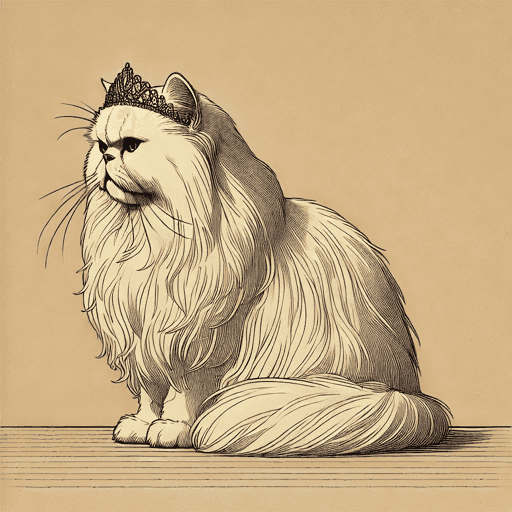
I was at a CFA cat show in Cleveland one year. I had a booth selling my cat-themed art, which is what I did for a living before I could write full time. There was a little, tortie Persian cat in a cage staring at me all weekend long. She appeared as if she hated me and wanted to rip my throat out. It was love at first sight.
How he wrote it
Two books, one spreadsheet, no outlineDinniman finished This Inevitable Ruin while also writing Operation Bounce House, a standalone sci-fi novel set entirely outside the dungeon. He had to develop a way to hold two very different books in his head on the same day, and the solution was temporal: morning for one, afternoon for the other.
I was also coming up, up to the end of This Inevitable Ruin, which is Dungeon Crawler Carl book 7. And I was ended up writing both at the same time. Like I would work on This Inevitable Ruin in the morning, and then I would work on Operation Bounce House in the afternoon. [paraphrased from audio]
The result of refusing to split the Faction Wars floor was a manuscript that alarmed his publisher. Ace/Penguin Random House, which had acquired only print rights in an unusual deal, had to reckon with a physical object that strained standard distribution.
The most recent book, which is called This Inevitable Ruin is also 270,000 words long, which in book world, that’s really long. It’s about the length of three books. It’s longer than even the longest Harry Potter book, I believe. [paraphrased from audio]
Writing 270,000 words across seven books without an outline requires a memory system. Dinniman’s is a single Excel spreadsheet that has grown so large it has become its own liability.
I am a pantser, I make everything up as I go along, but I keep very, very careful track of everything behind me. I have an Excel sheet... right now it’s a 207 or 8 pages long, which if you know Excel, that’s a lot. That’s too big... I joke about this, but if I lose that thing, I’m just gonna kill everybody. [paraphrased from audio]
Alongside the spreadsheet, Patreon subscribers introduce genuine chaos into the plot through polls. The system lets readers vote on items or events that then enter the story. What began as audience engagement became a structural feature Dinniman can no longer fully control.
They always screw me over every single time by picking the most bizarre things.
The Dungeon Anarchist’s Cookbook, a recurring prop that grew into a narrative thread spanning multiple books, originated in exactly this way: a reader poll that Dinniman had no plan for.
On what the book is wrestling with
Corporate evil as cosmic horrorThe dungeon in the series is a televised game show broadcast across the galaxy, but Dinniman insists on a word that cuts through the entertainment framing. He used it directly when describing the premise to Goodreads.
99% of the Earth is killed in the first paragraph of the whole book, and the few survivors are struggling to make it out of the dungeon. I mean, it’s a genocide.
The entity administering that genocide in Book 7 is an AI, the system that manages every rule and trap of the dungeon. Dinniman is careful to place it in a hierarchy. The AI is a tool, not the hand holding it.
This particular AI in this book was one of the main antagonists of the story. It’s the entity that runs the entire dungeon that Carl is stuck in. And but it’s not the only antagonist. It’s been used as a tool by the true protagonist, which is the alien corporations that are running the crawl and the game. [paraphrased from audio]
Dinniman’s argument for why corporations make more frightening villains than individuals is not about scale but about self-perception. The horror comes from the mundanity of the motivation, not from any single agent’s cruelty.
A lot of times, the bad guys don’t consider themselves to be the bad guys. When it’s a corporation, it’s a lot more realistic. It’s not just one person. It’s the whole group of people smooshed together, all with a common goal, which is not to have the person above them fire them. They are just trying to make money, and they’re doing that by doing something not necessarily for the community’s best interest... corporate evil feels so inevitable, like realistic cosmic horror.
What he wants us to sit with
Horror with a thread of hopeDinniman has never described Dungeon Crawler Carl as a comedy with dark edges. His framing reverses that. The humor is a delivery mechanism for something more uncomfortable, and Book 7 is where that inversion becomes the hardest to miss.
I consider Carl a horror novel. [paraphrased from audio]
At 270,000 words, Faction Wars puts the system’s true purpose in front of readers for longer than any previous floor. Dinniman does not let that weight go unacknowledged. What he asks readers to hold alongside the horror is a quality that has threaded through all seven books.
a thread of hope throughout the entire series, which I think still persists to this day. [paraphrased from audio]