What We Did to Survive
What We Did to Survive
A modern alternative to SparkNotes and CliffsNotes, SuperSummary offers high-quality Study Guides with detailed chapter summaries and analysis of major themes, characters, and more.
Summaries & Analyses
Quizzes
NEWReading Tools
Important Quotes
Content Warning: This section of the guide includes discussion of illness, death, and cursing.
“You shouldn’t turn your back on the ocean. It’s as unpredictable as my sister.”
(Chapter 1, Page 12)
In this moment of dialogue, Jackson advises Hannah after a wave knocks her over. The simile comparing the ocean to Emmy foreshadows how both Emmy’s impulsiveness and the ocean’s power will become sources of danger. This line also presents the ocean as an unpredictable force rather than a passive setting, establishing its importance as an indifferent and powerful presence throughout the novel.
“It’s not a big deal…I don’t want to take anything else from you.”
(Chapter 2, Page 23)
After agreeing to chaperone the boat trip, Jackson directs this cryptic statement to Hannah. His line functions as a key piece of characterization, revealing a deep sense of guilt and hinting at a painful history between them. The statement’s ambiguity creates suspense and hints at a significant past event that Hannah is desperate to conceal, adding complexity to their strained relationship.
“With the cash I can make some much-needed repairs to my baby before our next adventure. […] She’s been a little neglected lately. When we get back to shore, she’s getting a spa day, let me tell ya.”
(Chapter 3, Page 39)
Captain Keith makes this admission about his boat, the Be-Yacht-Ch, to Hannah and Jackson. The direct statement that the boat is “neglected” and needs “much-needed repairs” is a crucial instance of foreshadowing, directly linking to the vessel’s eventual failure. This detail highlights the gap between the boat’s appealing appearance and its underlying vulnerabilities, reinforcing the novel’s recurring warning that danger often hides beneath reassuring surfaces.
“Getting stuck on a stretch of mainland between towns is a bit like washing up on a deserted island.”
(Chapter 4, Page 43)
While discussing the coastline, Keith makes this observation about the remote, inaccessible jungle terrain. This statement is a direct and ominous piece of foreshadowing that precisely predicts the characters’ eventual fate. It transforms the landscape from a tourist backdrop into a potential trap, establishing the high stakes of their journey and the brutal isolation that defines the novel’s survival arc.
“I don’t know how you got mixed up with him, but be careful. Nobody decent smiles while he hurts someone.”
(Chapter 5, Page 63)
After Ben breaks his nose, a bloodied Keith offers this warning to Hannah. Keith’s observation that Ben “smiles while he hurts someone” is a pivotal moment of characterization, providing the first external confirmation of Ben’s capacity for cruelty and violence. This dialogue validates Hannah’s unease and directly supports the theme of The Dangers of Misplaced Trust by revealing the violent reality behind Ben’s charming facade.
“But I don’t take my eyes off Ben, and he only has eyes for the captain. One side of his mouth ticks up into a grin…and he very deliberately lets go of the wheel and throws himself back on the deck.”
(Chapter 5, Page 66)
Hannah’s narration captures the moment when Ben murders Keith. The detailed description of Ben’s actions—the grin, the “deliberate” release of the wheel—removes all ambiguity about his intent, establishing the act as cold-blooded murder rather than an accident. This sentence marks the novel’s central turning point, shifting the conflict from a mismanaged charter to a fight for survival against a human predator.
“A sailboat is almost impossible to flip. It’s designed that way. The keel will always right the boat—like it did just now.”
(Chapter 7, Page 84)
Ben offers this technical explanation to a panicked Emmy after a large wave nearly capsizes them. This statement is a powerful use of dramatic irony, as the boat’s keel is rusted and fails, leading to the capsize. Ben’s confident, reassuring tone here creates a false sense of security while foreshadowing the very disaster he claims is impossible.
“I’m not about to sail myself straight back to a murder charge […] I couldn’t risk that battery blinking on long enough for you to call for help. Not before I’m positive you’ll keep your fucking mouths shut.”
(Chapter 8, Page 90)
In this moment of confrontation after being caught sabotaging the boat’s electronics, Ben’s dialogue marks a decisive turning point in his characterization. His admission reveals that his actions aren’t born from panic but from a calculated desire to control the narrative and evade responsibility for Keith’s death. This speech solidifies the theme of The Moral Ambiguity of Survival by showing his willingness to endanger everyone for his own freedom.
“He might have a point, you know. You hit your head on the deck pretty hard. Maybe you didn’t see what you think you saw.”
(Chapter 8, Page 96)
While speaking to Hannah, Emmy rationalizes Ben’s behavior, revealing the depth of her misplaced trust. This line of dialogue demonstrates her initial unwillingness to accept the severity of their situation, choosing to doubt her friend’s perception rather than confront Ben’s violent nature. Emmy’s statement directly illustrates the theme of The Dangers of Misplaced Trust, showing how charisma can obscure evident malice.
“I thought that was the last time I was going to see you. I can’t deal with you dying right in front of me, Hannah. I can’t.”
(Chapter 10, Page 113)
After Jackson pulls Hannah from the water where she was tangled in the sinking mast, his dialogue reveals the emotional stakes of their relationship. The repetition of “I can’t” underscores a vulnerability that contrasts with his typically composed demeanor. This raw emotional confession, prompted by a near-death experience, foreshadows his later explanation of their complicated history.
“We’re not letting you get away with murder, so you have a decision to make: Would you rather be arrested or eaten by whatever’s in there with you?”
(Chapter 12, Page 129)
While Ben is in the water, Jackson uses psychological manipulation to force a confession. He presents a false dilemma, leveraging Ben’s terror to regain control. This act demonstrates how survival pressures can push characters toward morally uncomfortable choices in their efforts to protect themselves and others.
“I figured he’d have more incentive to help us if he thought he still had someone on his side. He might let something helpful slip while he’s trying to convince me to untie him.”
(Chapter 13, Page 140)
Emmy reveals to Hannah that her apparent loyalty to Ben is a strategic deception. This admission marks a significant turning point for her character, subverting the perception that she’s naive and easily manipulated. Her plan shows how deception can become a survival strategy, showcasing her own form of resourcefulness.
“Out of everyone cheering you on that day, the only family you had there was your dad. Ninety percent of your support system is my family, and if something went wrong between us, you’d lose more than I would.”
(Chapter 14, Page 164)
Jackson explains to Hannah why he ended their burgeoning romance, revealing that his actions were rooted in a misguided attempt to protect her. This confession provides crucial backstory, reframing his previous coldness as a flawed decision based on the complex dynamics of their interconnected families. His rationale highlights the intense pressure he felt to preserve their delicate familial ecosystem.
“I deserve it more!”
(Chapter 15, Page 173)
In the midst of the second storm, Ben attempts to rip Hannah’s life vest from her. This exclamation is the stark culmination of his character arc, stripping away his charming facade to reveal a core of profound selfishness and entitlement. The statement crystallizes the novel’s exploration of unchecked privilege, directly engaging with the theme of The Moral Ambiguity of Survival.
“Hannah, I need you to get below before I lose my fucking mind. Do you understand? You’re getting out of this even if it kills me.”
(Chapter 15, Page 174)
As a colossal wave bears down on the boat, Jackson speaks these words to Hannah. The dialogue functions as irony and foreshadowing, as his determination to save her at his own expense becomes a literal reality. This moment of extreme peril defines Jackson’s character through his selfless love for Hannah. The phrase “even if it kills me” transforms from a common figure of speech into a grimly accurate prediction.
“I have the weirdest sensation of being outside my body. I’m staring at the boat and cataloging everything that’s wrong with it, but it feels like I’m watching myself bob in the water. Like it’s not happening to me.”
(Chapter 16, Page 177)
Hannah regains consciousness alone in the ocean, tied to the wrecked sailboat. This passage captures her detached, out-of-body perception in the aftermath of extreme trauma. Her internal narration, which separates her consciousness from her physical self, illustrates the mind’s attempt to cope with an overwhelming reality and establishes a precedent for the hallucinations she will later experience.
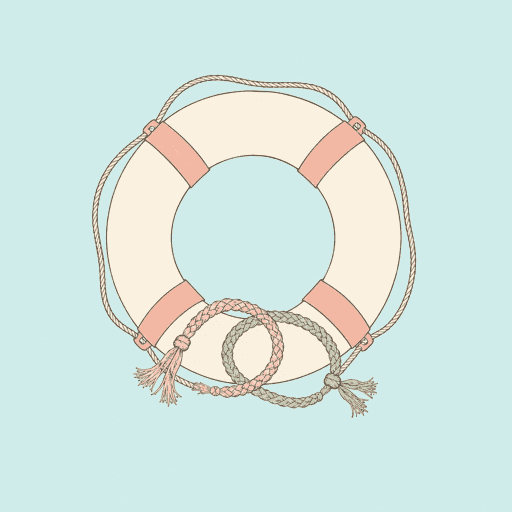
“I grabbed the nearest rope and tied you to a metal support as tightly as I could. I barely finished tying the knot when another wave hit, and the next thing I knew, I was in the ocean with that flotation ring.”
(Chapter 18, Page 195)
This quote is part of Jackson’s explanation to Hannah of how they survived the wave that washed them overboard. Spoken by what is later revealed to be a hallucination, the line serves as a crucial piece of internal narrative construction. It’s the story that Hannah’s traumatized mind creates to make sense of her own survival, offering an explanation before she’s able to confront the truth of what happened.
“My fingers curl into the hot sand, and I hang on like someone’s going to come along and drag me back to sea.”
(Chapter 20, Page 213)
After an exhausting swim, Hannah reaches the shore with Emmy while still believing that Jackson is beside them. This simile illustrates the lasting psychological trauma inflicted by their ordeal. The transition to land doesn’t bring immediate relief but rather a lingering fear, showing that the physical escape has not yet translated to a mental one. The action of clinging to the sand symbolizes her desperate need for stability after the chaos of the water.
“You don’t have to save her all by yourself, Hannah. You just have to keep her alive long enough for someone to find us. […] She needs you to get her to an emergency room, high-dose antibiotics, and IVs.”
(Chapter 20, Page 218)
As Hannah despairs over her inability to properly treat Emmy’s infected arm, the hallucinated Jackson offers this advice. His words help Hannah shift her focus from the impossible task of curing Emmy to the more manageable goal of keeping her alive until rescue. The speech reframes her objective from the impossible task of curing Emmy to the manageable one of stabilizing her, demonstrating how the version of Jackson she imagines provides the encouragement she needs to keep going.
“You’re doing it again. […] Saying the exact thing I want to hear.”
(Chapter 21, Page 222)
In this moment of dialogue between Hannah and what she believes is Jackson, irony foreshadows the novel’s central twist. The line operates on two levels: In this moment, it’s a romantic admission, but it takes on additional significance after the novel’s revelation, suggesting that the version of Jackson accompanying Hannah reflects the comfort and reassurance she most needs to survive. This moment underscores both her isolation and her determination to endure.
“Sounds more like Ben, a little voice in the back of my head whispers. But that’s impossible. He got washed overboard without a life vest. In the middle of a storm. […] There’s no way it could be him.”
(Chapter 23, Page 244)
Hannah’s internal monologue dismisses a moment of correct intuition, highlighting the tension between instinct and certainty. This use of foreshadowing builds suspense, as Hannah’s logic correctly identifies the perpetrator’s behavior but is overruled by her “certainty” of his death. This conflict between instinct and rationalization demonstrates how trauma can obscure the truth, making the eventual revelation of Ben’s survival more jarring.
“If you just quit for once in your life, you would all be dead. But you’re too fucking tenacious, so now I have to take matters into my own hands before someone sees your miles of fucking smoke.”
(Chapter 25, Page 253)
Ben delivers this line during his final confrontation with Hannah, revealing his motive for sabotaging the survivors’ camp. His words expose a ruthless self-interest that reframes Hannah’s resilience not as a virtue but as an obstacle to his own self-preservation. This monologue is a direct expression of the theme of The Moral Ambiguity of Survival, where Ben views the murder of three people as a necessary step to control his own narrative.
“You delusional little thing. Your dream boy isn’t here with you. I killed him on the boat.”
(Chapter 25, Page 259)
Ben’s statement is the novel’s climactic reveal, shattering Hannah’s understanding of her experience and recontextualizing her entire time on the island. The taunting tone is crafted to inflict maximum psychological harm, turning her source of strength into evidence of the trauma she has endured. This line functions as the ultimate betrayal, not only revealing Jackson’s death but also exposing the extent of Hannah’s reliance on an imagined version of him to survive.
“I see Jackson floating in the ocean, plain as day. […] Wearing the ‘Game of Holmes’ shirt that he never put back on after I used it to sop up the blood from Captain Keith’s broken nose. He was never here.”
(Chapter 26, Page 262)
This passage uses a concrete detail—a piece of clothing—to anchor Hannah’s devastating realization that Jackson was a hallucination. The memory of the shirt becomes the detail that finally forces Hannah to confront the truth about what happened after the storm. This sharp, visual memory represents the collapse of the explanation she has constructed for her survival, forcing her to confront the full scope of her solitude and loss in a single, visceral moment.
“I hold out my wrist, still wrapped in our frayed friendship bracelet, and she presses her matching one against it. ‘No boats.’”
(Epilogue, Page 272)
The novel closes on this image, highlighting the enduring bond between Hannah and Emmy after their shared ordeal. The final line, “No boats,” is a stark, simple declaration that encapsulates their trauma while also signaling a step toward recovery. This ending acknowledges that the experience will continue to affect them, but it also shows their determination to move forward together.

Unlock every key quote and its meaning
Get 25 quotes with page numbers and clear analysis to help you reference, write, and discuss with confidence.
- Cite quotes accurately with exact page numbers
- Understand what each quote really means
- Strengthen your analysis in essays or discussions