Breakneck: China's Quest to Engineer the Future
Breakneck: China's Quest to Engineer the Future
A modern alternative to SparkNotes and CliffsNotes, SuperSummary offers high-quality Study Guides with detailed chapter summaries and analysis of major themes, characters, and more.
Summaries & Analyses
Quizzes
NEWReading Tools
Games
Chapter 2Chapter Summaries & Analyses
Chapter 2 Summary: “Building Big”
Dan Wang opens this chapter by recounting a five-day, 400-mile bicycle journey he took through Guizhou province in southwestern China during summer 2021. Traveling with two friends, he cycled from Guangzhou to Chongqing and observed firsthand how even China’s poorest regions possess superior infrastructure compared to America’s wealthiest areas. This observation forms the foundation for his examination of China’s engineering state and its relentless commitment to constructing large-scale public works regardless of financial or human costs.
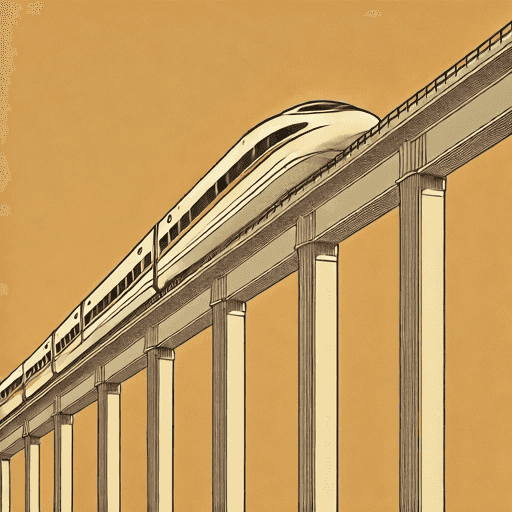
Guizhou serves as Wang’s primary case study. Historically one of China’s most impoverished and isolated provinces, characterized by rugged mountains and limited accessibility, Guizhou has been transformed through massive state investment. The central government constructed the world’s largest radio telescope there, developed major data centers in the capital city of Guiyang, and connected the province to the national high-speed rail network in 2016. Wang and his companions traveled from Shanghai to Guizhou in seven hours on comfortable high-speed trains, a journey that would have required weeks a century earlier. During their cycling expedition, they encountered newly built highways, spectacular bridges spanning deep gorges, and unexpected manufacturing centers, including Zheng’an County, which produces one in seven guitars manufactured worldwide.
Wang argues that China’s construction boom represents a compressed timeline of development, achieving in two decades what took the United States over a century. Since the 1990s, China has built highway systems twice the length of America’s interstate network, established subway systems in 51 cities, and created a high-speed rail network longer than the rest of the world combined. The country has also constructed massive housing stock to accommodate an urban population that has grown by an average of 16 million people annually since 1978. According to researcher Václav Smil, China produced nearly as much cement between 2018 and 2019 as the United States produced during the entire 20th century.
However, Wang emphasizes that this building frenzy comes with significant problems. Guizhou exemplifies both the benefits and costs of the engineering state. The province has accumulated massive debt, with infrastructure projects that generate insufficient revenue to justify their costs. Wang profiles Li Zaiyong, a party secretary in Liupanshui who authorized 23 tourism projects, including ski facilities in a region with minimal snowfall and replicas of European town squares. These vanity projects accumulated $21 billion in debt and failed to attract tourists, ultimately leading to Li’s arrest and death sentence by China’s Central Commission for Discipline Inspection.
China’s political system rewards construction because officials advance their careers by demonstrating economic growth in their jurisdictions. Since local governments primarily fund themselves through land sales rather than property taxes, officials have strong incentives to pursue glamorous infrastructure projects. Wang also examines Tianjin, a city near Beijing that built a financial district that now features mostly empty skyscrapers and a photogenic library with fake book spines on its shelves—a metaphor, Wang suggests, for impressive hardware that lacks meaningful substance.
Wang acknowledges that the engineering state incurs substantial costs beyond financial waste. Environmental damage has been severe, as China now burns more coal than the rest of the world combined. Large-scale construction has displaced millions of people, including targeted minority groups like Tibetans forced from high-altitude pastoral lands. Rushed construction has sometimes resulted in poor quality buildings, including schoolhouses that collapsed during the 2008 Sichuan earthquake, killing thousands of children. The state prioritizes monumental hardware projects over “softer” investments in healthcare and education in rural areas.
Despite these criticisms, Wang concludes by comparing China’s overbuilding problem with America’s underbuilding problem. China spent 13.5% of its GDP on infrastructure in 2016, while the United States averaged only 3% over the previous three decades (52). Wang argues that America’s permitting processes and legal challenges create paralysis. He suggests both countries would benefit from moving toward a middle ground, with China building less while America learns to build more, particularly for climate change mitigation.
Chapter 2 Analysis
Wang structures this chapter around the theme of The Engineering State versus the Lawyerly Society by using his bicycle journey through Guizhou as a narrative frame that reveals fundamental differences between Chinese and American approaches to development. The personal travelogue serves as an investigative method, allowing Wang to document infrastructure achievements while observing their consequences on the ground. By contrasting China’s poor provinces with America’s wealthy regions, Wang establishes that the comparison is not merely about national wealth but about institutional capacity and political will. The chapter synthesizes personal observation, economic data, and case studies to argue that both nations suffer from opposite problems: China builds too much too quickly, while America has largely stopped building at all. This framework positions the reader to understand Chinese infrastructure not as a model to replicate but as a mirror revealing American institutional paralysis.
The theme of Speed, Control, and Construction manifests through Wang’s analysis of how China’s political system enables rapid infrastructure development while creating perverse incentives. Wang demonstrates that officials like Li Xiaoyang advance their careers by demonstrating growth, leading them to pursue projects regardless of economic viability. The chapter details how China compressed more than a century of American construction into two decades, building highway systems twice the length of the interstate network and establishing the world’s longest high-speed rail system. However, Wang emphasizes that this speed comes at significant cost: environmental destruction, forced displacement of millions, and accumulating debt that threatens fiscal stability. The juxtaposition of achievement and consequence illustrates how centralized control enables both rapid construction and the ability to ignore local opposition, creating outcomes impossible in more democratic systems.
The theme of Rising Living Standards Amid Increasing Authoritarianism appears through Wang’s observation that infrastructure improvements generate genuine enthusiasm among Guizhou residents despite the political system’s coercive nature. Wang notes that people in Guizhou experienced material transformations—new bridges, highways, and rail connections—that created “an enthusiasm and an expectation for physical change, a feeling not often found among Americans today” (21). The chapter documents how the engineering state delivers tangible benefits like running water, mass transit, and modern amenities that residents can remember lacking in the recent past, creating a foundation for political legitimacy. However, Wang also details the authoritarian methods underlying these improvements, including the “thought work” process that achieves “‘voluntary’ resettlement rates of 100 percent” through a combination of inducements and threats (49). This duality illustrates how the Communist Party maintains power not through redistribution but through visible infrastructure that demonstrates state capacity while suppressing dissent through institutions like the Central Commission for Discipline Inspection.

Get in-depth, chapter-by-chapter summaries and analysis from our literary experts.
- Grasp challenging concepts with clear, comprehensive explanations
- Revisit key plot points and ideas without rereading the book
- Share impressive insights in classes and book clubs