Breakneck: China's Quest to Engineer the Future
Breakneck: China's Quest to Engineer the Future
A modern alternative to SparkNotes and CliffsNotes, SuperSummary offers high-quality Study Guides with detailed chapter summaries and analysis of major themes, characters, and more.
Summaries & Analyses
Quizzes
NEWReading Tools
Games
Summary and Study Guide
Overview
Breakneck: China’s Quest to Engineer the Future is a work of political economy and comparative analysis by Dan Wang, a technology analyst and writer specializing in Chinese industrial policy and US–China relations. Wang brings unique expertise to his subject, having worked for six years at Gavekal Dragonomics, an investment research firm, where he analyzed China’s technological developments and political economy for hedge funds and institutional investors. During this period, he lived in Hong Kong, Beijing, and Shanghai, experiencing firsthand Xi Jinping’s mobilization for great power competition, escalating US technological restrictions on China, and the three-year zero-COVID policy. Published at a moment of heightened geopolitical tension between the world’s two largest economies, Breakneck offers a framework for understanding the 21st-century superpower competition through the lens of professional culture and governance philosophy. Wang argues that the fundamental contest between the United States and China can be understood as a clash between a Chinese “engineering state” that excels at rapid construction and a American “lawyerly society” that excels at procedural obstruction (xv). Through personal observation, economic analysis, and political commentary, Wang examines how China achieved rapid modernization through authoritarian means while the United States has grown increasingly unable to deliver public goods despite its democratic values.
This guide is based on the 2025 Kindle edition published by W.W. Norton & Company.
Content Warning: The source material and this guide include mentions of death by suicide.
Summary
Dan Wang’s Breakneck examines the competitive relationship between China and the United States through the lens of governance philosophies, arguing that China operates as an engineering state while America has become a lawyerly society. Wang, a Canadian who emigrated from China as a child and later worked as a technology analyst in China from 2017 to 2023, develops this framework based on his observations of both nations during a period of dramatic transformation.
Wang’s core argument distinguishes between China’s technocratic approach to governance and America’s procedural legal framework. China’s leadership consists predominantly of engineers—by 2002, all nine members of the Politburo Standing Committee had engineering backgrounds, including Xi Jinping, who studied chemical engineering at Tsinghua University. By contrast, American governance is dominated by lawyers, with five of the last ten presidents having attended law school and roughly half of Congress holding law degrees while only a handful studied science or engineering.
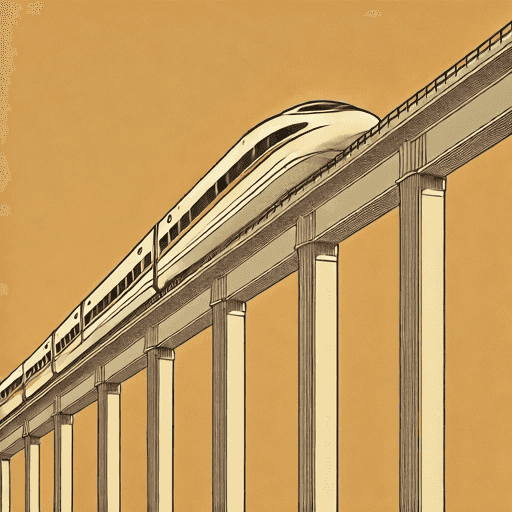
This fundamental difference produces starkly contrasting outcomes. Since 1980, China has built a highway system twice the length of America’s interstate network and a high-speed rail system 20 times more extensive than Japan’s. The country now produces between one-third and one-half of most manufactured goods globally. Wang illustrates the divergence with a comparison: In 2008, both California and China began planning approximately 800-mile high-speed rail lines. China completed its Beijing-Shanghai route in 2011 for $36 billion, transporting 1.35 billion passengers in its first decade. California has spent 17 years building only a small Central Valley segment, with costs now estimated at $128 billion and completion projected between 2030 and 2033.
Wang’s bicycle journey through Guizhou province in 2021 provides concrete evidence of China’s building capabilities. Historically one of China’s poorest regions, Guizhou has been transformed through massive state investment, including the world’s largest radio telescope and high-speed rail connections. However, the province exemplifies both the engineering state’s achievements and its severe problems. Local officials pursued vanity projects that accumulated $21 billion in debt without generating sufficient revenue. The political system rewards construction because officials advance their careers by demonstrating economic growth, and since local governments fund themselves primarily through land sales rather than property taxes, officials have strong incentives to pursue infrastructure projects regardless of financial viability. This has produced environmental devastation, displaced millions including targeted minority groups, and sometimes resulted in catastrophic failures like schoolhouses that collapsed during the 2008 Sichuan earthquake, killing thousands of children.
Wang traces how Shenzhen transformed from a fishing village of 300,000 residents in 1980 into the world’s premier electronics manufacturing hub. When Apple needed to mass-produce the iPhone after its 2007 announcement, Shenzhen’s ecosystem made it the natural choice. At Foxconn’s Shenzhen campus, which spans 500 acres, up to 300,000 workers operated in three eight-hour shifts at peak production times. This manufacturing intensity came at severe human costs—in 2010, over a dozen workers attempted suicide by jumping from factory dormitories, forcing Foxconn to install extensive safety netting. Wang emphasizes that Shenzhen’s success stems not from cheap labor but from dense concentrations of suppliers and skilled workers who create “communities of engineering practice.” He introduces the concept of “process knowledge”—practical expertise gained through hands-on manufacturing that cannot be easily communicated through blueprints (59). Chinese manufacturers progressed from contributing 4% of an iPhone’s value in 2007 to 25% by 2017. By offshoring manufacturing to China, American companies transferred this valuable knowledge, enabling Chinese firms to dominate solar panels, electric vehicles, and consumer drones. This knowledge transfer devastated American manufacturing, with employment collapsing from 17 million workers in 2000 to 11 million by 2010. American companies like Boeing, Intel, and Detroit automakers now struggle with quality issues and technological setbacks because they lost their communities of engineering practice.
Wang characterizes the one-child policy, implemented in 1980 and maintained for 35 years, as the engineering state’s most ambitious and damaging attempt at social control. The policy emerged after Deng Xiaoping’s government discovered China’s population had reached nearly one billion people. Song Jian, a missile scientist trained in cybernetics, applied mathematical control theory to demographic projections using flawed linear calculations that failed to account for natural fertility declines accompanying economic development. Enforcement was brutal—in 1983 alone, authorities sterilized 16 million women and performed 14 million abortions. Local officials used detention, fines, property seizure, and physical force to meet quotas. Women in their third trimester were subjected to forced abortions. The policy created approximately 40 million “missing” women due to sex-selective abortion and female infanticide, and over 150,000 children, mostly girls, were sent abroad for international adoption. Wang argues the policy was unnecessary, as China’s fertility rate had already declined from 6.0 children per woman in 1970 to 2.7 by 1980. Over the policy’s lifetime, China performed 321 million abortions and sterilized 134 million people. Now facing population collapse, Xi Jinping’s government attempts to reverse course through pro-natalist messaging, but decades of conditioning have proven difficult to undo.
Wang chronicles China’s three-year zero-COVID policy as a demonstration of both the engineering state’s capabilities and its severe limitations. Initially, during 2020 and 2021, life in Chinese cities felt relatively normal while much of the world struggled. Wang describes attending restaurants and cinemas in Shanghai and meeting his future wife during this period. The situation deteriorated dramatically in spring 2022 when the Omicron variant reached Shanghai. Despite official denials, authorities imposed a surprise quarantine on all 25 million residents that extended from eight days to eight weeks. Wang argues the government made no actual plans for confining millions of people, leading to systemic failures. Food supply chains collapsed, and residents experienced genuine hunger. Health workers in protective suits patrolled neighborhoods with drones broadcasting messages to “repress your soul’s yearning for freedom” (138). Authorities forcibly removed individuals who tested positive to massive quarantine facilities, separated parents from children, and killed pets. In December 2022, after protests erupted following deaths in an Urumqi fire where pandemic barricades prevented rescue efforts, the government abruptly abandoned zero-COVID with no explanation or transition planning. Wang estimates China experienced nearly two million excess deaths, though the government reported only 125,000.
The pandemic experience triggered mass emigration across all economic classes. Wang introduces the Chinese slang term “rún,” which emerged during the pandemic to describe fleeing both lockdown-heavy cities and China entirely. Nearly 14,000 millionaires left China in 2023 and over 15,000 in 2024, while less affluent Chinese took dangerous routes across the southwestern US border, with border officials apprehending 38,000 Chinese nationals in 2024, up from 450 in 2021. Wang spent time in Chiang Mai, Thailand, observing young Chinese emigrants who had initially moved to Yunnan province before relocating internationally. Through conversations with these emigrants, Wang learned that their decisions stemmed from a fundamental shift in worldview during Xi’s decade of rule. These educated urbanites had expected meaningful careers, expanding freedoms, and greater global integration. Instead, they experienced increasing political controls and pervasive feelings of catastrophe.
Wang reflects on his parents’ difficult choice to emigrate from China to the West in 2000. They arrived in Toronto during winter 2000, just as the dot-com bubble burst. His father struggled to find programming work while his mother took menial jobs as a janitor, garment worker, and massage therapist. Wang uses his parents’ story to critique America’s current paralysis in infrastructure development. He cites Biden administration projects that have produced minimal results: $42 billion allocated for rural broadband connected zero homes in four years, and $7.5 billion for electric vehicle charging stations produced only seven operational units in two years. New York’s subway construction costs five times more per kilometer than Paris. Wang argues this paralysis stems from excessive proceduralism and litigation that prioritizes process over outcomes.
Wang concludes that both China and the United States share transformational ideologies but express them differently. China’s top-down engineering approach achieves impressive physical results but suppresses human creativity and freedom through violent policy swings that leave citizens feeling unmoored. The Communist Party’s distrust of its own people restricts their potential for flourishing. America’s pluralistic values position it to find better solutions, but the country has abandoned its engineering heritage and lost faith in ambitious public projects. Wang argues that the ultimate competition between the superpowers depends not on factory output but on which system works better for its people. America must recover its building ethos to address climate change, housing shortages, and infrastructure decay while maintaining the pluralism that remains its greatest strength. Despite his criticisms of both systems, Wang expresses optimism that both nations can reform and improve their governance approaches, advocating for mutual curiosity as the best hedge against catastrophic conflict.

Get in-depth, chapter-by-chapter summaries and analysis from our literary experts.
- Grasp challenging concepts with clear, comprehensive explanations
- Revisit key plot points and ideas without rereading the book
- Share impressive insights in classes and book clubs