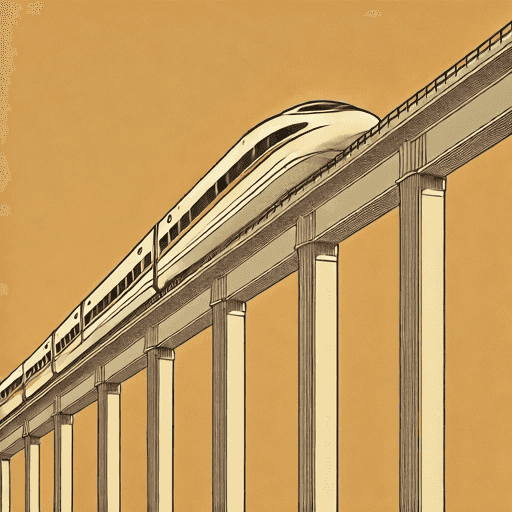
Breakneck: China's Quest to Engineer the Future
Breakneck: China's Quest to Engineer the Future
A modern alternative to SparkNotes and CliffsNotes, SuperSummary offers high-quality Study Guides with detailed chapter summaries and analysis of major themes, characters, and more.
Summaries & Analyses
Quizzes
NEWReading Tools
Games
Themes
The Engineering State versus the Lawyerly Society
In Breakneck, Dan Wang argues that the fundamental difference between China and the United States lies not in their economic systems or political ideologies, but in the professional orientations of their ruling elites: China operates as an engineering state that prioritizes building and production, while America functions as a lawyerly society that emphasizes process and litigation. Wang demonstrates this thesis through examining leadership composition, infrastructure development outcomes, and the systemic biases each approach creates.
The professional backgrounds of political leaders shape how each nation approaches governance and problem-solving. Wang documents that by 2002, all nine members of China’s Politburo Standing Committee had trained as engineers, including General Secretary Hu Jintao who studied hydraulic engineering and Xi Jinping who studied chemical engineering. By contrast, five of the last ten American presidents attended law school, at least half of Congress holds law degrees, and from 1984 to 2020, every Democratic presidential and vice presidential nominee went to law school. Only two American presidents worked as engineers—Herbert Hoover and Jimmy Carter—both remembered for their electoral defeats. This divergence creates fundamentally different governing philosophies: Engineers ask what can be built, while lawyers ask what procedures must be followed. The engineering mindset views society as a system to be optimized through technical interventions, whereas the legal mindset requires careful deliberation, stakeholder engagement, and judicial review before action.
The contrasting approaches produce dramatically different outcomes in infrastructure development. Wang presents the 2008 high-speed rail projects as definitive evidence: China completed its 800-mile Beijing-Shanghai line in three years for $36 billion, while California has spent 17 years building only a small segment with costs reaching $128 billion and completion projected between 2030 and 2033. Wang observes that “the margin of error for estimating when a partial leg of California’s high-speed rail will open is the same as the time it took China to build the entire Beijing-Shanghai line” (11). Since 1980, China has built highways twice the length of America’s system and a high-speed rail network twenty times more extensive than Japan’s. Meanwhile, America’s lawyerly society has created what Wang calls “proceduralism,” where agencies must conduct exhaustive studies and engage every stakeholder before taking even trivial actions, such as building a bike lane.
Each system creates distinct biases that advantage certain groups while disadvantaging others. China’s engineering state treats people as aggregates rather than individuals, making snap decisions with little regard for citizen input. This approach enabled both impressive achievements—running functional cities and spreading material benefits—and catastrophic policies like zero-COVID lockdowns. Conversely, America’s lawyerly society exhibits systematic bias toward the wealthy, as lawyers help homeowners block construction projects and navigate tax loopholes. The United States has 400 lawyers per 100,000 people, three times the European average. While New York’s wealthy can build high-rises, poor Americans struggle with dilapidated public transit and inadequate housing.
Wang’s framework illuminates how professional training shapes national trajectories in ways that traditional political labels obscure. The engineering state achieves material transformation at the cost of individual rights, while the lawyerly society protects procedural fairness at the cost of construction paralysis and elite capture. Understanding these nations as embodying different professional orientations provides insight into their competitive dynamics and internal challenges as both superpowers navigate the 21st century.
Speed, Control, and Construction
Wang examines how China’s authoritarian political structure enables unprecedented construction speed while creating systemic problems that threaten long-term sustainability. The tension between speed, control, and construction reveals the fundamental tradeoff at the heart of Chinese development: Centralized control allows the engineering state to build infrastructure at a pace impossible in democratic societies, but this same control generates perverse incentives that produce waste, environmental destruction, and unsustainable debt. Through his analysis of Guizhou province and other case studies, Wang demonstrates that speed and control are inseparable forces in Chinese development, creating both material progress and structural dysfunction.
China’s political system accelerates construction by eliminating the procedural obstacles that constrain democratic governments. Wang documents how China compressed centuries of American infrastructure investment into two decades, building highway systems twice the length of the interstate network and establishing the world’s longest high-speed rail system. This speed stems directly from centralized control: The Communist Party can allocate resources to strategic projects without navigating the legal challenges, environmental reviews, and community opposition that delay American construction. Wang contrasts this with the United States, where the Cape Wind offshore wind project faced sixteen years of lawsuits before abandonment, illustrating how democratic processes can paralyze infrastructure development. The engineering state’s ability to override local opposition and mobilize resources rapidly has delivered tangible improvements to millions of Chinese citizens, creating what Wang observes as “an enthusiasm and an expectation for physical change, a feeling not often found among Americans today” (21).
However, the same control mechanisms that enable rapid construction also create incentives for wasteful and destructive projects. Wang’s profile of Li Xiaoyang, the Liupanshui party secretary who built ski facilities in a region with minimal snowfall, demonstrates how officials pursue vanity projects to demonstrate growth and advance their careers. The political system rewards construction regardless of economic viability because the Communist Party evaluates officials based on their ability to stimulate growth while suppressing dissent. Since local governments fund themselves primarily through land sales rather than property taxes, officials have incentives to pursue glamorous infrastructure that can impress superiors in Beijing. This dynamic produces airports with fewer than a dozen weekly flights, libraries with fake book spines, and bridges that cannot generate revenue to recoup their costs, all financed through debt that threatens fiscal stability.
The relationship between speed, control, and construction ultimately reveals the limitations of authoritarian development models. While centralized control enables the rapid infrastructure necessary for climate change mitigation and economic modernization, it also generates environmental destruction, forced displacement, and financial instability. Wang’s analysis suggests that neither China’s overbuilding nor America’s underbuilding represents an optimal approach, and that both nations would benefit from learning from each other’s strengths while avoiding their respective excesses.
Rising Living Standards Amid Increasing Authoritarianism
Throughout Breakneck, Wang examines the paradox at the heart of contemporary China: The Communist Party has delivered unprecedented material prosperity to its citizens while simultaneously tightening political control and restricting individual freedoms. This tension between economic advancement and authoritarian governance challenges simplistic assessments of China’s development model and raises fundamental questions about what constitutes a successful society. Wang argues that while the engineering state has achieved remarkable improvements in living standards through infrastructure development and economic growth, these material gains cannot fully compensate for the psychological insecurity and political constraints that accompany life under authoritarian rule.
Wang’s family history illustrates how economic progress has unfolded alongside political repression across multiple generations. His grandparents endured Mao’s political campaigns despite coming from diverse backgrounds—merchant wealth, Nationalist connections, military service, and rural landholding—demonstrating that the Communist Party’s convulsions affected Chinese citizens regardless of their class origins. By the time Wang’s parents reached adulthood in the 1980s, Deng Xiaoping’s reforms had begun dismantling the planned economy, and they witnessed tangible improvements such as the gradual elimination of food ration coupons during their university years. However, the violent suppression of student protesters in 1989 shattered the optimism of that decade and reminded Chinese citizens that economic liberalization did not entail political freedom. This historical trajectory shows that material advancement in China has consistently occurred within an authoritarian framework that can reverse course at any moment.
The contrast between Wang’s parents and their classmates who remained in China reveals the complex trade-offs embedded in this paradox. Many of the classmates accumulated significant wealth through real estate appreciation and business ventures during China’s economic boom, achieving a level of material comfort that Wang’s parents never attained in suburban Philadelphia. Yet Wang notes that these prosperous Chinese citizens face constant anxieties about government interference, environmental hazards, and economic uncertainty. As Wang observes, “Chinese who have experienced the country’s blistering economic growth over the past four decades look to the past with pride and to the future with hope,” yet this optimism coexists with vulnerability to sudden shifts in Beijing’s policies (229). The classmates’ envy of Wang’s parents despite their superior financial position demonstrates that material prosperity alone cannot provide the sense of security and agency that characterizes a genuinely good life.
Wang’s treatment of this theme ultimately suggests that rising living standards under authoritarianism represent an unstable and incomplete form of development. While the engineering state can build infrastructure and generate economic growth, it cannot create the political conditions necessary for citizens to fully flourish. The material benefits that the Communist Party has delivered to the Chinese middle class have purchased consent and stability, but Wang implies that this arrangement remains fundamentally precarious. The question, Wang suggests, is not whether China has improved its citizens’ material conditions—the evidence is undeniable—but whether prosperity without political freedom constitutes genuine progress or merely a more comfortable form of constraint.

Unlock every key theme and why it matters
Get in-depth breakdowns of the book’s main ideas and how they connect and evolve.
- Explore how themes develop throughout the text
- Connect themes to characters, events, and symbols
- Support essays and discussions with thematic evidence