Open Throat
Open Throat
A modern alternative to SparkNotes and CliffsNotes, SuperSummary offers high-quality Study Guides with detailed chapter summaries and analysis of major themes, characters, and more.
Summaries & Analyses
Quizzes
NEWReading Tools
Character Analysis
Content Warning: This section of the guide includes discussion of animal cruelty and death, graphic violence, death, transgender discrimination.
Narrator/Heckit
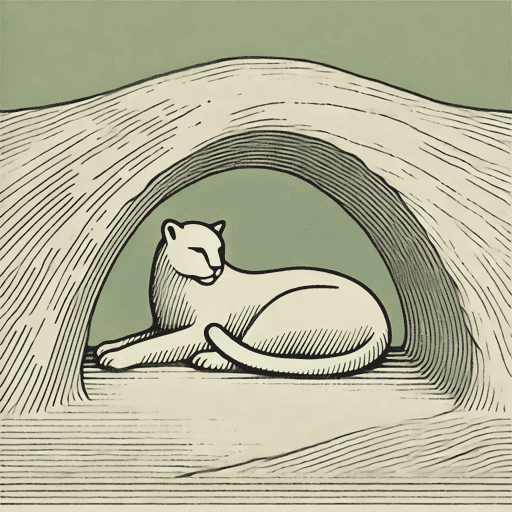
The narrator and protagonist of Open Throat is a mountain lion living underneath the Hollywood sign in Los Angeles. The narrator does not reveal a name at any point in the novel, though Little Slaughter does call the mountain lion “Heckit” (Hecate). Hecate refers to the Greek goddess of magic, witchcraft, and crossroads. Since Little Slaughter believes she summoned the narrator with witchcraft of her own, the name captures how she views the narrator.
The narrator struggles throughout Open Throat to find a place of belonging. Driven from the forest by a violent father, the narrator lurks around an unhoused encampment, believing that they live symbiotically with each other. When the man with the whip lights a fire, the narrator tries to save one of the people: “I leap on the young man and knock him to the ground on his back and I pound the fabric of his jacket where the fire is and knock it out and I grab his collar with my teeth and pull him away from the cardboard” (69). To the humans around them, it appears as though the narrator attacks the man, though in reality, the narrator seeks to put out the fire. The narrator’s actions reflect the desire to belong somewhere, refusing to give in to the desire to be a predator to humans.
The narrator is a dynamic character, whose experiences during and after the fire prove transformational. As Little Slaughter tries to flee with the narrator, the narrator sees the man with the whip, who lit the fire that drove the narrator from the park. After trying for so long to fit in with humans, the narrator decides to kill the man with the whip out of revenge, and in the confidence that it is the narrator’s own choice, rather than an unstoppable urge: “I can smell his blood on the pavement and I’m not at all hungry / this is not about need / no this is want / it’s a terrible choice but I’m making it / just like a person” (152). The narrator sees the man with the whip as a threat to the world, and though the narrator does not like the decision, takes pride in actually making it.
More than anything, this revelation demonstrates how the true transformation of the narrator lies in the narrator’s perception of humans. Despite many efforts to fit in through kindness, the narrator is only ever rejected. Now, by choosing to kill the man with the whip, the narrator feels more human than ever before.
Little Slaughter
Little Slaughter is the primary human character in Open Throat and acts as a guide to the narrator. She essentially adopts the narrator, becoming the first human to show kindness instead of fear for the first time in the narrator’s life. She gives the narrator a new kind of peace: “[M]y gaze meets hers and I don’t feel guilty for being seen / there’s not even a whiff of fear I summoned you says little slaughter/ and in our eyes it feels right / stay says little slaughter and I do” (98). Little Slaughter accepts the narrator, allowing the narrator to be themself. She not only guides the narrator through the human world, but also through the narrator’s own journey of discovery. The narrator, like many queer individuals, experiences the trauma of needing to hide their true self. With Little Slaughter, the narrator no longer feels guilty for being seen.
Though Little Slaughter acts as a catalyst for the narrator’s transformation, she experiences her own challenges, ones that the narrator cannot help her resolve. Little Slaughter, like the narrator, feels out of place. She is the daughter of the celebrity, Slaughter, and lives with him, his new wife, and their new baby. She feels abandoned and rejected, leading her to connect with the narrator so deeply. When she argues with slaughter, her discontent rises to the surface: “[Y]ou wanna have a baby dad fine yells little slaughter you wanna date a baby fine but I get a fucking baby too” (136). Little Slaughter no longer feels as though she belongs to a family, and wants to construct one for herself. In this way, she acts as a mirror to the narrator, as both are on journeys to find a place to belong and people to belong to.
The Man With the Whip
The man with the whip is the primary antagonist of Open Throat. Despite only appearing three times, this man’s actions deeply influence the narrator’s journey. His depravity reflects humanity’s abuse of the natural world and leads to the narrator’s outburst of violence.
When the narrator first sees the man with the whip, the narrator is wary, seeing the whip as a threat. The second time the man appears, he complains with a friend about the small community of unhoused people, and sets their tents on fire: “[T]he man with the whip turns and says shh and he goes to the pile of trash near the tents and he makes the fire and holds it against the trash and the trash becomes little bits of fire too” (67). In lighting the fire, the man with the whip endangers the lives of not only those in the encampment, but the narrator and the community around the park. The fire spreads rapidly because of the drought, driving the narrator out into the city. The carelessness and seeming lack of regret further solidifies the cruelty of people to the narrator.
In the final pages of Open Throat, the man with the whip becomes a symbol for the violence and cruelty of humanity, leading the narrator to violence. When the narrator sees the man with the whip, memories of the fire return, and the narrator focuses on the man’s hands. It is these hands that cracked the whip, and the hands that lit the fire. The narrator associates hands with violence, and since every human has hands, every human has such capability to inflict harm. The narrator attacks and kills the man, and upon looking at the corpse, sees something different: “I look down at the man with the whip who is now the man with no whip and no life / I look down at his open throat / his hands aren’t hands anymore they’re just useless hunks of white” (154).
The man’s death results in the threat of violence evaporating. Since the hands cannot move, the hands cannot hurt anyone or anything. The narrator no longer views the man as a person, but as an object, or a meal. It inverts the relationship between human and animal, with humans treating animals as though they are meant to be killed for humanity’s benefit. The narrator now believes that by killing the man with the whip, nature benefits.
Slaughter
Slaughter is the father of the Little Slaughter and yet another character who exemplifies the depravity of humanity. He and Little Slaughter struggle to coexist, and are often at odds, such as when he discovers the narrator.
While staying in the house, the narrator hears Slaughter often. In one conversation, the narrator hears Slaughter talking on the phone about the fire: “[S]laughter goes quiet and I hear the sound of a bottle hitting metal and then he says this is what happens when we let them just live up there and no one does anything about it” (96). Slaughter immediately blames the unhoused encampment in the park, thinking that there could be no other reason why there might be a fire. The narrator, who knows why the fire started, hears the same prejudice in Slaughter as he saw in the man with the whip. Slaughter’s sentiments also further exacerbate the narrator’s disapproval of Slaughter having so much space but not being willing to share it.
Kill Sharer
Kill Sharer is another mountain lion and a love interest to the narrator. When the narrator’s father attacks the narrator’s mother, the narrator flees toward the city and meets the Kill Sharer. At first, the narrator is unsure if the Kill Sharer will allow another mountain lion to share in his meal, and is surprised when he does: “I waited until he’d eaten a bite of intestine and then joined / my face buried in the deer and my eyes on him / when you meet a big cat who will share a kill you can’t let go of him easily” (61). The Kill Sharer acts as a foil to the narrator’s father, who attacked the narrator, seeing a threat. The Kill Sharer, however, invites the narrator in and the two form a bond. In the brief time the narrator knows the Kill Sharer, the narrator feels love, and when he later sees two men having sex, thinks of doing the same with the Kill Sharer.
Narrator’s Mother and Father
The narrator’s parents offer starkly different influences in the life of the narrator. While the mother is kind and nurturing, the father lurks in the distance, an ever-present threat. It is through interactions with both mother and father that the narrator learns how to form relationships. The narrator’s mother teaches the narrator kindness and survival skills: “[M]y mother could stay still for days and listen for the soft sounds prey makes / my mother was very kind / her bloodthirst was insatiable / she taught me how to snap a neck with my jaws” (33).
The narrator’s mother is a positive influence, while the narrator’s father is a threat. Through interactions with both, the narrator learns what it is like to be both predator and prey: “[M]y mother taught me to hunt but my father taught me to be hunted / after the attack he chased me toward the sunrise” (36). The fact that the narrator’s father hunted the narrator instills distrust within the narrator, making it difficult for the narrator to form bonds with others. This confusion in identity, between the hunted and the hunter, contributes to the narrator’s desire to belong.

Unlock analysis of every major character
Get a detailed breakdown of each character’s role, motivations, and development.
- Explore in-depth profiles for every important character
- Trace character arcs, turning points, and relationships
- Connect characters to key themes and plot points