Open Throat
Open Throat
A modern alternative to SparkNotes and CliffsNotes, SuperSummary offers high-quality Study Guides with detailed chapter summaries and analysis of major themes, characters, and more.
Summaries & Analyses
Quizzes
NEWReading Tools
Pages 3-44Chapter Summaries & Analyses
Content Warning: This section of the guide includes discussion of death, emotional abuse, and physical abuse.
Pages 3-44 Summary
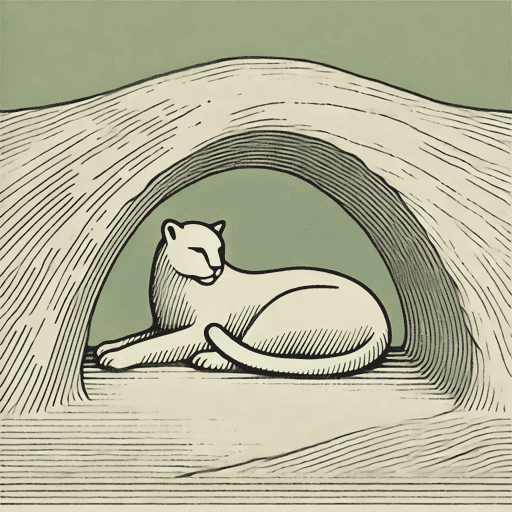
The narrator, a mountain lion living in a park in Los Angeles, wakes up in a bush. The narrator hears the crack of a whip: A man with a brown hat is swinging a whip at a man and woman. Though the narrator does not eat people, the hunger they feel may change that.
The man without the whip lies down on the ground, asking the man with the whip to hit him in the groin. The woman films it. The narrator does not understand humans, and this sight only deepens that confusion. The narrator looks toward the man with the whip, and sees a vein bulging from his neck. The narrator can smell the man’s blood. The hunger grows, and the narrator smacks their lips. The people hear the sound, but cannot see the narrator, who is camouflaged in the bush.
The man with the whip approaches the bush, getting close enough for the narrator to consider how best to attack him. The narrator thinks of how little food there is, and how long the man with the whip would last. The man with the whip leaves when the others suggest getting food. The narrator goes back to sleep.
When the narrator wakes up again, the final hikers of the day pass by. The narrator overhears two girls, one of whom complains that there is not enough time for her to do everything she wants. The other girl encourages her to get rid of her scarcity mentality. The narrator notices their water bottles and, feeling thirsty, goes to a nearby ravine to lick at puddles. The ravine was once filled with water, but now, in a drought, it is dry.
The narrator considers what the girls said about a scarcity mentality, and believes they have it. The narrator knows they live under the Hollywood sign in “ellay” [LA] and often hears hikers talking about the sign and the view. The narrator does not see what they see, only blurred shapes on the horizon.
When night begins to fall, the narrator leaves the ravine for the small town of four unhoused people. The narrator likes these people more than the hikers, and believes they all share a symbiotic relationship. The people’s trash attracts vermin, and the narrator eats the vermin. Though they often light fires at night, the drought keeps them from doing so, meaning the narrator can approach without fear. The narrator goes to their water pump and drinks from the puddle at its base before finding a bucket of chicken bones the people left out for them.
In the morning, the narrator travels back to their thicket, listening to the early morning hikers. The narrator falls asleep to the sound of a man on the phone, pleading that he can be a good listener. The next night, in the thicket, the narrator feels an earthquake hit. The narrator feels as though they are in water, and cannot stabilize themself. In a panic, the narrator leaves the thicket and finds a woman next to them. She does not see the narrator, talking in a panic on the phone. She rushes away.
The narrator returns to the cave, and is overjoyed to see that the earthquake disturbed the bats that live there. As they fly in a panic, the narrator leaps and grabs them from the air, enjoying a nice dinner. The narrator thinks of what the hikers say about earthquakes, and how it is best to be outside. The narrator is always outside. Despite this, the narrator feels lonely, as though something is missing in their life.
A stream of urine wakes the narrator. A man is peeing into the cave. When the narrator moves, the man sees their eyes, and flees in a panic. The narrator does not chase him, but instead pees over the man’s puddle and thinks of what it might feel like to hunt the man, the smell of the man’s fear lingering. The narrator finds the man’s phone and sees their reflection in it. The narrator pushes the phone toward the base of a nearby sign. The narrator cannot read, but learns what some signs mean by listening to hikers. Most pertain to fire danger.
Outside the cave, the narrator hears a helicopter and looks up. The narrator overhears hikers saying it is a medivac, and the narrator thinks of the injured person and their blood inside the helicopter. They picture blood raining down from the sky. When the narrator is hungry, blood always comes to mind.
The narrator finds a new thicket, and listens to passing hikers talk about their therapists. The narrator believes having a therapist would help them. When the narrator hears one woman complain about her parents, the narrator thinks of their own mother.
Before living in Los Angeles, the narrator lived in the forest with their mother and other mountain lions. Their mother was kind, and ferocious, teaching the narrator how to kill. The narrator’s father, however, always lurked in the distance, hostile. When the narrator grew up, they stayed with their mother instead of venturing off, like the other mountain lions. The father wanted more territory and attacked them, going after the mother first.
One hiker says that the best therapists are in New York and the narrator considers what it might be like to move there. The narrator wants to be in a place where no one will hate them, and thinks New York could be that place.
After the narrator’s father attacked their mother, he chased the narrator away toward Los Angeles and the highway the narrator calls “the long death” (37). The long death has impossibly fast cars going by on it, killing many animals.
The narrator often hears hikers complaining about how no one in Los Angeles has a real job. The narrator thinks of their own skills. The best skill the narrator offers is the ability to kill. As the hikers go by, the narrator sees a girl drop a green piece of paper. The narrator knows they are important, and goes to pick it up and bring it to the town, where they believe the people will make use of it.
It is night when the narrator reaches the town, and stops just outside of it after noticing a barking dog. Behind the dog, the narrator sees coyotes, and sneaks around them. The narrator kills one of the coyotes to send a warning to the others. They bring the coyote to the water pump, eat it, and drift off to sleep, dreaming of the man with the whip’s neck and its veins.
Pages 3-44 Analysis
In Open Throat, the narrator and protagonist is a mountain lion who observes the humans around them through a unique worldview. As an animal, the narrator looks out onto the world with a different knowledge and experience than a human narrator would. Henry Hoke uses this gap between animal and human understanding to explore the theme of The Disillusioning Nature of Human Society.
The narrator observes how people function by carefully noting their behavior and its apparent effects on themselves and others, such as how a weapon changes the confidence of a man: “[T]he whip makes the bulky man brave and he steps slow toward me and squints and leans in with his throbbing neck vein in full focus” (5). The narrator recognizes that the man feels bolder just because he is armed, enabling him to commit greater violence and implying that he desires domination over others. While this seems to suggest a power imbalance, the narrator’s preparations to attack the man prove that, despite the whip, the man is prey: “[M]y mouth opens and I judge the distance between the man and his skinny friends” (5). Though the man needs weapons to feel powerful, the narrator does not—with strength, speed, and a killing instinct, the narrator knows they can kill him. The strong dislike the narrator feels toward the man despite their usual policy of not killing humans foreshadows how the narrator will kill the man at the novel’s end.
Throughout the novel, the mountain lion is isolated and searching for a place to belong, introducing the theme of Forging Queer Identity Through a Desire to Belong. The narrator is rejected by their father and separated from their mother, forcing them to find a new home in Los Angeles. The narrator is also queer, with their struggles with isolation closely mirroring the experiences of queer folk who face rejection and hate from those who discriminate against them. As a queer individual, the narrator searches for a place to belong, in which they will not feel hated or feared.
At first, the narrator hopes to find this home with the people of a nearby unhoused encampment: “[T]hey may have made it through the earthquake and they may have tents to keep out the cold and the rain and they may have piles of trash but I want to contribute” (41). The narrator tries to help the people, believing that by “contribut[ing]” to their small town, they will accept the narrator as one of their own. The mountain lion therefore searches for found family, a common journey in the queer community, as queer folk search for others who understand and accept them, allowing them to be themselves.
Open Throat uses a stream-of-consciousness narrative to explore the life of the narrator. To create this sense of consciousness, the novel consists of extremely short paragraphs, each representing a single thought. This structure creates the sense of reading the narrator’s thoughts at the pace they think them. Some stretches are calm and observational, while others are hectic and reactionary. To add to this stream of consciousness, Hoke does not use any punctuation throughout the novel. The mountain lion does not use periods or commas while they think. This simulates stream of consciousness by allowing one thought to flow into the other, in an unending chain of events.
The style of the narration also helps to characterize the novel as one told through the eyes of an animal. The mountain lion’s thoughts often swing between what they see and their hunger and thirst, demonstrating how their natural instincts and need for survival are at the forefront of their mind. Additionally, the narrator’s inability to read is on full display, with words such as Los Angeles (LA) or Disney being phonetically spelled. By using “ellay” and “diznee,” Hoke demonstrates the narrator’s struggles to fully understand the human world around them.

Get in-depth, chapter-by-chapter summaries and analysis from our literary experts.
- Grasp challenging concepts with clear, comprehensive explanations
- Revisit key plot points and ideas without rereading the book
- Share impressive insights in classes and book clubs