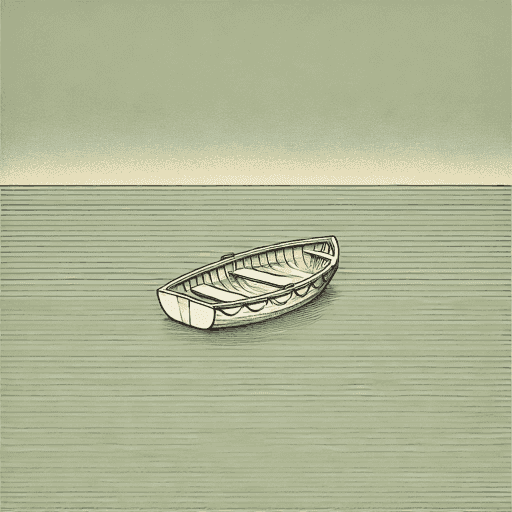
Small Boat
A modern alternative to SparkNotes and CliffsNotes, SuperSummary offers high-quality Study Guides with detailed chapter summaries and analysis of major themes, characters, and more.
Summaries & Analyses
Quizzes
NEWReading Tools
Part 3Chapter Summaries & Analyses
Content Warning: This section of the guide features discussion of death, child death, racism, physical abuse, emotional abuse, and suicidal ideation.
Part 3 Summary
The narrative returns to the narrator’s perspective. Some time after the disaster, the narrator is temporarily suspended from her job. Each morning, she runs along the beach near Boulogne while Léa sleeps. She sits on rocks, contemplating the sea. Speaking in her mind to the police investigator she is certain she will soon meet, who she imagines will look much like herself, she describes the sea as an ancient, untamable evil and imagines that the impoverished migrants who drown there are the sacrifices modernity must make to appease this evil. She recalls that Julien once theorized that all the world’s oceans are the remnant of the biblical Flood. The framing blurs between her morning runs and the Cherbourg interrogation, which she imagines or remembers as if it has already happened while simultaneously speculating that it will happen soon; she imagines or recalls the policewoman accusing her of self-pity and asking whether she sees the harm she has caused. The door of the interrogation room blows open in the wind, and instead of the street and the construction site opposite the police station, she sees only the sea. She speaks to the policewoman while brushing sand from her running shoes.
Later, walking on the beach, she shouts the recorded phrases into the wind, including her statement that the migrants will not be saved. She sees two figures approaching along the beach, taking them for the two survivors come to demand justice or to drown her. She recounts Eric’s phone calls accusing her of traumatizing Léa by discussing the disaster, and Léa’s fantasy that the young caller swam to a distant island and became king of its people. She considers an alternative image of the drowned walking along the seabed. She rejects turning herself in, reasoning that she has already conducted the interrogation in her head. She argues that everyone watches the disaster as spectators while she alone keeps watch. She enters the water. She becomes uncertain whether she said the phrase “you will not be saved” to the caller, or whether he said it to her.
Part 3 Analysis
Part 3 returns the narrator’s perspective, but now, instead of defending herself to the policewoman, she is alone with her thoughts. At times, she “seem[s] to remember” details from her conversation with the policewoman (80), but soon her narration of this encounter shifts from past tense to future, as she admits that she is not remembering something that has already happened but imagining what may happen soon. In the meantime, running along the beach near her house in Boulogne, she contemplates her obligations to others and the extent of her personal agency in confronting vast political and natural forces.
The scope of the narrator’s argument expands far beyond the limited terrain of law and protocol that comprised the limit of her reasoning in Part 1. Having seen the inadequacy of Bureaucracy as a Defense for Moral Failure, she now turns to fatalism. Citing her coworker, Julien, she suggests that the sea is evil, a malevolent force antithetical to life, humanity, and order. She uses the language of human sacrifice as a metaphor for the inequality that forces people into the sea in in leaky, overcrowded boats:
Every night we feed that gaping maw, and stuff into it little pieces we've scraped off the edges of the coast, spoonfuls of twenty, thirty poor people […] It's the sacrifice the world pours into the mouth of evil, what it has to give it, so everyone else can sleep in peace and it won't devour everything (83)
The metaphor treats these deaths as inevitable, “what [the world] has to give [the sea],” and the language of “spoonfuls” that must be “scraped off the edges of the coast” perpetuates The Dehumanization of Migrants. Still, by including herself in this “we,” the narrator at least partially acknowledges her culpability and her privilege as a member of the group whose peace is assured by the deaths of others.
The policewoman, confronting the narrator inside her mind, is now so intimately connected to the narrator that she can communicate without the need for words:
These mystical flights of fancy, her eyes seemed to say, are just another way of avoiding your responsibilities. Blaming the sea: the most infantile and absurd approach, the ultimate and most pathetic kind of buck-passing, the most desperate. (85)
The narrator knows what the policewoman is thinking because these thoughts are her own. As it becomes increasingly clear that the interrogation in Part 1 was imaginary, the narrator’s interactions with the policewoman are narrated in both past and future tense, blurring the line between memory and imagination. She is the narrator’s doppelganger, and she articulates what the narrator cannot face. In this instance, the novel allows them both to be right. The narrator cannot singlehandedly fix the global, systemic inequality that led to the migrants’ deaths, but she still had a moral obligation to do more than nothing.
While the policewoman indicts the narrator for her own, personal failures, the narrator turns that indictment on the public at large, highlighting The Complicity of Spectators. Standing at the water’s edge, she insists she is not alone on the shore: “there are all the others at my back, so many of them, thousands, millions of people. The entire world is there” (102). She names them on sofas, in deck chairs, in offices, “watching without watching” (102). Through her self-justification, the novel arrives at a social critique that extends beyond her. Those who accuse the narrator of monstrosity, she argues, do so to absolve themselves of blame, even as they continue to accept and benefit from the systems that forced those migrants into the sea at night.
The chapter closes on a note of uncertainty. Walking into the water, the narrator says she can no longer tell whether she said “You will not be saved” to the young man, or whether he said it to her: “I don’t know which way [the words] are going: from him to me or from me to him” (106). She imagines her own words coming back to her, but since she is not in physical danger, the meaning of the words changes: They refer not to her physical safety but to the spiritual salvation she dismissed as ridiculous in Part 1. The implication is that her soul will not be saved, and that neither she nor the community of spectators behind her will be saved from the moral trap in which they are caught, in which their comfortable lives depend on the suffering of others. In the narrator’s imagination, the words hover in the distance between herself and the caller, occupying both meanings at once.

Get in-depth, chapter-by-chapter summaries and analysis from our literary experts.
- Grasp challenging concepts with clear, comprehensive explanations
- Revisit key plot points and ideas without rereading the book
- Share impressive insights in classes and book clubs
Featured Collections
Books on Justice & Injustice
View Collection
Class
View Collection
Class
View Collection
Colonialism & Postcolonialism
View Collection
Good & Evil
View Collection
Guilt
View Collection
Immigrants & Refugees
View Collection
Politics & Government
View Collection
Safety & Danger
View Collection