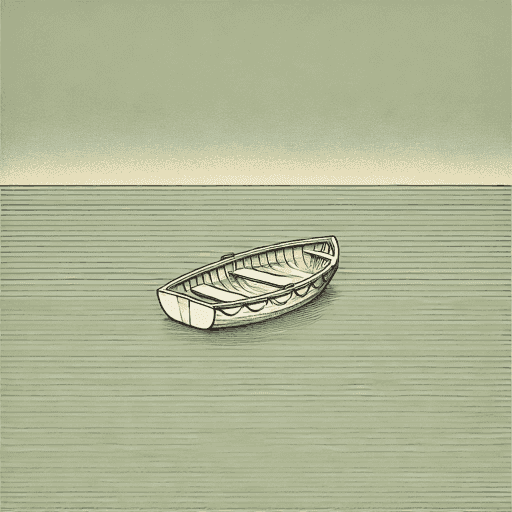
Small Boat
A modern alternative to SparkNotes and CliffsNotes, SuperSummary offers high-quality Study Guides with detailed chapter summaries and analysis of major themes, characters, and more.
Summaries & Analyses
Quizzes
NEWReading Tools
Symbols & Motifs
Content Warning: This section of the guide features discussion of death, child death, and racism.
The Small Boat
The deflating Zodiac is a symbol of human vulnerability and of the inadequacy of the systems designed to protect the most vulnerable people. Part 2’s account establishes that the boat is doomed before any wave or call: “obvious there were too many of them” (61), the outboard “low in the water, as though bogged down” (61), the deck already “sticky, damp with briny pools of water” (61-62). The disaster is built into the launch, not produced by a single later failure. When the tubes deflate and the floor begins to sink, the passengers’ efforts to redistribute weight only speed the collapse (66-67); the boat will not hold whatever is placed on it. By Part 3, the boat is the figure the narrator cannot keep contained inside her console. The narrator sees “little inflatable boats in her soup, tiny arms emerging from her soup” (81) at her own kitchen table, and refuses to hang a mobile in her daughter’s room because “I would have seen the French navy helicopter circling over my daughter’s bed” (82). The dinghy refuses to stay in the jurisdiction she assigned it. Léa’s bed becomes “a fragile nut shell” (79) by the same logic. The boat ends up standing for every instance of human vulnerability for which the narrator declines to recognize her share of responsibility.
The Sea
The sea moves from beloved childhood element to a hungry, malign presence pressing against every surface of the narrator’s life. She remembers loving it: “I was born here on the coast, with the sea in my eyes and my nostrils” (82). That love is now gone. “The sea consumes migrants all night long; it would consume everyone if the land didn’t do its best to resist” (83), she says. She describes the world feeding “spoonfuls of twenty, thirty poor people” into “the gaping maw” (83) so that everyone else can sleep, a kind of human sacrifice on a massive scale. Julien describes all the world’s oceans as “the remains of the Flood” (84) from the biblical book of Genesis, reigned over by Leviathan, a destructive entity older than God and destined to outlive God. On the narrator’s drive home from work, the sea is “always with [her] […] poisoned” (81), “glutted with women and children.” On the beach in Part 3, it becomes her interlocutor: She shouts her recorded phrases at the water and the sea answers, “Just come a few steps closer and I’ll have you” (89). The sea is the one listener that will not absolve her, and the only force in the book larger than the bureaucracy whose failures the investigation is trying to localize in her.
Cold and Darkness
Cold and night are the literal conditions of the crossing and the climate of the narrator’s thoughts. These conditions symbolize the emotional numbness that allows the narrator to justify her inaction. More broadly, they symbolize the collective apathy that allows Europe to respond to mass human suffering with bureaucracy and hardened borders. In Part 2, hypothermia disguises itself as peace: The passengers mistake their numbness “for calm and the subterranean, indestructible continuity of the vegetative state. In fact they were dying” (75). The same numbness reappears at the console. Pressed by the inspector to remember her state of mind that night, the narrator finds only “a kind of lethargy. An absence, a loss of consciousness, as though none of it was true” (44). The cold that kills the passengers and the lethargy that lets her say “you will not be saved” are the same condition in two locations.

Unlock the meaning behind every key symbol & motif
See how recurring imagery, objects, and ideas shape the narrative.
- Explore how the author builds meaning through symbolism
- Understand what symbols & motifs represent in the text
- Connect recurring ideas to themes, characters, and events
Featured Collections
Books on Justice & Injustice
View Collection
Class
View Collection
Class
View Collection
Colonialism & Postcolonialism
View Collection
Good & Evil
View Collection
Guilt
View Collection
Immigrants & Refugees
View Collection
Politics & Government
View Collection
Safety & Danger
View Collection