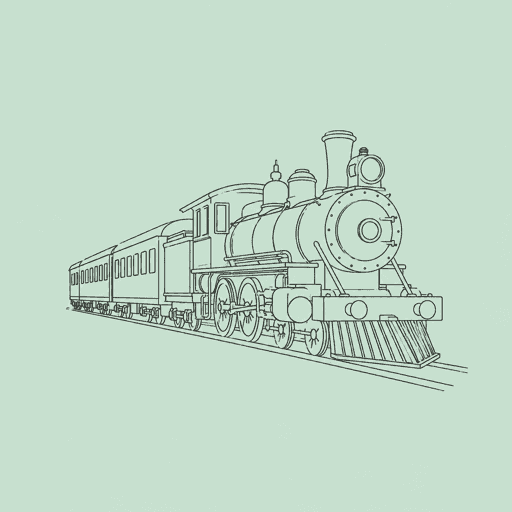
The Elsewhere Express: A Novel
The Elsewhere Express: A Novel
A modern alternative to SparkNotes and CliffsNotes, SuperSummary offers high-quality Study Guides with detailed chapter summaries and analysis of major themes, characters, and more.
Summaries & Analyses
Quizzes
NEWReading Tools
Part 1Chapter Summaries & Analyses
Content Warning: This section of the guide includes discussion of illness, death, death by suicide, and child abuse.
Part 1: “The First Leg: Everywhere”
Part 1, Chapter 1 Summary: “Welcome Aboard”
The novel opens with a welcome letter from the conductor of the Elsewhere Express. The letter thanks the new guest for choosing the train and expresses hope that their accommodations are satisfactory. It concludes with a warning that the crew is not responsible for any lost valuables, baggage, or souls.
Part 1, Chapter 2 Summary: “Meet the Passengers”
This chapter introduces the backstories of two main characters. Hiraya Sia was born prematurely and conceived as a “savior sibling” to provide bone marrow for her older brother, Jace, who had the blood disorder thalassemia major. Her name, Hiraya, is an ancient Tagalog word for the power to create, reflecting her parents’ desperate hope. In the neonatal intensive care unit, she heard a nurse humming a soothing lullaby—a song whose message the infant Hiraya absorbed as “Live. Breathe. Be” (9). Growing up, Hiraya wrote songs while her parents worried that she needed to find a more practical dream, like her brother, who planned to become an oncologist. All her songs aimed to convey the same message as the lullaby she heard as a newborn. Her parents forbade her from eating candy or “junk food” to keep her in optimal health in case Jace needed any further transplants. She felt that they viewed her as a collection of “spare parts” for Jace, but she shared a close bond with her brother, who often stole cookies from the pantry to share with her. Her purpose was shattered when Jace died.
Quentin Chen Philips Jr., who insists on being called “Q,” is a celebrated portraitist who’s losing his sight to a degenerative eye disease. When he was 13, his father died by suicide—a death that his mother, Connie, publicly claimed was an accident—leaving Q wary of the false smiles people wear. He’s haunted by having his father’s gray eyes and channels his anger and grief into his art. As his vision shrinks to a pinhole, he prepares for his final art show, an auction for blindness research. He’s left with one unfinished painting of a woman from a recurring dream, which is accompanied by a song containing the words, “Live. Breathe. Be” (14).
Part 1, Chapter 3 Summary: “Boarding: Where Do I Board the Elsewhere Express?”
Ten years after her brother Jace’s death, Hiraya now goes by Raya. She’s a 25-year-old medical student, pursuing what she feels is her brother’s dream, not her own. She feels purposeless and like “a wasted wish” (18). The narrative reveals that Jace became brain-dead after a drunk driver in a red pickup struck him—though this is explicitly only half of what happened that night, with Raya carrying a secret guilt about the rest. While on the subway, she reflects on a cadaver from her anatomy class whose peaceful expression unnerved her, making her contemplate a life lived with purpose.
Meanwhile, Q is at a metro-card top-up machine on a subway platform, struggling with his deteriorating vision. After a blue blur darts in front of him and trips over his walking stick, breaking it in two, Q is overcome with despair about his future blindness. In a fit of rage, he hurls his final, unfinished painting onto the train tracks.
Part 1, Chapter 4 Summary: “What Time Does the Elsewhere Express Depart?”
On the subway, Raya observes her fellow passengers lost in their daydreams. One man dreams of his ex-lover, Lily, while a student visualizes math formulas as glowing numbers on an oak tree. To quiet her own thoughts around the anniversary of Jace’s death, Raya puts on noise-canceling headphones. She smells a scent of rose and mint and suddenly sees the student’s daydream in her mind. Deciding to indulge the vision for a moment, she closes her eyes. When she opens them, the subway car has been replaced by an antique train carriage.
Part 1, Chapter 5 Summary: “Meet the Conductor: Who Is in Charge of the Train?”
In the antique train car, a woman in a neatly pressed, formal uniform introduces herself as Lily, the conductor. Lily has borrowed this appearance from the daydream of a man on Raya’s subway. Neither the name Lily nor the body she inhabits is her own. She adopts a new identity for each new passenger to make herself easier for them to relate to. Like all the crew, Lily was once a passenger like Raya, but she boarded the Elsewhere Express so long ago that she no longer remembers much of her former life. A panicked Raya believes that she’s hallucinating, but Lily calmly explains that she has simply “switched trains.” Lily states that the Elsewhere Express has no stops and boards passengers who have lost their purpose, becoming so emotionally light that they “float away” from their lives.
Part 1, Chapter 6 Summary: “Are the Elsewhere Express’s Tickets Refundable?”
Raya first assumes that she’s dead, but Lily clarifies that she simply drifted away from her life because she was “too light.” Insisting that a mistake has been made, Raya discovers a black train ticket in her notebook. The ticket bears her name and a shimmering, moving golden symbol called the eternal knot. When Raya crumples it, the ticket dissolves into her palm, leaving a tattoo-like mark of the knot. Lily shows an identical mark on her own hand, explaining that it prevents tickets from being lost. To demonstrate that the ordinary rules of reality don’t apply within the train, Lily makes an empty picture frame float in the air, revealing a moonlit meadow within it from which a live bird emerges.
Part 1, Chapter 7 Summary: “Where Are the Train’s Doors Located?”
Raya recognizes the scent of rose and mint from the meadow in the frame. Lily explains that the scenery is constructed from the daydreams of the passengers on Raya’s original train. Lily expands the frame into a doorway, and they step into the meadow, which Lily confirms is still part of the moving boarding car. She explains that the Elsewhere Express is a physical destination for the thoughts and daydreams of people in the real world. Raya is angered by the idea of the train being a “sanctuary,” insisting that she never asked to be rescued. Lily shows her how to use another frame to find the next door: a patch of glowing wildflowers. She explains that doors on the train can look like anything and are often hidden, requiring a frame or a special “ear for music” to find (42).
Part 1, Chapter 8 Summary: “Welcome Drinks at the Lotus Lounge: Is Alcohol Allowed on the Train?”
After passing through the wildflower door, Raya finds herself in the Lotus Lounge, a bar inside a giant lotus flower with a purple sky where sea creatures swim. There, they meet the bartender, Aki, who also has the eternal knot on his palm. When Lily reveals that her name and appearance are temporary for the evening, Raya accuses her of being a liar. The conversation is interrupted by a crash; a man has stumbled into the lounge. Lily calls him a stowaway, but Raya spots a sliver of black paper in the man’s coat pocket and points it out. The ticket bears his name—Quentin “Q” Philips—and Lily welcomes him aboard, noting that it’s the first time two passengers have boarded in one night. Q, believing that he’s in an elaborate dream, is unconcerned, but Raya insists that their situation is real and that they’re trapped. Lily returns with life vests and leads them to the next door: a rice wine kettle.
Part 1, Chapter 9 Summary: “Passenger Orientation on the Deck: Does the Train Have a Set Route?”
Raya and Q travel through the kettle and emerge onto the deck of a massive Chinese junk ship. The sky above is split between day and night. Lily explains that the train alters its form to suit its route and is currently following the “border between waking and dreaming” on silver tracks visible beneath the ocean (59). She reveals that the tracks lead nowhere and that the train itself is constructed from thoughts, such as a ship’s mast made from a list that a woman wrote of all the reasons for divorcing her husband. A large wave hits the ship, knocking Lily off her feet; separately, she apologizes for the Echoes, explaining that they grow restless when they sense passengers on the deck.
Part 1, Chapter 10 Summary: “How Much Baggage Am I Allowed to Bring?”
From the water, spectral faces with hollow eyes—the Echoes—emerge. Lily begins the orientation on the train’s baggage policy, stating that passengers cannot carry excess emotional baggage. The train’s pharmacist, Mr. Goh, has created a serum from a poem that erases unnecessary memories of a passenger’s former life. When Raya and Q both refuse the serum, Lily reveals that the Echoes are the ghosts of former passengers who wouldn’t let go of their baggage and consequently fell from the train.
Part 1, Chapter 11 Summary: “What Type of Accommodations Does the Elsewhere Express Provide?”
Q, recalling how grief hollowed out his mother after his father’s death, believes Lily’s story about the Echoes. Lily explains that passengers must find their own compartments without help. The eternal knot on their palms represents their bond to the train; if they’re weighed down by memories of the past, the knot will unravel, and they will fall. Q angrily asks why they can’t rescue the Echoes, but Lily states that lost tickets can’t be reissued. Finding their compartment will secure their place on the train, allowing them to take on a role among the other passengers. Lily then uses a frame to locate a door hidden within one of the ship’s sails, but lightning strikes the sail before anyone can proceed, sending it crumpling to the deck in flames.
Part 1, Chapter 12 Summary: “What Should I Do in the Event of an Emergency on the Elsewhere Express?”
A wave extinguishes the burning sail, but the door is gone. With the air growing heavy and sorrowful, Lily directs them to an emergency exit: the clay pot, used in the wrong direction—an unreliable passage that could lead anywhere. Raya refuses until Lily points out that the eternal knot on her palm is rapidly unraveling due to the weight of her baggage. Faced with the choice of taking the memory-erasing serum or risking the unknown door, Raya chooses the door. Already inside the pot, she realizes that she can’t allow the weight of Jace’s memory to drag her off the train and into the Echoes.
Part 1, Chapter 13 Summary: “What Type of Weather Should I Pack for?”
Alone on deck, Lily reflects that while maintenance can fix the burnt sail, they can’t fix “Train Rot”—a creeping decay that appears only when it rains and consumes the train’s thought-fabric. As her predecessor told her, it never rains on the Elsewhere Express. Just then, a torrential downpour begins. Lily understands that rain can only mean two things: There’s a dangerous presence on the train that must be washed away, and she has failed in her duty as the conductor.
Part 1 Analysis
These opening chapters, identified in the Part 1 subtitle as “The First Leg” of Raya’s journey, establish the novel’s allegorical premise and its fantastical setting. When Raya’s subway car transforms into an antique train carriage, the ordinary rules of the world are suspended, and she enters a world that operates by entirely different—though quite rigid and codified—rules of its own. This transition introduces the Elsewhere Express as a symbolic setting—a liminal space where the boundary between thought and reality dissolves. The conductor, Lily, explains that the train is a physical destination for disembodied daydreams; the boarding car’s decor, from a student’s oak tree comprised of glowing math formulas to an ex-lover’s imagined meadow, is literally constructed from these stray thoughts. The train operates outside conventional physics, traveling on silver tracks along the “border between waking and dreaming” and changing its form to suit the conceptual terrain (59), becoming first a bar inside a giant lotus and then a Chinese junk ship. This liminal setting externalizes the characters’ internal states. The train is an embodied psychological landscape where abstract concepts, like a woman’s reasons for divorce, manifest as concrete objects, like a ship’s mast. On the Elsewhere Express, the internal world is the only reality that matters, and emotional states have tangible, physical consequences.
The backstories of Raya and Q reveal that both characters arrive on the train already unmoored, a condition that lays the groundwork for the novel to explore The Importance of Self-Determination. Raya was conceived as a “savior sibling” for her brother, Jace, a medical reality that, in her view, reduced her existence to a function—a source of “spare parts.” Her name, Hiraya, meaning a “dream come true,” encodes this purpose, which is nullified by Jace’s death, leaving her feeling like a “wasted wish” (18). She sheds her old name for “Raya,” a first attempt to distance herself from her failed purpose. Similarly, Q’s identity is overshadowed by his father’s suicide. Named for his father, Quentin, he renames himself “Q” to spare his mother the pain of saying her late husband’s name. Both characters alter their names in a bid for control over an identity defined by trauma and loss. Their shared condition of purposelessness is what makes them “too light” to remain in their own lives, qualifying them for passage on the train. Both characters are defined by legacies they didn’t choose—one medical, one traumatic—and their journey begins from a place of negated identity.
The train’s fantastical nature is juxtaposed with its rigid, almost cruel bureaucracy, which is introduced through the chapter headings styled as frequently asked questions (FAQ), as well as Lily’s orientation. Though the train’s resort-like settings suggest a gentle healing retreat, Lily’s inflexible rules and threats of disaster should the rules be broken reframe the journey as a high-stakes process demanding compliance. The welcome letter’s warning about lost “souls,” the strict baggage policy, and the offer of a memory-erasing serum present a stark choice: Excise your past or be consumed by it. The spectral Echoes—hollowed-eyed faces of former passengers trapped in the water—offer a warning of what happens to anyone who fails to discard their “excess baggage.” The echoes are the first clear visualization of Unresolved Trauma as a Psychological Trap, though the train itself soon emerges as a trap for those who are unable to face their painful memories. While Lily portrays the echoes as passengers pulled overboard by the weight of their emotional “baggage” (a characterization that later proves false), her insistence that the past can simply be discarded keeps passengers trapped in a weightless, unreal world—a train that circles its tracks endlessly without purpose or destination.
The eternal knot that appears on each passenger’s hand is a visual motif representing physical manifestation of the passengers’ struggle with the past. When Raya’s ticket dissolves into her palm, it becomes a “living tattoo,” an embodied contract that can’t be discarded. This transformation from an external object into an internal part of the self signifies the all-encompassing nature of the journey; one doesn’t simply ride the Elsewhere Express but becomes part of it. The knot is a visible barometer of a passenger’s psychological state. Its constant, shimmering coiling suggests the ceaseless internal work required to maintain one’s place, while its unraveling on Raya’s hand provides a tangible sign of her unprocessed grief. Lily warns that heavy baggage will pull on the knot until it comes undone, causing the passenger to “tumble from” the train. This imagery literalizes the idea that clinging to the past can tear a person away from their present reality, leaving them adrift. The knot is both a lifeline and a liability, symbolizing the precarious connection between a person and their will to move forward.
The refrain “Live. Breathe. Be.” establishes an unconscious link between the protagonists and introduces Creative Expression as a Mechanism for Healing (9). This simple, three-word wish first appears in the lullaby sung to an infant Hiraya and recurs as the song that accompanies Q’s dreams of a mysterious woman. The phrase acts as an ironic counterpoint to their present states: Raya is on autopilot, trying to live out her brother’s dream, and Q’s rage at his impending blindness is the only thing that “ke[eps] [him] breathing” (13). At this stage, both have abandoned their art. Raya no longer writes the songs that once filled her purple notebooks, and Q, in a fit of despair, hurls his final painting onto the subway tracks. Their arrival on the Elsewhere Express coincides with the absolute nadir of their creative lives. The recurring song motif thus suggests a shared, unrealized potential for healing through the very outlets they have rejected. Their connection through this musical thread implies that their meeting is more than coincidence, framing their journey as a quest to reclaim their creative identities.

Get in-depth, chapter-by-chapter summaries and analysis from our literary experts.
- Grasp challenging concepts with clear, comprehensive explanations
- Revisit key plot points and ideas without rereading the book
- Share impressive insights in classes and book clubs