The Elsewhere Express: A Novel
The Elsewhere Express: A Novel
A modern alternative to SparkNotes and CliffsNotes, SuperSummary offers high-quality Study Guides with detailed chapter summaries and analysis of major themes, characters, and more.
Summaries & Analyses
Quizzes
NEWReading Tools
Symbols & Motifs
The Elsewhere Express
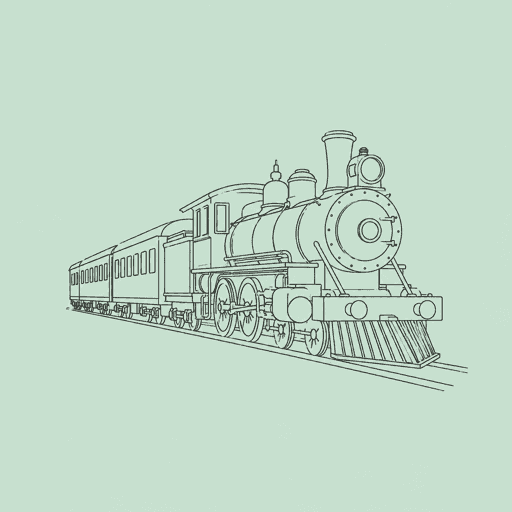
As is typical of allegory, the story’s main setting is a central symbol, in this case representing Unresolved Trauma as a Psychological Trap. It’s a destination for individuals who have become so unmoored by grief or a lack of direction that they have floated away from their lives. The conductor, Lily, explains that the train catches those who have become weightless, stating, “It might surprise you how little a person without purpose weighs” (32). This concept establishes the train not as a physical mode of transport but as a tangible manifestation of a psychological state. It literalizes the feeling of being adrift by placing characters in a self-contained world that travels in an endless, cyclical loop. The train offers a “second chance,” a new purpose found in its own maintenance, which directly connects to the theme of The Importance of Self-Determination. However, this new life comes at the cost of erasing one’s past, presenting a paradox where finding a future requires severing the connection to the self that arrived. The train is therefore both a sanctuary from the pain of the outside world and a gilded cage, a beautiful but static existence that challenges the very idea of progress and healing.
The Eternal Knot
The eternal knot is a recurring motif that represents each passenger’s fragile bond to the Elsewhere Express and the perilous weight of their past. Appearing on everything from uniforms to the architecture, its most significant form is the ticket that fuses with a passenger’s skin, a living tattoo that visually tracks their psychological state. The knot’s integrity is threatened by “excess baggage,” a metaphor for unprocessed grief, guilt, and memory. As Lily warns, “The knot will unravel if you forget what you’re searching for. It can happen slowly or fast, depending on the weight of the baggage pulling on it” (68). This makes the knot a powerful visual metaphor for the theme of Unresolved Guilt as a Psychological Trap, where the very memories that constitute a person’s identity become a force that threatens to tear them from their chance at a new life. The knot is more than a ticket; it’s a psychological barometer. Its gradual unraveling on Raya’s palm creates a constant source of tension, symbolizing the precarious balance between holding onto one’s identity and the necessity of letting go in order to survive in the train’s unique ecosystem.
Moths and the Stowaway
The stowaway, which often takes the form of a swarm of black moths, is a symbol of unprocessed guilt and self-destructive thoughts. The creature is a physical manifestation of an internal state, externalizing the novel’s central theme of Unresolved Guilt as a Psychological Trap. The stowaway’s origin is ultimately traced back to the first Raya (Lily), whose unresolved guilt over Q’s and Jace’s deaths gave it form. The new Raya eventually recognizes this darkness, telling Lily, “Your guilt conjured the first stowaway, Lily. That’s why only you and I could see its true face” (387). The moths represent thoughts that are corrosive and all-consuming, spreading rot and decay that threaten to destroy the train itself. This symbolizes how unaddressed trauma can poison and dismantle a person’s world from within. Q’s personal artistic motif of painting burnt moths further connects him to this symbolism, suggesting a shared, albeit different, struggle with grief and anger. The stowaway’s monstrous nature forces the characters to confront the ugliest parts of their own minds, demonstrating that true healing requires facing one’s inner demons rather than trying to outrun or erase them.
Songs
In the world of the Elsewhere Express, songs are a motif representing the restorative power of art and its connection to authentic identity. Songs manifest as winged, living creatures that are used by the maintenance crew to literally mend the train. As Dev explains, “The more hopeful the song, the healthier the leaf. The more tragic the song, the harder the seal. There isn’t a part of the Elsewhere Express that a song hasn’t touched up or repaired” (98). This magical element literalizes the theme of Creative Expression as a Mechanism for Healing, showing how art can physically restore what is broken and decaying. For Raya, whose identity was initially defined by her role as a “savior sibling,” her rediscovery of songwriting is central to The Importance of Self-Determination. The ability to create songs that can heal the train and even repair the crystal train gives her a purpose that’s intrinsically her own, separate from the one she was born to fulfill. The songs symbolize the life-giving, restorative power that comes from embracing one’s true creative self, offering a path to healing that’s deeper than simply erasing the past.

Unlock the meaning behind every key symbol & motif
See how recurring imagery, objects, and ideas shape the narrative.
- Explore how the author builds meaning through symbolism
- Understand what symbols & motifs represent in the text
- Connect recurring ideas to themes, characters, and events