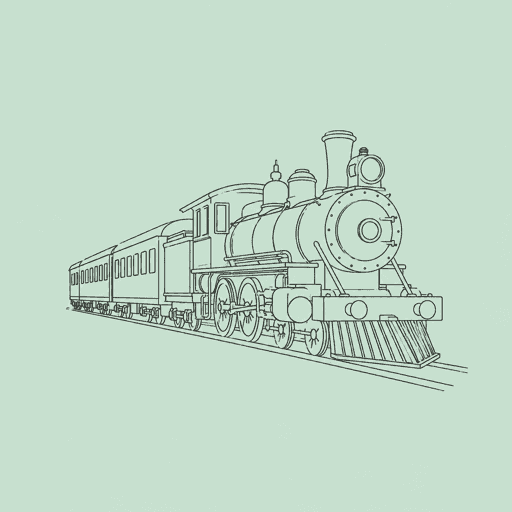
The Elsewhere Express: A Novel
The Elsewhere Express: A Novel
A modern alternative to SparkNotes and CliffsNotes, SuperSummary offers high-quality Study Guides with detailed chapter summaries and analysis of major themes, characters, and more.
Summaries & Analyses
Quizzes
NEWReading Tools
Parts 5-6Chapter Summaries & Analyses
Content Warning: This section of the guide includes discussion of illness and death.
Part 5: “The Fifth Leg: Here” - Part 6: “The Sixth Leg: A Detour”
Part 5, Chapter 62 Summary: “Eternity on the Elsewhere Express: Day One”
In her new, private compartment, Raya clutches a bottle of memory-erasing tonic. It’s still the “longest night” of her life, as the painters haven’t yet changed her ceiling from night to day. Deciding that Q deserves to be mourned, she throws the tonic away, resolving not to erase him yet. Rasmus visits and gives her a black envelope from Q. He admits that he tried to prevent Q from saving her, believing that Q was more deserving of a second chance. Raya states that Q brought the stowaway on board; Rasmus responds only that “it seems that way” (361). After Rasmus leaves, Raya refuses to open Q’s letter, choosing to keep his final words sealed to prolong their “conversation” indefinitely. She begins wandering the train to outrun her thoughts.
Part 5, Chapter 63 Summary: “Day Two”
Raya wakes up in a train car designed to look like the last page of a book, with only hazy memories of the previous night. Q’s letter tumbles from her lap. Inside, she finds a pencil sketch that he drew of her, depicting her with the scarf he gifted her. On the back, a note urges her to take the blue memory-erasing tonic but to hold on to her name and face. He signs it, “Your friend or something stranger, Q” (364).
Part 5, Chapter 64 Summary: “Day Five or Fifteen”
Raya has lost track of time and no longer knows how long she has been on the Elsewhere Express. She still hasn’t taken the blue serum that erases memories. She meets with Dev, the head of maintenance, and quickly accepts his job offer, desperate for a distraction from her obsessive thoughts about Q’s departure. Dev remarks that Raya looks familiar, claiming to have seen her during his own orientation long ago. To prove it, he takes her to his photo-covered compartment and shows her a picture of a woman with Raya’s exact face, lavender hair, and the scarf from Q. Dev says that the conductor isn’t in the photo but recalls that the conductor at the time was male presenting. He suggests that Raya ask Rasmus, who has a better memory.
Part 5, Chapter 65 Summary: “Passenger Manifest: The First Raya”
A passenger record reveals a past timeline in which Raya and Q discovered that the train had mistakenly assigned them the same compartment. Rasmus, then the conductor, arrived and told Raya that her journey ended there. Q threatened to use his dark thoughts to destroy the train unless Raya could stay. Rasmus explained that breaking the rule to let her stay would cause the passengers to doubt all rules, which would also shatter the train. To save everyone, Raya agreed to be escorted off the Elsewhere Express.
Part 5, Chapter 66 Summary: “Embroidery Lessons”
Raya learns from a passenger record that she and Q have boarded the train countless times, with each cycle ending in Q’s death. Rasmus reveals that in the very first timeline, Q begged to say goodbye at the back door; when Rasmus opened it, Q threw himself out. He explains that part of this record was intentionally cut out. Raya correctly deduces that the mysterious woman in Dev’s photograph was Lily, the current conductor, wearing her own face, which is identical to Raya’s. Rasmus confirms this and reveals that after Lily cut the record, he sewed the truth into the scarf himself, embroidering it as a song because he lacked enough thread for a knot. He gives Raya the choice to learn the full truth about the stowaway’s origin or to forget everything.
Part 5, Chapter 67 Summary: “Passenger Manifest: The First Raya (Continued)”
The continuation of the passenger record shows the immediate aftermath of Q’s jump. A devastated Raya—the first version of her, who would become Lily—received the key to the compartment from Rasmus. To help her cope, Rasmus gave her a vial of Mr. Goh’s memory-erasing serum. She drank it, but the single dose wasn’t enough to purge her immense grief and guilt over both Jace and Q. This powerful, unprocessed guilt manifested as a black moth, which took flight and became the first stowaway to terrorize the train.
Part 5, Chapter 68 Summary: “A Meeting With the Train Conductor”
Raya confronts Lily in her office, located inside a teapot. Lily, wearing her original face identical to Raya’s, admits that she’s the first Raya and has had this conversation with many previous versions of Raya. Raya rejects Lily’s long-held belief that Q brings the stowaway, revealing that the creature was born from Raya/Lily’s own guilt. As they argue, Lily’s reawakened guilt begins to form a new swarm of moths. To force Lily to face the full truth, Raya stabs a needle into Lily’s hand, carrying the complete record from the scarf. Overwhelmed by the restored memory, Lily decides to end the cycle by jumping from the train. Before taking the sake bottle and leaping, she tells Raya that the train cannot be without a conductor, effectively passing the role to her.
Part 5, Chapter 69 Summary: “Loudspeaker Announcement”
An announcement is made over the loudspeaker to the passengers of the Elsewhere Express. It officially informs them that the conductor has retired after years of outstanding service. The announcement wishes her well and assures passengers that a new conductor will be stepping into the role shortly, asking for their patience during the transition.
Part 5, Chapter 70 Summary: “Week Six or Month Six or Year Six”
An unknown amount of time later, Raya is serving as the new conductor. Rasmus has taken the memory-erasing tonic and believes a crafted story that Lily simply retired and chose Raya as her successor. He encourages Raya to take the tonic as well, but she wants to keep her memories. A new passenger boards: another version of Hiraya Sia. However, her ticket is actually an invitation to an art exhibit titled “HERE” by Q Chen Philips Jr. Later, in the private room of Q’s exhibit, Raya finds her own invitation in a nightstand drawer. Printed in small gold lettering on the back of the invitation are the words, “Raya. On the count of three. Jump” (397).
Part 5, Chapter 71 Summary: “Disembarkation: Six Weeks or Six Months or Six Years Ago”
From Q’s perspective, the narrative shows what happens immediately after he jumps from the train to save Raya. He lands on his feet, eyes shut, holding his broken walking stick, which tells him where and when he is. It’s the very night he first boarded. He realizes that he could choose to re-board the train and meet Raya all over again. However, knowing that his presence awakens Lily’s guilt and creates the stowaway, he chooses to break the cycle. To keep Raya and the train safe, he turns and walks away from the platform, sacrificing his chance to be with her.
Part 5, Chapter 72 Summary: “Live. Breathe. Be.”
Raya decides to leave the train. After leaving a song for Rasmus as an explanation, she uses a sake bottle as the train’s back door and jumps, landing in a subway car in the real world. She goes to Q’s art exhibit, an immersive installation that recreates the Elsewhere Express, with sections that must be navigated blindfolded to mimic Q’s experience of blindness. In a private final room designed like her train compartment, she finds a note and earphones. She listens to a recording from Q, who explains that he lost his sight but found a new way to create art. He reveals that he’s speaking from the past and won’t live long enough to complete the exhibit, which he has built in the hope that it will find her in the future. He wanted to meet her in the world outside the train, but their stations were too far apart in time. His final message urges her to live fully. Raya leaves a notebook of her songs behind in the room, allowing her art to join his.
Part 6, Chapter 73 Summary: “Is It Possible to Disembark From the Train at Any Point During the Journey?”
An excerpt from the “Elsewhere Express Passenger Handbook” addresses the question of disembarkation. It confirms that passengers can choose to leave the train at any time. However, it provides a stark warning: There are no guarantees that a passenger will arrive at their destination “on time, intact, or at all” (413). It also adds a note that a passenger is welcome to try jumping again if the train happens to pass through the same day twice.
Part 6, Chapter 74 Summary: “The Station”
In an alternate ending, Q lands on the station platform after his jump and is immediately greeted by Raya’s voice. She explains that she also jumped after receiving his invitation. She hands him a Braille invitation to his exhibit, which his hands don’t remember making. Realizing that they have both escaped the train’s cycles, Raya takes Q’s hand and leads him into a vast, sunlit train terminal. She places his hand over her heart and tells him that they have finally arrived at their stop, implying a shared, hopeful future together.
Parts 5-6 Analysis
The revelation that the first Raya’s unprocessed trauma physically manifested as a black moth reframes the novel’s central conflict, highlighting that on the Elsewhere Express, external phenomena always have internal origins. When a single dose of Mr. Goh’s serum proves insufficient to erase her grief from both Jace’s and Q’s deaths, her psychological burden becomes a literal monster, symbolizing the harm that can come from trying to forget painful memories without addressing them. This origin story for the stowaway externalizes the theme of Unresolved Trauma as a Psychological Trap, suggesting that trying to discard the past as “excess baggage” only traps a person in a cycle of suffering. The Elsewhere Express, as a liminal space where thoughts become tangible, provides the mechanism for this transformation. The moths and the stowaway aren’t an invading evil but a symbol of a wound that was buried rather than healed. Lily’s long-held belief that Q brings the stowaway is exposed as a defense mechanism, a projection of a battle she has been fighting with herself across countless timelines. The train’s circular journey mirrors the repetitive nature of her unresolved trauma, which is re-triggered with each new version of Q who boards.
Raya’s confrontation with Lily, her original self, becomes the critical moment of divergence that finally breaks the train’s deterministic loops. Lily embodies a fixed identity, one defined by her failure to save Q and her subsequent attempt to control the train to prevent further chaos. Her confession about the engine’s dancers—who “weren’t dancing. They were just trying not to fall” (389)—is a recognition of her own state; her role as conductor hasn’t been one of purpose but one of perpetual damage control. By forcing Lily to absorb the full, unedited memory from the scarf, Raya challenges this static identity and refuses to inherit it. This act highlights The Importance of Self-Determination. Where Lily accepted the conductorship as penance, Raya chooses to disembark entirely, rejecting the seductive trap of the train to instead pursue a full life in the real world. Lily’s final leap from the train echoes Q’s sacrifice, but Raya’s departure is an act of self-determination, a refusal to accept a role born of guilt and a clear break from the cycle that defined her predecessor.
Q’s art exhibit, “HERE,” demonstrates how creation can transcend the boundaries of grief, time, and disability. The installation, which recreates the Elsewhere Express with segments that must be navigated blindfolded in order to mimic Q’s experience with blindness, shows Q as an artist who has transformed his vision loss into a new, deeper sensory language. His recorded message explains this evolution: “When I had my eyes, I made pictures you could hang on walls. Without them, my paintings allowed you to walk through their world” (409). This illustrates Creative Expression as a Mechanism for Healing, as his art becomes a way to process his experiences and reach out to Raya from the past. The exhibit itself acts as a bridge—a tangible connection built from memory and hope that defies the finality of their separation. Raya’s final act of leaving her notebook of songs at the exhibit completes this artistic dialogue. The motif of songs, previously used as a tool to repair the physical train, now serves to unite their separate journeys, allowing their creative legacies to coexist in a world where they could not.
The novel’s conclusion dismantles the premise that the Elsewhere Express offers a viable solution to a life without purpose. Both Q’s choice to walk away from the platform and Raya’s decision to jump from the train are acts of agency that prioritize breaking a destructive cycle over finding solace within it. The Elsewhere Express is ultimately revealed to be a beautiful but unsustainable purgatory. Its seductive promise is articulated by Lily, who argues that it’s “better to have no destination than to be forced to get off at stations filled with disappointment and pain” (388). However, the narrative ultimately refutes this by showing that true progress requires leaving this liminal state. Q’s sacrifice isn’t just for Raya but to prevent the awakening of Lily’s guilt, a recognition that his presence perpetuates the cycle. Raya, in turn, understands that becoming the conductor only continues the story of her other self. Their separate departures are a rejection of the train’s core function: to trap its passengers in comforting but static thoughts.
The final chapters employ a fractured, multi-part structure to explore the consequences of breaking the story’s central loop, offering alternative resolutions rather than a single definitive ending. The primary narrative concludes in Chapter 72 with a bittersweet reality in which Q and Raya are separated by time but connected through their art. This is followed by a fictional handbook entry and then “The Station,” an alternate ending that offers a more traditionally romantic reunion. This structural choice subverts a linear conclusion, suggesting that the act of escaping the cycle is more significant than the specific outcome. The handbook’s warning that passengers may not arrive at their destination “on time, intact, or at all” frames disembarkation as an existential gamble (413). By presenting two different landings—one of artistic legacy and one of personal reunion—the narrative embraces ambiguity. Raya’s final line in the alternate ending, “I think it’s our stop” (416), signifies a definitive arrival, a stark contrast to the train’s endless journey and a fulfillment of the agency that both characters fought to claim.

Get in-depth, chapter-by-chapter summaries and analysis from our literary experts.
- Grasp challenging concepts with clear, comprehensive explanations
- Revisit key plot points and ideas without rereading the book
- Share impressive insights in classes and book clubs