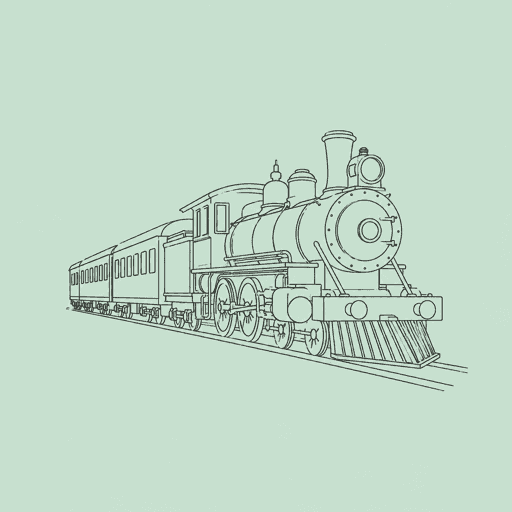
The Elsewhere Express: A Novel
The Elsewhere Express: A Novel
A modern alternative to SparkNotes and CliffsNotes, SuperSummary offers high-quality Study Guides with detailed chapter summaries and analysis of major themes, characters, and more.
Summaries & Analyses
Quizzes
NEWReading Tools
Part 3Chapter Summaries & Analyses
Content Warning: This section of the guide includes discussion of illness, death, and child abuse.
Part 3: “The Third Leg: Nowhere”
Part 3, Chapter 21 Summary: “Map Reading Tutorial at the Archive: Where Can I Borrow a Map of the Train?”
In the Stew, Lily and Rasmus report to Raya and Q that the serum only partially restored their memories; they recall the stowaway’s destruction of the Lake car but not how they defeated them. They don’t remember who the stowaway was or what they looked like, but Lily is certain that the stowaway has returned because of the feeling of “old sorrow” it creates—a feeling that Q and Raya confirm they also experienced on the deck.
Lily tasks Q and Raya with helping her and Rasmus hunt the creature. Raya angrily accuses Lily of choosing them because, as newcomers, they’re expendable. Rasmus tells them that they have no choice but to help if they want to survive. Lily instructs Rasmus to take them to the Archive first to get a map; from there, they will begin their search at the point between the art gallery and the opera house where she lost the stowaway’s trail.
Part 3, Chapter 22 Summary: “How Do I Use the Archive?”
Raya and Q enter the Archive, a vast, temple-like train car. Rasmus says that he has been acting the Archivist, a role that leaves him plenty of time to work on hobbies, including a miniature train set whose track mimics the pattern of the knot on the passengers’ hands. Noticing that the magical knot on Raya’s palm is unraveling, Q privately agrees with her suspicion that they’re expendable and urges her to focus on saving herself rather than hunting the stowaway. Rasmus shows them a notebook filled with Olly’s unsettling drawings as a cautionary tale about the danger of opening doors not marked on the train’s maps. Despite Q’s advice, Raya commits to helping, stating that she wants to be a person she can be proud of. Rasmus explains that they’re inside the Archive’s innermost sphere and uses a model of it to summon a giant jade dragon, which breathes the train’s map over them in the form of a mist. The Archive lends the map to Raya and Q in the form of a mist that they breathe in, allowing them to sense the train’s layout, though Rasmus notes that it won’t reveal itself to them until they’re ready for it. They’re now “tethered,” which means that they can feel each other’s emotions and share the map’s weight. If either of them dies, the person left holding the map alone will be crushed by it.
Part 3, Chapter 23 Summary: “Where Can I Catch a Tiny Train?”
Raya finds the gallery’s song by tracing the gossamer tracks with her fingertips, remembering the way she used to “hear” with her fingers as a guitarist, and they see the map before boarding a tiny crystal train built by Rasmus. The train’s interior resembles a playground, triggering a sadness in Raya that Q feels through the tether without understanding the reason for it. Raya explains that she was never allowed to play on playgrounds as a child: Her childhood was very restrictive because of her brother’s chronic illness.
Part 3, Chapter 24 Summary: “A Private Visit to the Gallery: What Happened to Olly?”
Raya and Q arrive at the Gallery car, where they meet the curator, Han, who explains that the car’s main feature is a fountain that rains upward and trades passengers’ secrets for gossip. Han reveals that she’s married to a different version of Rasmus, who’s also on the train, and warns them that Olly went missing in the Gallery. Her husband’s theory is that Olly accidentally exited through a locked door in his rush to leave the exhibit, and fear of a similar fate keeps other passengers away from it.
Part 3, Chapter 25 Summary: “What’s on Display at the Gallery?”
In the gallery, Raya and Q find an outdoor water garden but no sign of the stowaway. A watercolor portrait of Raya, titled with her full first name, “Hiraya,” appears in a lagoon. When Raya expresses her fear and refusal to have her secrets publicly displayed, the portrait becomes animate, grabs her, and drags her into the water. Q prepares to dive in to save her.
Part 3, Chapter 26 Summary: “How Deep Is the Gallery’s Reflection Pool?”
As Raya is pulled to the bottom of the lagoon, her secrets manifest around her as a labyrinth of underwater watercolor paintings depicting scenes from her life. Q reaches her, but a powerful current pulls them both into one of the paintings, trapping them inside a memory of her childhood bedroom.
Part 3, Chapter 27 Summary: “What Time Does the Gallery Close?”
Inside the painting, Raya is forced to relive the night of her brother Jace’s death. He was driving home to watch her first musical performance. She confesses her deep-seated guilt to Q, believing that she’s responsible for putting him on the road that night. When the memory becomes too painful, she smashes the painting with a guitar. The stowaway appears as a swarm of black moths. Q quickly paints an escape hatch on the ceiling, and they climb out into the real gallery. They use magical flares to signal Rasmus before approaching the stowaway in a pavilion, which collapses around them as they flee. They manage to escape in the crystal train, taking a random track away from the danger.
Part 3, Chapter 28 Summary: “How Do the Train’s Flares Work?”
This chapter recounts the backstory of Rasmus, the Elsewhere Express’s former conductor and current acting archivist, who has a history of dismantling things and abandoning relationships, including leaving his fiancée at the altar. Years after this event, he encountered his ex-fiancée on the train, but she had changed her face, and the train’s memory-erasing tonic meant that neither recognized the other. She’s now married to another man also named Rasmus, a more popular version known as “Han’s Rasmus” because his wife, Rasmus’s ex-fiancé, is named Han. The two Rasmuses are different versions of the same person. Han’s Rasmus is the train’s reigning Scrabble champion. Meanwhile, the Rasmus she nearly married in the past tracks down monsters and is called “Other Rasmus.” While inspecting the unique, thought-built opera house for rot, Rasmus reflects on his lonely duties and how the train runs on the passengers’ collective faith. His search concludes abruptly when he’s blinded by flares in his eye, which transmit a vision from Raya showing him lightning, rain, and the very rot he was seeking.
Part 3, Chapter 29 Summary: “Free Time: What Do I Do if I Damage Items I’ve Borrowed From the Archive?”
The crystal train derails and shatters, stranding Raya and Q in the Missed and Misplaced Department—a valley filled with lost objects, where Olly was once lost. They take shelter from a storm of falling items inside a tree house depicted in Olly’s notebook. Raya voices her suspicion that the train’s leadership isn’t as benevolent as it seems and may have abandoned Olly there deliberately. When they open a dresser drawer, a hidden mechanism transforms the small tree house into a massive, lopsided tower.
Part 3, Chapter 30 Summary: “Who Should I Call if a Pipe Leaks?
Rasmus is in the gallery, where a putrid smell is coming from what he identifies as a leaking pipe in the reflection pool. He’s looking for Han, who appears behind him, also reacting to the terrible scent. Upon seeing him, Han recognizes him as “Other Rasmus.” Rasmus urgently tells Han to leave, claiming that he has already called maintenance and will deal with the two guests still at the exhibit. As he tries to get her to go, Lily bursts in, stating that she received his message and has come to help.
Part 3, Chapter 31 Summary: “What Did Olly Write in His Notebook?”
Raya and Q explore the former treehouse and find Olly’s other notebooks. While examining his spiral drawings, they decipher a map legend for the valley, which is arranged in a giant spiral of lost objects. At its center is their only potential exit: a whirlpool.
Part 3, Chapter 32 Summary: “Why Aren’t Passengers Allowed to Go Outside?”
On the roof of the gallery car, Lily and Rasmus have arrived too late to catch the stowaway and are now trying to stop the spread of decay. While Rasmus lures the Echoes away from the coupling, Lily uses a torch to separate two connected metal figures representing a romantic couple separating in the world outside the train—the same decoupling method that Lily described in telling the story of the previous stowaway. She remembered how she had felt about tearing that previous pair apart, but this time, she’s more emotionally prepared. After she throws the torch, Rasmus screams. Lily turns to see that the Echoes have swarmed and overwhelmed him.
Part 3, Chapter 33 Summary: “Why Are Certain Doors on the Train Locked?”
As Raya and Q climb down from the treehouse, wedding rings rain down around them. Raya wonders why people attach their wedding vows to something so easily lost, but she reflects that no bond is unbreakable. Q spots Raya’s old guitar among the valley’s instruments and tries to persuade her to engage with it, but she doesn’t believe this one is hers, as hers is broken. Q suggests that the guitar exists here as she longs for it to be—restored to perfection. Near the whirlpool, Raya and Q meet a translucent being with Olly’s face. The being explains that it’s a collection of thoughts that the real Olly lost.
Part 3, Chapter 34 Summary: “Should I Be Afraid of the Echoes?”
After being blinded by a flare and slipping on the gallery car’s roof, Rasmus is swarmed by the Echoes. The creatures immediately begin consuming his memories, starting with the most recent and working backward. They devour his memory of what the flare illuminated, his afternoon tea, the hours he spent with his miniature trains, and his plans for a new invention. Understanding that the Echoes are incapable of sensation, Rasmus doesn’t fight back. Instead, he lies still and silent, resigned to his fate as the Echoes continue their frenzied feast, knowing they will erase his identity completely.
Part 3, Chapter 35 Summary: “Where Do the Echoes Go?”
The thought-version of Olly explains that the train’s conductor lies about the Echoes’ true nature to ensure that all passengers willingly drink the memory-erasing serum, which is necessary to maintain order. The whirlpool is a drain for memories purged from passengers by Mr. Goh’s serum. These flushed memories become the monstrous Echoes. The real Olly, haunted by the echoes, jumped into the drain to silence them, and the thought-Olly wonders aloud how much of him was able to return, implying that he came back diminished while his lost thoughts remained stranded in the valley. He warns Raya and Q not to make the same mistake Olly did by entering the dangerous drain.
Part 3, Chapter 36 Summary: “What Makes Us Human?”
Raya suspects that Lily and Rasmus deliberately abandoned Olly. She picks up her old guitar, believing that it may be the key to getting them out of the Missed and Misplaced Department. By playing a new song of hope, she magically repairs the shattered crystal train. As they board it, Raya feels torn between her desire to go home and a new, frightening sense of belonging on the train through her music.
Part 3, Chapter 37 Summary: “What Kinds of Remedies Does the Train’s Pharmacy Offer?”
In the Archive’s office, Lily tends to Rasmus, who’s lying unresponsive on a cot and staring blankly at the ceiling. She dabs his forehead with a wet towel, an act she performs not because it helps him but to cope with her own feelings of helplessness. Rasmus’s mind has been devoured, and his condition is beyond the help of even the most powerful healers on the train. Both the oldest healer, a phoenix, and Mr. Goh have been unable to mend him, leaving him in a seemingly permanent catatonic state.
Part 3, Chapter 38 Summary: “The Wandering City Boat Tour: What’s Rarer Than a Banana?”
The crystal train takes Raya and Q to the Wandering City, a car made of transient thoughts that constantly changes its form. They meet a boatman, Alain, who uses questions as currency. Before they depart, he asks them to deliver a basket of rubies to his friend, a perfumer named Manon de Lambilly.
Part 3, Chapter 39 Summary: “Design Your Own Fragrance at the Perfumery: Why Can’t I Find Any Perfume on the Train?”
Raya and Q find Manon’s perfumery behind a locked door, a violation of the train’s rules. Inside, time stops. Manon explains that her perfumes are made from memories and are forbidden because they allow passengers to experience loss—a feeling she believes is essential to appreciating life. She reveals that she never took the memory-erasing tonic, as memory is essential to her trade.
Part 3, Chapter 40 Summary: “Who Do I Call to Have My Towels Replaced?”
Rasmus lies in the Archive office while Lily tends to him with a wet towel. He understands that her actions are a product of hope needing something to do, just as it was when he had cared for Olly. Rasmus is conscious and aware of his surroundings, including Lily’s presence. However, he’s unable to communicate this to her because he has lost his memory of too many words, making his attempts to speak come out as nonsense.
Part 3, Chapter 41 Summary: “Are There Consequences for Breaking the Train’s Rules?”
Dev, a maintenance worker, arrives to buy one of Manon’s perfumes, explaining that it provides the “gift of goodbye” (240). Manon confirms that Alain is an agent who finds new scents for her. Q and Raya smell like rain, and Manon wants to collect this scent. In exchange, she offers them a unique fragrance that can restore lost memories. She collects the rain scent from Q’s neck and gives him the memory-restoring perfume, which he plans to offer to Lily and Rasmus to help them remember how they stopped the stowaway the last time. She warns him that resurrected memories can be corrupted by their time in the dark.
Part 3 Analysis
The Gallery car exhibit forces Raya to confront her past as a hostile, physical environment. When her watercolor portrait, titled with her full Tagalog first name, “Hiraya”—a name that, for her, symbolizes her parents’ view of her as “spare parts” for her brother—becomes animate and drags her into a lagoon, the narrative transforms her internal psychological landscape into a literal, immersive space. The underwater labyrinth of paintings depicting her life makes her secrets tangible, and the current that traps her and Q inside the memory of her childhood bedroom forces a confession of her long-held guilt over Jace’s death. This sequence externalizes her trauma, illustrating the theme of Unresolved Trauma as a Psychological Trap by showing her literally drowning in her past. The emergence of the stowaway from the painting she shatters reinforces the symbol of moths and the stowaway as a manifestation of unresolved grief. Her trauma isn’t just a personal burden; it has become a destructive entity that threatens the entire train, linking her personal healing to the collective survival of its passengers.
Revelations within the Missed and Misplaced Department and the perfumery expose a system of control and deception underpinning the train’s utopian facade. The thought-version of Olly reveals that the monstrous Echoes are not lost passengers but the purged memories of the train’s inhabitants, flushed away through a whirlpool drain. This revelation calls into question Lily’s trustworthiness as an authority figure. Olly explains that the conductor maintains this lie to ensure compliance with Mr. Goh’s memory-erasing serum, recasting the train’s leadership from benevolent guides to manipulative wardens. The Elsewhere Express now appears to be a carefully curated system that relies on erasure and falsehoods to maintain order. This sentiment is captured in Q’s observation that “for a place that’s supposed to be limitless, [he] can’t shake the feeling that [they]’re trapped” (236). This “trap” is the product of Lily’s insistence on forgetting the past, though it’s not yet clear whether she should be seen as a malicious tyrant or a well-intentioned leader whose fear of chaos drives her to exert excessive and counterproductive forms of control.
Stranded in the valley of lost objects, Raya’s musical talent—formerly a source of guilt, as Jace died while driving home for one of her performances—becomes a tangible power for renewal. When Q encourages her to engage with her old guitar—which exists in the valley in its whole, idealized form—he prompts her to reconnect with her forsaken artistic self. By composing a new song inspired by hope and her growing connection to Q, she magically mends the shattered crystal train, demonstrating the power of Creative Expression as a Mechanism for Healing. In this moment, Raya is no longer defined solely by her past as a “savior sibling” whose music is tied to Jace’s death. Instead, she reclaims her creative voice as a force for restoration, an identity she chooses for herself. Q’s subsequent request to wait inside her song notebook affirms the value of her art as a sanctuary and a source of strength.
The narrative repeatedly uses doubles and fragmented selves to question whether a new, whole identity is truly possible on the train. The existence of two Ollys—the muted cook in the Dragonfly and the articulate thought-form in the valley—literalizes the experience of losing a part of oneself. The thought-Olly’s existence proves that the train’s process of forgetting is a violent schism, leaving behind sentient fragments. The clean erasure of the past that Lily touts is impossible, even in the magical world of the train. Similarly, the two versions of Rasmus represent divergent paths from the same origin point: One embraces a grim, isolated duty, while the other finds a place within the train’s community. This pattern suggests that the Elsewhere Express, rather than helping passengers become whole, may instead compartmentalize them. Raya’s own feeling of being “split in two” after her creative breakthrough shows that even positive transformations can lead to internal division (214), challenging the idea that one can find a singular, unified self in this liminal space.
The introduction of Manon de Lambilly’s perfumery establishes a black market of memory and emotion that operates in direct opposition to the train’s ideology. While the train’s system treats memory as waste to be purged, Manon’s business reframes it as a rare and precious commodity. Her fragrances, forbidden because they allow passengers to experience loss, offer a “gift of goodbye” that fulfills a deep-seated need for authentic feeling (240). Manon’s own story—having refused Mr. Goh’s tonic to preserve the memory of her husband without becoming an Echo—provides a powerful counternarrative, proving that it’s possible to retain one’s past and still find a place on the train. The memory-restoring perfume she gives Q is the ultimate contraband, a tool that threatens the entire system of control. Its success in reviving Rasmus validates memory not as a burden to be discarded but as the foundational material of identity, the loss of which is the train’s greatest vulnerability.

Get in-depth, chapter-by-chapter summaries and analysis from our literary experts.
- Grasp challenging concepts with clear, comprehensive explanations
- Revisit key plot points and ideas without rereading the book
- Share impressive insights in classes and book clubs