Crossroads of Twilight
Crossroads of Twilight
A modern alternative to SparkNotes and CliffsNotes, SuperSummary offers high-quality Study Guides with detailed chapter summaries and analysis of major themes, characters, and more.
Summaries & Analyses
Quizzes
NEWReading Tools
Chapter 26-EpilogueChapter Summaries & Analyses
Content Warning: The source text and this guide contain depictions of graphic violence, physical abuse, and death.
Chapter 26 Summary: “In So Habor”
Perrin’s party arrives at the heavily fortified town of So Habor seeking to buy grain. They find the town squalid and its inhabitants filthy and fearful; the guards on the wall even ask if the newcomers are alive before letting them in. The local grain merchants are jumpy and evasive, but Perrin insists on inspecting their warehouses. He discovers that the grain is swarming with weevils, an unnatural infestation given the winter cold. Berelain uses this to negotiate a drastically reduced price.
As the grain is being loaded, a soldier named Kireyin shrieks that he saw a man walk through a solid stone wall. The Aes Sedai Seonid investigates and confirms his story, reporting that the spirits of the dead are walking in So Habor. This phenomenon has caused widespread terror, leading to accidental deaths as frightened townspeople strike out at shadows. Lord Cowlin, the town’s ruler, has already fled. Seonid begs to stay and help, but Perrin refuses, stating that he needs every Aes Sedai to rescue Faile. He orders his party to finish their business and depart, leaving the haunted town to its fate.
Chapter 27 Summary: “What Must Be Done”
Returning to camp, Perrin learns that Aiel Maidens have captured five Shaido. He finds Masema’s followers torturing the prisoners with hot coals under the supervision of Gerard Arganda. Perrin halts the torture and questions one of the captives, who answers with a defiant, mocking song. Perrin chops off the man’s hand with his axe, then has Seonid Heal the stump. He then threatens all five: They will each lose two hands and two feet unless they answer his questions about the captive women, and if they hold out entirely, he will leave them to beg in a village as crippled men.
The Shaido give consistent answers, all claiming they have never seen Faile or the other captive women. Elyas notes this may simply be true—with thousands of Shaido and thousands of prisoners, a man could live among them and never meet more than a few hundred—and warns that further coercion would only produce the answers Perrin wants to hear. Overcome with guilt, Perrin goes into the woods, throws his axe into a tree, and confesses to Elyas his fear of becoming addicted to the violence of battle. Three days later, Balwer returns with Tallanvor, whom he had encountered by chance in So Habor. Tallanvor proposes a desperate alliance: 15,000 Seanchan soldiers, including damane, are also hunting the Shaido and could serve as allies in rescuing Faile.
Chapter 28 Summary: “A Cluster of Rosebuds”
Mat Cauthon’s journey with Valan Luca’s circus is slow and fraught with tense encounters with Seanchan patrols. The three Aes Sedai and three sul’dam in his party frequently sneak into towns and villages to gather intelligence, learning that the main Seanchan army is moving east to invade Illian. Seeking to manage his high-value prisoner, Tuon, Mat begins a calculated courtship. He visits her nightly to play a board game called “stones” and brings her gifts.
His first major gift, an expensive necklace, backfires when Tuon gives it to Selucia, who forces Egeanin to wear it. Tuon then renames Egeanin “Leilwin Shipless,” stripping her of her identity. Though Tuon is a captive, she remains the all-powerful heir to the Seanchan throne in Egeanin’s eyes, and Mat is amazed to see Egeanin groveling before her. Mat shifts his strategy, presenting small gifts of flowers to Selucia instead. His plan is complicated when Egeanin reveals a Seanchan marriage custom: A marriage is legally formed if a man calls a woman his wife three times and she later does the same, even if done separately before witnesses. Mat had been told he would marry the Daughter of the Nine Moons, and Egeanin’s explanation confirms what he already suspected—that he unwittingly completed his half of the ritual when he kidnapped Tuon. Soon after, he presents Tuon with a cluster of silk rosebuds, and she agrees to take walks with him, signaling that she is now in control of their strange courtship.
Chapter 29 Summary: “Something Flickers”
Mat takes Tuon and Selucia on a shopping trip in the town of Jurador to fulfill a promise to buy Tuon new clothes. When they return, he learns that the sul’dam Renna has stabbed Egeanin and fled on a stolen horse. The Aes Sedai Teslyn heals Egeanin, who reveals Renna’s secret: She and the other two sul’dam, Bethamin and Seta, can learn to channel and can be leashed by an a’dam. Renna likely feared Egeanin would expose her.
Mat and his men pursue Renna, who is riding hard toward Coramen. They spot her on the far side of a river, urging a lathered horse up a slope, still some 50 feet from the crest of the ridge behind which the town lies. To prevent her from cresting the ridge and alerting the Seanchan garrison, Mat orders his men to shoot. Gorderan’s crossbow bolt strikes her back first; then, as she struggles upright, Harnan’s arrow takes her. Her body tumbles down the slope and into the stream.
Mat returns to the circus, expecting it to be gone, but finds it still in place. Tuon has stopped the escape by issuing an official warrant of protection for the show, placing it under her authority. She tells Mat his actions against the traitor were just, but coolly informs him that his name is at the top of the list of those not covered by her protection. Mat sees she is wearing the rosebuds he gave her and begins to laugh, realizing she has completely outmaneuvered him.
Chapter 30 Summary: “What the Oath Rod Can Do”
In the rebel Aes Sedai camp, Egwene learns that another Blue sister, Kairen Stang, has been murdered by a man channeling saidin, deepening the climate of fear. Egwene’s dream-warning about an imminent Seanchan attack is dismissed by the other sisters, who do not believe she is a Dreamer—that is, an Aes Sedai capable of seeing the future in dreams.
During a tense meeting, Romanda confronts Egwene about the Kin. Egwene points out that the one real difference between Aes Sedai and the Kin is that the Kin left the Tower before swearing on the Oath Rod—implying that the Oaths shorten life. She then reveals that the Oath Rod can unbind as well as bind, suggesting that sisters could be released from their oaths upon retirement to live longer lives among the Kin. Romanda is appalled by the idea. Later, Lelaine suggests modifying the Warder bond to create a form of Compulsion to control male channelers, an idea Egwene furiously forbids.
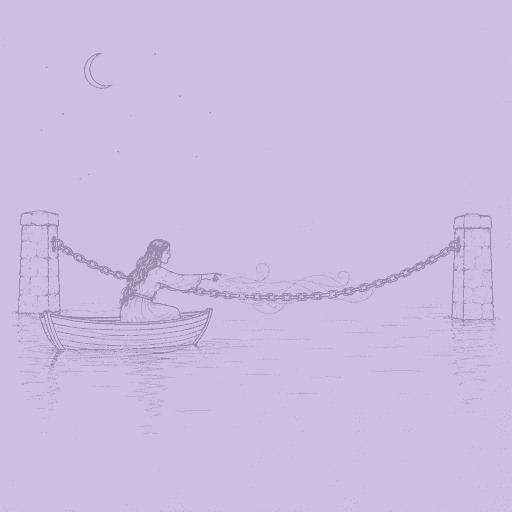
Egwene herself devised a plan to break the defensive chain across Tar Valon’s harbor, and selected Bode Cauthon—a novice of the White Tower and Mat Cauthon’s younger sister—to perform the channeling after the original choice, Kairen, was murdered. Deeming the mission too dangerous for a novice, Egwene secretly takes Bode’s place. Under cover of darkness, she rides to the river, boards a boat with soldiers, and successfully shatters the chain. Immediately after, she is captured by White Tower Aes Sedai who were waiting in ambush, revealing that she has been betrayed.
Epilogue Summary: “An Answer”
In the city of Tear, Davram Bashere returns from a diplomatic mission to Rand al’Thor. Bashere reports that the Seanchan are amenable to meeting, but require Rand to come in person rather than send an emissary. They have one condition: Rand must meet with a newly arrived royal, the Daughter of the Nine Moons.
Chapter 26-Epilogue Analysis
Perrin’s interrogation of the captured Shaido, in which he severs a prisoner’s hand with his axe, is a turning point for his character and a clear manifestation of Desperation as a Path to Moral Collapse, as Perrin’s single-minded drive to rescue Faile leads him to adopt the cruel methods he once abhorred. His subsequent confession to Elyas that he fears becoming addicted to the heightened senses of battle reveals his awareness of this internal decay, and his decision to throw away his axe is a symbolic attempt to reject the part of himself that committed the atrocity. However, the damage is done; he has already embraced a darker path, a trajectory confirmed by his readiness to consider an alliance with the Seanchan, a morally compromised choice he would not have entertained before. The preceding visit to So Habor functions as an externalization of this theme: The town is a place of literal and figurative decay, where the social order has broken down under a supernatural blight that symbolizes the moral blight afflicting Perrin himself. Perrin’s decision to leave the haunted town to its fate, refusing to spare an Aes Sedai to help, demonstrates how his personal desperation has narrowed his moral focus, eclipsing his broader responsibilities as a leader.
Mat Cauthon’s interactions with Tuon, evolve into a subtle but high-stakes battle over Information as a Form of Political Power. Mat initially believes he is manipulating the situation through a calculated courtship, congratulating himself that “He truly did have no need of what the sul'dam and Aes Sedai learned. He had better sources, people he trusted” (540). However, his gifts and games of “stones” become opportunities for Tuon to assert her own authority. The turning point comes from a critical piece of intelligence he lacks: Egeanin’s explanation of the Seanchan marriage custom reveals that he has been completely outmaneuvered from the moment of the kidnapping. Tuon’s final act—issuing an official warrant of protection for Valan Luca’s show while explicitly excluding Mat—demonstrates her own mastery of information as power, as she uses the formal structures of her society to trap her captor. Throughout these chapters, the motif of dice tumbling in Mat’s head signifies his loss of control; the game is no longer one of chance but one of political maneuvering in which he is an amateur. His laughter signals his recognition that the Daughter of the Nine Moons has been playing an entirely different and superior game.
As Amyrlin Seat, Egwene al’Vere embodies The Isolating Burden of Leadership, as her position places her at the center of power yet leaves her deeply alone. The other Aes Sedai dismiss her dream-warning of a Seanchan attack, demonstrating that they offer her the respect of her title but not the trust of a true leader. This lack of trust forces her to operate in secret, managing spies and navigating the political challenges from Romanda and Lelaine without a reliable inner circle, and yet her secrecy isolates her further, depriving her of the friends and allies who might warn her of danger. When she secretly takes Bode Cauthon’s place in the mission to destroy Tar Valon, she believes that she is fulfilling her duty as a leader—assuming risk on behalf of others. Her subsequent capture reveals that she has been betrayed, the final and most destructive consequence of her isolation.
Egwene’s confrontation with Romanda reveals the complex and divisive nature of the Oath Rod, long seen as an unambiguous emblem of integrity and duty. Her revelation that the Three Oaths shorten an Aes Sedai’s lifespan, coupled with the knowledge that the Rod can “unbind as well as bind,” (589) challenges the very foundation of Aes Sedai identity. For centuries, the Rod has represented a willing sacrifice for the sake of ethical purity and service. Egwene’s proposal to use it to grant sisters a longer life after retirement suggests that such sacrifice may be unnecessary. The conflicting reactions to this new information highlight a fundamental schism in the rebels’ ideology. Romanda’s horror reveals how deeply her identity is bound up with the sisterhood of the Aes Sedai: For her, the sacrifices required of sisters give her life purpose. In contrast, Lelaine and Maigan immediately see the Rod’s potential as a weapon, proposing its use to create a form of Compulsion to dominate male channelers. The Oath Rod is no longer a unifying symbol but a focal point of conflict over the future ethics and purpose of the White Tower itself.

Get in-depth, chapter-by-chapter summaries and analysis from our literary experts.
- Grasp challenging concepts with clear, comprehensive explanations
- Revisit key plot points and ideas without rereading the book
- Share impressive insights in classes and book clubs