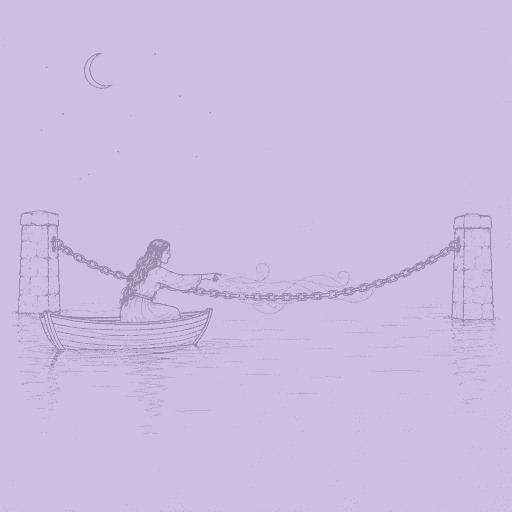
Crossroads of Twilight
Crossroads of Twilight
A modern alternative to SparkNotes and CliffsNotes, SuperSummary offers high-quality Study Guides with detailed chapter summaries and analysis of major themes, characters, and more.
Summaries & Analyses
Quizzes
NEWReading Tools
Chapters 3-8Chapter Summaries & Analyses
Content Warning: The source text and this guide contain depictions of graphic violence, physical abuse, and death.
Chapter 3 Summary: “A Fan of Colors”
Mat Cauthon deflects a brewing argument with Egeanin by announcing his intention to visit their captive, Tuon. After Bayle Domon warns Mat not to underestimate Tuon’s resilience, Mat enters her wagon. Tuon is furious about the cover story painting her as Mat’s thieving servant and throws a cup at his head. Mat explains the necessity of the ruse. Admitting that he abducted her as a hostage to ensure the safety of himself and his associates, he promises not to harm her and to free her as soon as it is safe to do so. They strike a bargain: Tuon promises not to escape or cause trouble so long as Mat keeps his promises to her. They seal the deal by spitting on their palms and shaking hands. The moment their hands touch, the dice in Mat’s head fall silent.
Thom Merrilin arrives with news that Queen Tylin has been murdered in the Tarasin Palace, found still bound hand and foot with her head torn off. Mat—who tied her up and hid her under the bed at her own suggestion as part of the plot to free the Windfinders—is horrified, realizing that the gholam, a creature of the Shadow that has been hunting him, must have killed Tylin while she was left tied up. Before he can process this, he is summoned by Blaeric, a Warder, to see the Aes Sedai he helped escape. All three sisters—Joline, Teslyn, and Edesina—have sensed a massive, distant channeling of the One Power to the north, which Joline believes is the work of the Forsaken; she demands that Mat abandon his plan to reach Lugard and instead take the ferry across the harbor to Illian. Mat, however, recognizes the phenomenon as the “fan of colors” he associates with Rand al’Thor and dismisses her fears, refusing to alter their course.
Chapter 4 Summary: “The Tale of a Doll”
Furyk Karede, a Banner-General of the Seanchan Deathwatch Guard, grows frustrated by the lack of leads nine days after the disappearance of High Lady Tuon. He is visited by a Seeker for Truth named Almurat Mor, who reports a suspicious rumor: A girl with a Seandar accent has been extorting merchants in Ebou Dar, and soldiers accompanying her wore armor described as matching Deathwatch Guard colors.
Mor reveals that on the night of Queen Tylin’s murder, two damane—enslaved women capable of channeling the One Power, or the magical force flowing through the universe—were freed from the palace kennels by Egeanin. Egeanin then fled the city with three damane in her entourage, along with a group that included Thom Merrilin. Two of the sul’dam—enslavers who use a magical collar to control the damane—that Egeanin used have close connections with Suroth. Mor implies a wider conspiracy involving Suroth and the Aes Sedai, suggesting that the formal Seeker organization has been compromised. He appeals directly to Karede’s well-known personal loyalty to Tuon. The following day, Karede crosses the harbor by ferry and meets with a force assembled through Captain Musenge: 100 Deathwatch Guards, 20 Ogier Gardeners, and a contingent of sul’dam and damane. Karede then prepares his force to begin a meticulous search for Tuon and her captors.
Chapter 5 Summary: “The Forging of a Hammer”
Perrin Aybara, Lord of the Two Rivers, awakens from a wolf dream in which he smelled a scent of death and hatred. When he mentally reaches out to a distant wolf pack, they ominously tell him “The Last Hunt is coming” (154) before breaking contact. He marks the 22nd day of his wife Faile’s captivity, reflecting on how he has disciplined his initial rage into a methodical hunt for her Shaido Aiel captors.
Selande Darengil, leader of a group of young nobles loyal to Faile, reports intelligence gathered from her spy Haviar in the camp of the zealot Masema. Haviar has seen the Aes Sedai Masuri Sokawa meeting with Masema more than once, and is certain the second woman present is Annoura Larisen, another Aes Sedai, though the accompanying man has not been seen clearly enough to confirm. Concerned, Perrin instructs his secretary, Sebban Balwer, to use Selande’s network to uncover the purpose of these meetings. Perrin is increasingly troubled by the alienation of his Two Rivers followers, who have come to believe the false rumors of his infidelity with Berelain sur Pendrag Paeron, heiress to the throne of House Paeron. Meanwhile, Balwer speculates that Masema is sending riders to ally with the Whitecloaks, though Perrin is certain he is contacting the Seanchan.
Chapter 6 Summary: “The Scent of a Dream”
While riding through the forest, Perrin detects the foul, sulfurous scent from his wolf dream and soon discovers the tracks of Darkhounds pressed into solid stone. He sends Aram to warn the camp, then follows the trail, determining that a large pack of the Shadowspawn circled his camp before continuing their hunt for another target. He is soon intercepted by Berelain, who gives him a basket of food as a pretext for a private meeting.
Hidden inside the basket is a document her thief-catcher stole from Masema’s desk: n official letter of protection signed by the Seanchan High Lady Suroth, instructing recipients to give the bearer whatever aid he requires in service to the Empire. Berelain reveals that her two thief-catchers have since disappeared, meaning Masema likely knows she has the incriminating letter. In turn, Perrin confronts Berelain with his knowledge that her Aes Sedai advisor, Annoura, has also been meeting secretly with Masema. As the rest of their party joins them, the group gathers to investigate the Darkhound tracks.
Chapter 7 Summary: “Blacksmith’s Puzzle”
Masuri examines the Darkhound tracks and concludes that a large, unknown pack passed by over an hour ago on an urgent hunt and is unlikely to return. As her troops’ fear subsides, Berelain rallies them by publicly reaffirming her oath to see Faile rescued no matter the danger. Soon after, Perrin’s sentries signal the approach of Masema, who arrives with several hundred followers.
Masema confronts Perrin and tells him that the nearby town called So Habor has ample supplies. He suggests Perrin divert his forces there. Sensing a trap designed to delay him, Perrin refuses, insisting that rescuing Faile is his only priority. As a tense standoff develops, reinforcements from Perrin’s main camp arrive and outflank Masema’s men. After a cryptic warning to Perrin, Masema and his followers retreat. Just as they depart, Perrin’s lead scout, Elyas Machera, arrives to deliver his report on the Shaido.
Chapter 8 Summary: “Whirlpools of Color”
Elyas reports that the Shaido are forty miles away, camped around a captured city. Their force is far larger than anticipated, with at least ten thousand warriors. Perrin, unwilling to trust the Shaido, rejects the idea of ransoming the captives. He has the Asha’man Grady create a gateway to a ridge overlooking the enemy camp. From this vantage point, Perrin and his party witness the immense scale of the Shaido encampment. The Wise One Marline senses a shocking concentration of female channelers—between four and five hundred—and concludes it must be the entire assembly of Shaido Wise Ones.
Suddenly, a massive surge of the One Power is felt from far away. The channelers in Perrin’s group fear it is the work of the Forsaken, but Perrin’s ta’veren senses show him a clear image of a man and a woman seated facing one another, and he knows Rand is the source. The overwhelming scale of the challenge purges Perrin’s despair, leaving him with cold resolve. He tells the Maiden Sulin that he needs prisoners for interrogation, beginning his methodical plan to free Faile.
Chapters 3-8 Analysis
Perrin Aybara’s blacksmithing background is a metaphor for his internal struggle to manage his grief and rage, as he consciously begins to reforge his emotions into a weapon. His reflection on tempering his initial rage into a hardened resolve as he hunts for Faile shows him realizing that his initial, reactive anger must be “hardened and shaped to a purpose” (156), like steel on an anvil. The process of working iron, which he knows requires patience and precision, becomes the model for weaponizing his own fury. This shift is a dangerous departure from his identity as a creator and protector toward that of a destroyer, highlighting the theme of Desperation as a Path to Moral Collapse. This internal battle, taking place before any physical confrontation with the Shaido, reflects the series’ larger focus on the emotional toll of prolonged conflict, echoing the psychological realism of warfare informed by the author’s own military experience.
The complex web of espionage and counter-espionage that unfolds across these chapters highlights how information has become a form of capital among the fractured alliances. Berelain uses a basket of food as a pretext to pass Perrin a stolen Seanchan document incriminating Masema, a tangible piece of intelligence that is dangerous to both its subject and its holder, highlighting the importance of Information as a Form of Political Power, as the Seanchan are desperate to control access to this information. In the Seanchan camp, the Seeker Almurat Mor holds a secret meeting with Furyk Karede to reveal a suspected conspiracy involving High Lady Suroth and the Aes Sedai, bypassing official channels he believes are compromised. This reliance on secret meetings and eavesdropping extends to Perrin, who instructs his own secretary to use spies to monitor his supposed allies, Berelain and the Wise Ones. The narrative structure, cross-cutting between these disparate groups all engaged in clandestine intelligence gathering, emphasizes a pervasive paranoia. With large-scale military action stalled, the conflict has shifted to a war of information where mistrust is rampant, no alliance feels secure, and every conversation is layered with potential deception.
As Perrin’s becomes more single-mindedly focused on rescuing Faile, his relationships with his followers fray, illustrating The Isolating Burden of Leadership. When Perrin walks through the camp, his Two Rivers followers avoid his eyes and show open contempt. This alienation culminates in a moment of deep loneliness, as he realizes he “walked through his friends and neighbors and servants and felt alone” (167). His desperation to rescue Faile has turned his thoughts inward, away from his community, allowing rumors—such as those of his infidelity with Berelain—to take hold. This estrangement forces him to rely more heavily on his own judgment, which is increasingly colored by his grim, methodical anger, pushing him further into isolation as his decisions serve his own interests rather than those of his people.
The chapters contrast different forms of supernatural knowledge to explore the intersection of personal destiny and world-altering events. The dice rattling in Mat’s head, a personal omen of his ta’veren nature, signals an unavoidable turn of fate. This internal indicator of uncertainty is a motif throughout the novel, representing the power of chance—though Mat’s exceptionally consistent good luck suggests that what looks like chance is instead a predetermined fate. The ambiguity of the rolling dice is resolved the moment he and Tuon shake hands, sealing their bargain with the words, “Thus is our treaty written; thus is agreement made” (130). When the dice immediately fall silent, the moment cements Tuon’s key role in a destiny Mat doesn’t yet fully understand. Mat’s personal connection to the Pattern—a cosmic order beyond human understanding—grants him a more accurate understanding than those, like the Aes Sedai, who perceive events only through the One Power. This deeper understanding allows him to recognize that the “immense, inconceivable” power felt by the Aes Sedai (138) is the work of Rand al’Thor—one of only two people in the world (the other being Perrin), whose magical power rivals Mat’s own. The distant presence of this power foreshadows a coming confrontation and reinforces the series’ syncretic mythology, where grand, cyclical history is shaped by the precise, key moments of individual connection and choice.
This section’s narrative structure embodies the book’s function as a strategic pause, where factions consolidate and react rather than advance. In epic fantasy novels, such periods of regrouping amid relative calm typically occur before the climax. Crossroads of Twilight fulfills this narrative role within the larger arc of the series. The plot moves horizontally, not linearly; Mat is still trying to leave Ebou Dar, and Perrin is still hunting the Shaido. Instead of forward momentum, the narrative cross-cuts between disparate viewpoints—Mat, Karede, Perrin—to show the global repercussions of the cleansing of saidin and the complex realignments it has triggered. The conflicts that arise are tests of will and strategy, not battles. Masema’s offer of supplies in So Habor is a feint to test Perrin’s resolve, and Joline’s demand to reroute to Illian is a reaction to a misunderstood event. This structural choice deliberately builds tension not through action, but through the depiction of psychological strain, logistical planning, and political maneuvering. The reader is shown all the pieces moving into position on a world-sized chessboard, creating an atmosphere of impending crisis as the world holds its breath.

Get in-depth, chapter-by-chapter summaries and analysis from our literary experts.
- Grasp challenging concepts with clear, comprehensive explanations
- Revisit key plot points and ideas without rereading the book
- Share impressive insights in classes and book clubs