Lady Tremaine
Lady Tremaine
A modern alternative to SparkNotes and CliffsNotes, SuperSummary offers high-quality Study Guides with detailed chapter summaries and analysis of major themes, characters, and more.
Summaries & Analyses
Author Insights
Quizzes
NEWReading Tools
Rachel Hochhauser on Lady Tremaine
In their own words: quotes and insights from the author.Why they wrote it
A hospital waiting room and a villain who wasn’tThe idea arrived during the worst year of Hochhauser’s life, not at a desk. Their husband’s emergency brain surgery in 2023 left them caregiving through a months-long recovery, solo-parenting a toddler, and pregnant, all at once. It was in that compressed, exhausted state that a single image on their phone reordered twenty years of assumptions about a fairy tale.
I had an objectively bad year in 2023. I was pregnant and caretaking for my husband through an emergency brain surgery and grueling monthslong recovery, all the while effectively single parenting our toddler. During this season of what felt like ongoing sacrifice, I was sitting in a hospital waiting room, scrolling on my phone, when I came across a depiction of Cinderella’s evil stepmother. For the first time, I didn’t see a villain. I saw a mother — a woman doing what she needed to do to take care of her family.
The waiting room reframed one character, but a longer unease had been building. Becoming the mother of two daughters gave Hochhauser a reason to scrutinize a story she had loved without question as a child, and what she found there was a premise she could no longer leave unchallenged.
Lady Tremaine is less a reclamation-of-the-villain narrative than it is an untelling of the overall Cinderella fairytale. I grew up absolutely enthralled with Cinderella, but now, as an adult, and especially the mother of two little girls, I’ve started to question its message: that if you’re beautiful and nice, you might be lucky enough to be picked by a prince. I felt like it was time to have a new version of this age-old folktale — one that is just as romantic and delicious as some of the earlier adaptations, but that put women’s agency at the center.
The book also arrived after two decades of false starts, an unsold novel from grad school, years of revision, and finally quitting fiction altogether to co-found a puzzle company. When the new idea surfaced, Hochhauser’s relationship to writing was tangled with grief over everything the earlier project had cost them.
I have a whole other novel that I poured myself into in my 20s that I couldn’t sell. I rewrote it so many times and walking away was a true creative heartbreak. When I got the idea for Lady Tremaine, it was like revisiting an ex. In hindsight, I’m really happy that this book was my debut, but it’s a really important part of the story to start at the beginning and explain that this has been a 20 year path.
How they wrote it
Composite centuries and a falcon on the wristSetting a novel in a vaguely preindustrial Western Europe, rather than in a pinned historical moment, was a deliberate craft decision. By refusing to anchor the story to a single court or decade, Hochhauser could range across roughly 150 years of source material and choose only the details that served the story. The research that fed this composite world was specific even when the world itself was not.
I wanted it to read like historical fiction but I didn’t need to be hyper-specific about what life looked like in England in 1797. Instead, I researched a broader swath of time — I read the diaries of 18th-century women, etiquette books for women, fiction written during that time…
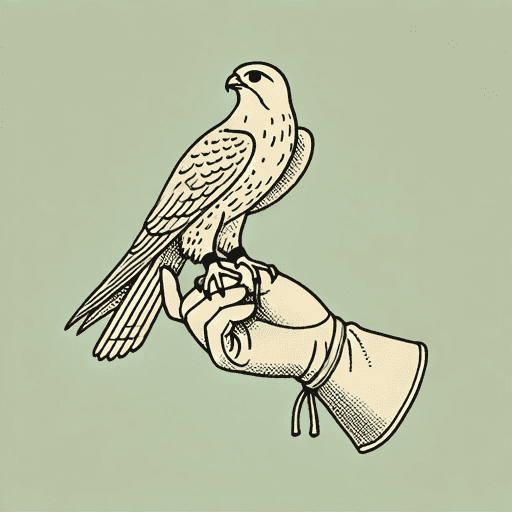
One detail in the novel, a falcon named Lucy who becomes central to Ethel’s story, required its own research path that began years before the book existed. A pandemic falconry workshop gave Hochhauser hands-on experience with birds of prey, and they followed that with old falconry manuals and additional workshops when the novel demanded more precision.
Lady Tremaine is an untelling of Cinderella from the so-called evil stepmother’s point of view. So it’s not the fairy tale you know just from a different perspective… It’s a meditation on maternal love and on grief and on what women who are bold enough to make their own fortunes. So it ends up playing with a lot of themes that almost feel antithetical to what we think of when we think of the traditional Cinderella narrative. [paraphrased from audio]
The first-person voice was not part of a plan; it emerged when Hochhauser began writing. Once Ethel, the novel’s protagonist and the character who becomes Lady Tremaine, began to speak in her own register, the structural question of whose story this was answered itself.
As soon as I heard her voice, I just knew that’s the story. It’s giving a character who’s never been in the spotlight the same interiority that we think of as the more, you know, princessy heroines. And so it had to be in her voice. [paraphrased from audio]
Writing the first draft quickly required Hochhauser to engineer the conditions for it, not wait for them. They took a leave of absence from running Piecework, knowing that any window to write uninterrupted would be narrow and would not repeat itself.
I took that opportunity very seriously. I was motivated partly by guilt and partly by fear — I knew how rare that window was, and I didn’t want to waste it... Because I have young children, any writing time for me has to coincide with some form of childcare... It was never glamorous. It was incremental and protected.
When the publisher’s original cover design used generic florals, Hochhauser pushed back with a specific alternative: Clara Peeters, one of the only women painters working at the level of the Dutch Golden Age masters. The substitution mattered to them because the source had a story the generic design could never carry.
They’re not just pretty florals. They’re from a woman who was ahead of her time and doing something different.
St. Martin’s Press sourced the final cover flowers from an actual Peeters painting. That painting now hangs at the Met, and Hochhauser has visited it since the book came out.
The personal thread
A letter their daughters will one day readHochhauser did not set out to write a book for their children. The personal dimension of the ending surprised them when it arrived, and the surprise seems to have been part of what made it land.
if I were to package up a message and put a bow on it and present it to my daughters, I would give them this novel. I wasn’t expecting that level of gratification.
The final sentence of the novel crystallizes what Hochhauser wanted their daughters to carry forward, and the phrasing they chose is deliberately not soft. It inverts the traditional fairy-tale logic in which the woods are the place of danger that women must survive or escape.
The ending almost reads like a letter to young girls, to my daughters. My favorite sentence is the last sentence: ‘You are the scariest thing in the woods.’
On what the book is wrestling with
Money, matrimony, and the economics of the happily ever afterThe novel’s romantic surface covers a colder argument. Hochhauser wanted the preindustrial economic reality of women’s lives to be present in every choice Ethel makes, not as background color but as the actual engine of the plot. Without that frame, the novel would replicate the evasion it was trying to undo.
So much of the traditional happily ever after has hinged on marriage. But historically, that’s because — for women — matrimony meant security. And security, more often than not, meant money. It felt impossible to write about female autonomy in a preindustrial setting without reckoning with the economic realities that shaped women’s choices.
The reframing of Lady Tremaine as protagonist required Hochhauser to ask whether the original verdict on the character was ever warranted, not just whether it was too harsh. That distinction shaped the book’s entire moral architecture.
My goal wasn’t to soften a villain; it was to question whether she was ever one to begin with.
Hochhauser has spoken about plot structure as a matter of deliberate navigation between a known start and a known end. Applied to a fairy tale with a fixed cultural ending, this method became a tool for interrogating how stories are told rather than simply retelling one.
For me, this often comes down to what I think of as before-and-afters. There are many ways to talk about this — plot structure, character arcs, narrative turns — but at its core, it’s about knowing where you begin and where you end, and then deliberately charting the path between the two.
What they want us to sit with
The scariest thing in the woodsThe book asks readers to extend the same imaginative generosity to Lady Tremaine that fairy tales have always reserved for their heroines. Hochhauser framed this not as sympathy for a villain but as a correction to a category error the original story made.
My goal wasn’t to soften a villain; it was to question whether she was ever one to begin with.
Hochhauser wants readers, especially those who grew up loving Cinderella, to feel the full weight of what the classic tale was asking women to want. The novel’s romantic pleasures are real, but they exist in deliberate tension with a message about agency that the original story suppressed.
Lady Tremaine is less a reclamation-of-the-villain narrative than it is an untelling of the overall Cinderella fairytale. I grew up absolutely enthralled with Cinderella, but now, as an adult, and especially the mother of two little girls, I’ve started to question its message: that if you’re beautiful and nice, you might be lucky enough to be picked by a prince. I felt like it was time to have a new version of this age-old folktale — one that is just as romantic and delicious as some of the earlier adaptations, but that put women’s agency at the center.
The last image Hochhauser leaves readers with reverses the oldest piece of fairy-tale geography: the dangerous forest and the woman who must pass through it. After everything Ethel survives and chooses, the final sentence redefines who the threat is and who the power belongs to.
The ending almost reads like a letter to young girls, to my daughters. My favorite sentence is the last sentence: ‘You are the scariest thing in the woods.’