Nightmares!
A modern alternative to SparkNotes and CliffsNotes, SuperSummary offers high-quality Study Guides with detailed chapter summaries and analysis of major themes, characters, and more.
Summaries & Analyses
Quizzes
NEWReading Tools
Chapters 15-21Chapter Summaries & Analyses
Content Warning: This section of the guide includes discussion of bullying, mental illness, illness, and death.
Chapter 15 Summary: “Alfie’s Secret Power”
Drawing on his memory of the model of the Roman Colosseum Alfie made for a school project, Charlie locates an ancient rope-and-pulley elevator exactly where the model had placed it. Meduso operates the mechanism and lifts Charlie up to the arena floor, where Alfie stands frozen beside a prowling lion while a crowd of goblins jeers. Alfie’s glasses are in the sand between him and the beast. Charlie instructs Alfie to crawl toward the lion to retrieve them and then hurry for the trapdoor, but President Fear releases all three animals into the arena at once. In the chaos, Charlie accidentally grabs the lion’s leg and receives a scratch along his forearm, his first real injury in the Netherworld. He drags Alfie through the opening just before the trapdoor slams shut.
Alfie embraces and thanks Charlie, but Charlie credits Alfie for making the rescue possible. Before they can rest, Meduso warns them that the goblins are closing in and tells the boys to shut their eyes on his signal. A head goblin identifies Charlie by sniffing the real blood from his scratch and taunts them with news that Dabney the clown has been captured and faces trial the next day. Meduso petrifies most of the mob, but the head goblin shields his eyes and calls for gorgon shields. Facing a three-way fork in a tunnel, Alfie confidently leads them down a secret passage.
Chapter 16 Summary: “The Stone Garden”
The group emerges into a vast outdoor dump where thousands of goblins and other creatures have been turned into stone. Meduso clarifies that the frozen creatures aren’t dead. He also tells Alfie that fleeing a nightmare rather than facing it breaks a core Netherworld rule, meaning Alfie will face a worse version of the same fear later.
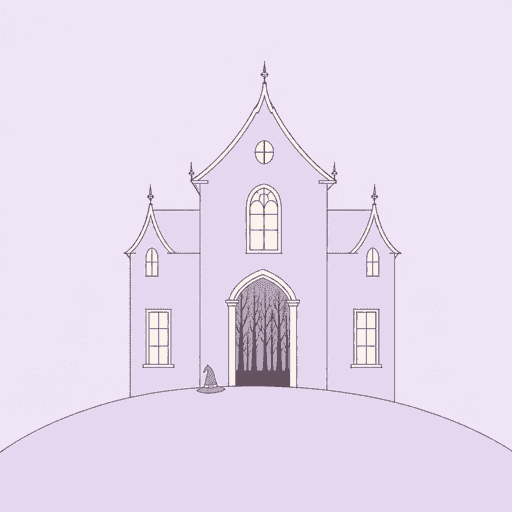
Charlie presses Meduso for the full truth. Meduso explains that the portal between the Netherworld and the Waking World has been opened before when someone living in the purple mansion “allowed fear to take over their lives” (202). A human can only pass through the portal with their physical body of their own free will. He then reveals that President Fear has been using that same portal inside the Laird family’s house. Charlie’s overwhelming fear inadvertently unlocked it, and Fear needs him to stay terrified to keep it open. With the door open, nightmares are already crossing into Cypress Creek and endangering the whole town. Meduso also discloses that he was present the last time this portal opened, which was 25 years ago, before pointing to a cave high on the nearby mountain and announcing they need expert assistance.
Chapter 17 Summary: “The Cave Dweller”
Thinking of Jack gives Charlie the strength to climb a mountain road lined with petrified stone figures of warriors, soldiers, ordinary people. Meduso says he isn’t responsible for these statues. From the summit, they can see a nightmare version of Cypress Creek below, including the Colosseum, a black copy of the purple mansion, and the bell tower at the forest’s edge.
The cave at the top of the mountain has gilded doors and a balcony. Meduso rings the bell and is greeted by Medusa, his mother, a centuries-old gorgon with a serpent’s lower body, living snakes for hair, and oversized protective sunglasses. Though President Fear has ordered her to report her son, she flatly refuses. Inside her lavish home, she assures Charlie that the witch won’t eat Jack because then she’d lose her only leverage over Charlie. Medusa then disguises Alfie as a mummy, Charlie as a ghost from Japanese folklore called a yurei, and Meduso as the Grim Reaper. Her gentle care while tending to Charlie’s costume reminds him painfully of his mother.
Medusa explains that nightmares must either keep frightening people or retire and become dreams. However, President Fear has sown doubt about whether the Dream Realm, the supposed reward nightmares attain upon retirement, actually exists, trapping most nightmares in service out of fear. She also reveals that Meduso once visited the Waking World, encountered human children, and returned unwilling to be a nightmare but too afraid to retire under Fear’s rule. Before Charlie leaves, Medusa whispers that Meduso’s secret is that he genuinely enjoys helping humans.
Chapter 18 Summary: “The Guinea Pig”
The disguised group joins the line outside a dilapidated courthouse. A street vendor hawks mirrored sunglasses as gorgon shields, and Meduso explains that seeing his own reflection would petrify him, making the mirrors a real threat. At the entrance, a guard grows suspicious of Charlie and Alfie. Her supervisor, Kali, a four-armed blue goddess, demands a demonstration. Meduso activates hidden microphones built into their costumes, and the boys produce a combined roar and shriek that shatters the remaining courthouse windows. They are waved through.
Inside, Dabney is chained to a chair and tormented by a goblin guard. President Fear enters flanked by escorts wearing mirrored shields, announces that two human children are loose, and blames Dabney as the crowd pelts the clown with food. Fear then reveals that he has secured access to the Cypress Creek portal and plans to invade the Waking World, keeping it in perpetual fear so nightmares never need to change or die. To demonstrate his Terrorizer 3000, a device that monitors and adjusts a subject’s fear level, he projects live footage of Paige, who is being held in an adjacent facility as his test subject.
Chapter 19 Summary: “Who’s Afraid of the Dark?”
President Fear demonstrates the Terrorizer 3000 on Paige: He plunges her room into darkness, stretches its walls beyond reach, and sends in the oldest nightmare, a featureless shadow called the Dark, to stalk her. Charlie and Alfie move to intervene, but Meduso holds them back, warning that revealing themselves would doom Dabney. When a cockroach in the audience loudly walks out in protest of Fear torturing a child, Charlie uses the disruption to slip away and sprint to the adjacent testing facility.
He locates Paige’s room, removes his disguise even though he knows the footage will identify him, and enters. The Dark slips out as he opens the door. Inside, Paige is badly shaken. Charlie removes the Terrorizer sensors from her skin and learns she’s kept her nightmares secret because she fears others would think she is like her mother, who is sometimes hospitalized to treat her depression.
President Fear’s forces surround the building and capture Charlie and Paige. Alfie then reveals himself in the crowd and uses his costume’s microphone to unleash a roar that shatters every gorgon shield nearby. The unprotected guard is instantly petrified by Meduso, throwing the area into chaos. Meduso frees Charlie and reunites the group. He then throws a skeleton key to Dabney, who begins freeing himself from his chains. Meduso orders Charlie, Paige, and Alfie to find the witch while he completes Dabney’s escape.
Chapter 20 Summary: “Late to Dinner”
Charlie leads Alfie and Paige through the forest toward the bell tower, concealing his mounting panic about the unseen creature that has stalked him since his bad dreams began. The forest is noticeably smaller than before, and they reach the belfry quickly, but the witch is gone, and there’s no sign of Jack. Charlie fears his detours may have cost him his brother.
Sitting in the dungeon, the three examine their fears honestly. Alfie admits his sports nightmares are really about the humiliation of being laughed at. Paige acknowledges her fear of the dark is rooted in her mother’s mental illness and the possibility she could inherit it. Charlie admits that he fears Charlotte will permanently displace him in his father’s and brother’s lives, though he says nothing about the thing in the woods.
Paige and Alfie then recall that Meduso said travelers must pass through the portal willingly, so the witch couldn’t have carried the real Jack across. Whatever Charlie saw was a decoy used to lure him in. To confirm Jack’s body is safe at home and only his spirit is in the Netherworld, the group resolves to find his nightmare. Charlie recalls how his words made Jack’s confidence collapse at school and concludes that the one thing that could truly frighten his brother is Charlie himself.
Chapter 21 Summary: “Nightmare School”
The group travels through the Netherworld until they reach a barren wasteland where a nightmare version of Cypress Creek Elementary stands with iron bars on its windows and padlocks on every door. Dozens of children are trapped inside, each convinced a different monster is roaming the halls. Since no one has actually seen a creature, Alfie concludes that fear alone is keeping them imprisoned.
The trapped students direct Charlie to Rocco, who’s sitting on the front lawn completing endless impossible exams. A gray-faced proctor explains that one padlock is removed from the school’s doors with every test the boy passes, and one is added for each test he fails. The chains are already heavy with failures. When Alfie impulsively offers to help with an answer, the proctor declares it cheating and adds another lock. Charlie and Alfie argue that the tests are unsolvable by design, but Rocco refuses to abandon the students inside.
Meduso arrives disguised as a zombie, furious at having to track the group to the president’s own school. A convoy of limousines surrounds the building, forcing the group to hide in a nearby maintenance shed. Meduso has brought only two goblin costumes along with Charlie’s jeans and Alfie’s pajamas. Rocco proposes that Paige and Alfie pose as goblin captors marching Charlie and Rocco as prisoners to a stolen limousine while Meduso drives. As Charlie changes into his jeans, he discovers Charlotte’s drawing of the Netherworld mansion still folded in his back pocket and tucks it away.
Chapters 15-21 Analysis
In the novel’s third section, the authors deepen the characterization of Charlie’s friends and the theme of Finding the Courage to Face One’s Fears by examining the anxieties behind the children’s nightmares. In the Netherworld, the monstrous scenarios the children face are directly tied to their waking-world insecurities. When President Fear demonstrates the Terrorizer 3000 on Paige, he unleashes the Dark, an entity that preys on her secret dread of inheriting her mother’s mental illness. Similarly, Alfie admits his sports-related nightmare masks a deeper terror of being laughed at and made to feel “small on the inside” (258). Furthermore, Rocco’s agonizing loop of failing impossible exams exposes his hidden anxiety that he lacks the intelligence necessary to succeed in life and help his friends. By forcing the characters to articulate the roots of their terrors, the narrative shifts the conflict from an external struggle to physical survival to an inner journey of emotional confrontation. The monsters lose their mystique once the children’s underlying vulnerabilities are named, demonstrating the power of facing one’s fears. This externalization of complex internal struggles, such as clinical depression and social inadequacy, aligns with the conventions of the children’s horror genre by providing a framework for young readers to process emotional burdens from a safe distance.
The motif of costumes and disguises structures the protagonists’ journey, emphasizing the theme of Appearances Can Be Deceiving. To navigate the Netherworld undetected, Medusa outfits the group in theatrical disguises: Alfie becomes a mummy, Charlie a yurei, and Meduso the Grim Reaper. Conversely, President Fear operates in the Waking World disguised as Principal Stearns. These physical costumes mirror the psychological truth underpinning the realm itself, where every nightmare is merely a disguise for a deeper insecurity. Meduso explicitly links these concepts when he tells Charlie, “Nightmares are humans’ fears in disguise” (243). For Charlie and his allies, the adoption of physical disguises becomes a catalyst for empowerment. Alfie, previously frozen by fear, utilizes the built-in microphone in his mummy wrappings to unleash a roar that shatters the courthouse glass and neutralizes the goblins’ gorgon shields. His disguise allows him to project a strength he previously lacked. These chapters reinforce the narrative’s argument that superficial appearances are inherently deceptive. True understanding requires looking beyond the obvious, whether recognizing the insidious evil of a corrupt principal or uncovering the hidden courage of an anxious child.
Charlie’s realization that he is his brother’s nightmare marks a turning point in his confrontation with Redefining Family After Loss. After Paige points out that travelers must cross the portal willingly, Charlie realizes the witch couldn’t have dragged Jack into the Netherworld against his will. The kidnapping was merely a decoy leveraging Charlie’s protective instincts. To locate Jack’s actual spirit, Charlie must identify what frightens his brother the most. He ultimately concludes that his own withdrawal and volatile anger since their mother’s death have made him the primary source of Jack’s terror. This epiphany forces Charlie to confront the collateral damage of his unprocessed sorrow. Rather than continuing to blame his stepmother for his family’s problems, Charlie must acknowledge how his hostility has actively harmed his remaining loved ones. Recognizing himself as the “monster” in his brother’s life shifts his objective from simply defeating a witch to taking accountability for his own behavior. This self-awareness is a step in Charlie’s emotional maturation, demonstrating that repairing his fractured home life requires him to dismantle the emotional barriers he’s erected against his family.
In Chapter 16, the revelation regarding the portal’s mechanics solidifies the Netherworld as a symbol of the destructive, destabilizing power of fear. Meduso explains that Charlie’s intense, unspoken terror literally weakened the barrier between the Waking World and the Netherworld, unintentionally opening a doorway inside the purple mansion. Because of this rupture, President Fear is able to cross over, threatening to trap Cypress Creek in a state of perpetual panic so that nightmares never have to retire or change. This lore establishes that fear isn’t an isolated, internal phenomenon. When allowed to fester, it bleeds outward, endangering the broader community. The physical breach between the dimensions illustrates how avoidance only grants fear greater power to dictate people’s inner reality.

Get in-depth, chapter-by-chapter summaries and analysis from our literary experts.
- Grasp challenging concepts with clear, comprehensive explanations
- Revisit key plot points and ideas without rereading the book
- Share impressive insights in classes and book clubs