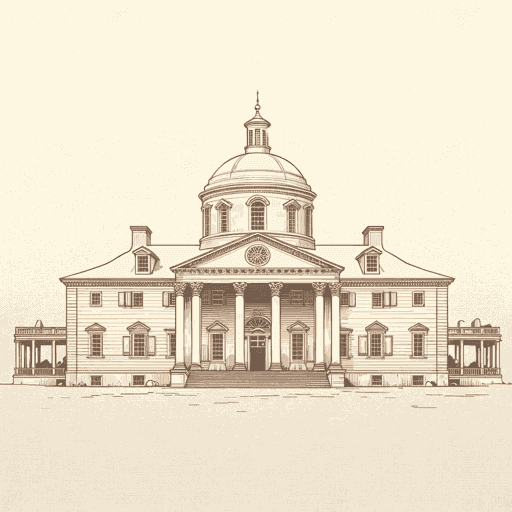
The Great Contradiction: The Tragic Side of the American Founding
A modern alternative to SparkNotes and CliffsNotes, SuperSummary offers high-quality Study Guides with detailed chapter summaries and analysis of major themes, characters, and more.
Summaries & Analyses
Quizzes
NEWReading Tools
Key Figures
Content Warning: This section of the guide includes discussion of racism, physical abuse, emotional abuse, and child abuse.
Joseph J. Ellis
Joseph J. Ellis is the book’s author and historical guide and is a specialist in the founding generation. Here, he shifts the emphasis of his previous work on the Founders to confront two of the American founding’s gravest failures: the inability to end slavery and the dispossession of Indigenous peoples. He describes this inquiry as an examination of the “downside of the American founding” (xi), asking whether these failures were unavoidable tragedies or outcomes that different leadership might have prevented. His central question is whether these outcomes were inevitable or the result of flawed leadership. This distinction shapes Ellis’s treatment of the Founders throughout the book, as he examines how revolutionary ideals collided with racial assumptions, demographic pressures, political interests, and the perceived need to preserve national unity.
By exploring the Founders’ choices within the constraints of their time, Ellis seeks a more subtle understanding that avoids both mythologizing them as “demigods” and demonizing them as “villains.” He’s particularly wary of presentism, arguing that historical actors must first be understood within the assumptions and political possibilities of their own era. At the same time, this contextual approach doesn’t absolve the Founders of responsibility for their decisions, especially because antislavery arguments and challenges to Indigenous dispossession already existed during their lifetimes. Ellis therefore uses historical context to assess what choices were realistically available and where political leaders failed to pursue them. He contends that decisions to protect national unity while postponing or limiting action on slavery and Indigenous land rights helped leave both conflicts unresolved, with consequences that extended far beyond the founding era.
George Washington
George Washington illustrates the tension between national leadership and slavery that Ellis traces through the founding generation. His primary goal was securing national unity, a conviction that led him to believe that any direct confrontation with slavery would fracture the fragile new republic. Ellis portrays Washington’s personal views on slavery as evolving, particularly during the Revolutionary War, when his experiences exposed him to a broader range of egalitarian ideas and brought Black soldiers into the Continental Army. His response was nevertheless contradictory: Early in his command, Washington initially sought to exclude Black men from enlistment, although Black soldiers later served alongside white soldiers in the Continental Army. His changing views didn’t translate into a public campaign against slavery during his presidency.
Washington was acutely aware that his status as an enslaver at Mount Vernon contradicted the nation’s principles and threatened his historical legacy, but legal and financial complexities were only part of what prevented him from acting. Ellis also emphasizes Washington’s deeply rooted identity as the “master” of Mount Vernon, where authority over enslaved people was integral to his social and economic life. His attempts to recover Ona Judge after she self-emancipated in 1796 demonstrate the persistence of these assumptions even as he contemplated emancipation. Ellis presents Washington’s decision to free his enslaved people in his will as the culmination of his changing position on slavery. The decision distinguished Washington from most of his Virginia enslaver peers, but Ellis complicates any straightforward narrative of moral transformation: Washington acted against slavery only at the end of his life, after repeatedly declining opportunities to challenge the institution more directly. His trajectory therefore demonstrates the distance between recognizing slavery’s injustice and accepting the personal and political consequences of acting on that recognition.
Thomas Jefferson
Thomas Jefferson stands at the center of the book’s “Great Contradiction.” As the author of the Declaration of Independence, he articulated the universal ideal of human equality, yet he was a lifelong enslaver who never freed most of his enslaved people, including the children he fathered with Sally Hemings. Ellis presents Jefferson’s position on slavery as deeply contradictory: He condemned the institution while retaining racial beliefs that limited his willingness to pursue emancipation. Jefferson’s central dilemma was his belief that slavery was a moral abomination coupled with his conviction, detailed in Notes on the State of Virginia, that Black people were inherently inferior and couldn’t coexist with white people in a free society. This led him to champion “expatriation”—the logistically and financially unworkable scheme of removing freed Black people from the US—as a precondition for emancipation. By making emancipation dependent on expatriation, Jefferson attached it to a solution that he increasingly recognized was impractical. In Ellis’s analysis, the contradiction between Jefferson’s egalitarian principles and racial assumptions demonstrates how deeply white supremacy constrained his vision of what freedom and equality could entail.
James Madison
James Madison is depicted as a leading political strategist of the founding generation, central to the creation of a national government designed to endure despite the divisive issue of slavery. As a constitutional thinker, Madison’s primary goal was to create a robust federal system, and he recognized that this required the support of the Southern states. To that end, he acted as a pragmatist, supporting compromises that protected the institution of slavery in order to secure national unity. Madison had helped formulate the three-fifths ratio during an earlier debate in the Confederation Congress; the formula later became part of the compromise over representation at the Constitutional Convention. He also participated in the Convention debates that resulted in restrictions on immediate federal action against the trafficking of enslaved people.
Later, in the first Congress, he successfully maneuvered to bury Benjamin Franklin’s abolitionist petition, helping establish a precedent that Congress had no authority over slavery within the states. While privately acknowledging slavery’s evils, Madison’s public actions were guided by the conviction that confronting it would shatter the republic. Ellis therefore uses Madison’s political choices to show how preserving national unity repeatedly took precedence over confronting slavery, allowing the contradiction to become embedded in the new nation’s political structure.
Benjamin Franklin
In his final years, Benjamin Franklin became one of the founding generation’s most prominent advocates for abolition. Having evolved from racial ambivalence to committed abolitionism, he served as president of the Pennsylvania Abolitionist Society. Ellis focuses on Franklin’s 1790 petition to the first Congress, which called for a ban on the trafficking of enslaved people and urged Congress to consider measures leading toward emancipation. The petition brought the unresolved question of slavery directly before the new federal government.
Franklin’s effort ultimately failed, as Congress concluded that the federal government had no authority to interfere with slavery within the states. The episode demonstrates the political limits of antislavery action at the federal level even when advocated by a prominent Founder. Franklin’s position also provides an important contrast with James Madison, who helped contain the congressional debate despite recognizing slavery’s incompatibility with the Revolution’s egalitarian principles. For Ellis, the failure of Franklin’s petition demonstrates how the political commitment to preserving the federal union restricted efforts to address slavery during the founding era.
Henry Knox
Henry Knox, George Washington’s secretary of war, is a central figure in the book’s account of federal policy toward Indigenous peoples. With Washington’s support, he rejected the claim that Indigenous peoples were conquered subjects whose lands could simply be seized. He argued that tribes were sovereign nations and that their land could only be acquired through legally binding treaties. Knox helped develop a federal policy intended to protect Indigenous land rights and regulate further US expansion. The Treaty of New York (1790) with the Creek Nation was an important test of this policy. Its implementation proved difficult as settlers continued moving onto Indigenous lands and Georgia resisted federal restrictions on its territorial claims. The federal government lacked the power to enforce its agreements consistently. Ellis uses Knox’s efforts and their limitations to examine why federal recognition of Indigenous sovereignty failed to prevent continued dispossession.
Alexander McGillivray
Alexander McGillivray, a Creek leader of Creek and Scottish ancestry, is presented as a skilled diplomat whom Ellis calls the “Talleyrand of the southern frontier” (147). Fluent in multiple languages and well educated, he negotiated among the US, Spain, and Georgia in an effort to protect Creek sovereignty. His political and diplomatic role also challenges historical and contemporary American portrayals of Indigenous peoples as “savages.” As the central Indigenous figure in the negotiations leading to the Treaty of New York, McGillivray sought to secure Creek lands against the incursions of white settlers. He recognized the growing pressure that expanding white settlement placed on Creek territory and used competing American and Spanish interests to strengthen his negotiating position. Despite his diplomatic efforts, McGillivray couldn’t prevent continued encroachment on Creek lands. His role gives Ellis’s account an Indigenous diplomatic perspective and shows how Creek leaders attempted to defend their sovereignty within the rapidly changing political landscape of the southern frontier.
Anthony Benezet
Anthony Benezet was a Quaker abolitionist whose writings helped bring sustained attention to slavery and the Atlantic Slave Trade before the American Revolution. Ellis identifies him as an important voice in breaking the “Great Silence” that had allowed slavery to remain largely outside public debate. Through widely circulated pamphlets, Benezet documented the violence of slavery and challenged arguments used to justify it. His significance to Ellis’s account lies partly in the timing of this work: Benezet articulated a clear moral critique of slavery before the founding generation confronted the contradiction between revolutionary claims about liberty and the continued enslavement of Black people.
Benezet also directly challenged prominent enslavers. In his correspondence with Patrick Henry, he pressed Henry on the inconsistency between defending American liberty and continuing to enslave others. Henry acknowledged the injustice of slavery but didn’t free the people he enslaved. The exchange provides Ellis with evidence that objections to slavery were already being presented to revolutionary leaders in terms they could understand. Benezet’s role therefore helps establish the intellectual and moral context in which the Founders made their choices about slavery.

Unlock analysis of every key figure
Get a detailed breakdown of each key figure’s role and motivations.
- Explore in-depth profiles for every key figure
- Trace key figures’ turning points and relationships
- Connect important figures to a book’s themes and key ideas
Related Titles
By Joseph J. Ellis