The Great Contradiction: The Tragic Side of the American Founding
A modern alternative to SparkNotes and CliffsNotes, SuperSummary offers high-quality Study Guides with detailed chapter summaries and analysis of major themes, characters, and more.
Summaries & Analyses
Quizzes
NEWReading Tools
Part 3Chapter Summaries & Analyses
Content Warning: This section of the guide includes discussion of death, racism, physical abuse, emotional abuse, and child abuse.
Part 3: “Southern Vistas”
Part 3, Chapter 8 Summary: “Regrets at Mount Vernon”
George Washington’s 1799 will served as his final personal farewell, in which he arranged for the emancipation of all his enslaved people. The document stipulated that they be freed upon the death of his wife, Martha, and that the younger freed people receive an education and training in a useful trade. Unlike most Virginia enslavers, including Thomas Jefferson, Washington allowed the people he freed to remain in the state, where many settled in a community they named Freetown. Martha ultimately freed them early, in January 1801, before her own death.
This decision was the result of a long personal struggle that began in the 1780s. In December 1785, a Quaker abolitionist named Robert Pleasants—who had already emancipated all 80 of his enslaved people on Virginia’s Eastern Shore—challenged Washington to do the same, warning that his failure to do so would tarnish his historical legacy. For Washington, who no longer believed in a Christian afterlife, his place in the memory of posterity was the only true form of immortality, making Pleasants’s warning particularly consequential. However, three major obstacles blocked his path. First, many of his enslaved people had married Martha’s “dower slaves,” whom she had inherited and whom Washington had no legal right to free. Second, he faced financial difficulties, and his plan to sell western lands failed to generate the income he expected.
The third obstacle was his own ingrained identity as the “master” of Mount Vernon. This was starkly revealed in his pursuit of Ona Judge, Martha’s personal maid, who had self-emancipated from the presidential mansion. After several attempts, Washington made contact with Judge, who offered to return in exchange for a promise of future freedom. Washington refused, stating that to “enter into such a compromise with her [wa]s totally inadmissible” (177). Because Judge was a “dower slave,” he lacked the legal authority to free her in any case, yet Ellis argues that he remained incapable of regarding her as an equal participant in determining her own fate. Ultimately, Washington deferred emancipation to his will, to take effect after his death. Ellis also interprets Washington’s decision to divide the Mount Vernon estate into five separate plots as an attempt to prevent it from becoming a dynastic monument focusing on his life as an enslaver. Mount Vernon was later preserved, however, and its interpretation has increasingly incorporated the lives of its enslaved residents, making Washington’s actions as an enslaver central to the legacy that Ellis argues he had hoped to obscure.
Part 3, Chapter 9 Summary: “Memories at Monticello”
In 1824, the Marquis de Lafayette, a French hero of the American Revolution, visited his old friend Thomas Jefferson at his Monticello plantation. Lafayette intended to challenge Jefferson for abandoning his earlier antislavery leadership, an institution they had both once hoped the Revolution would extinguish. However, Jefferson kept his guest occupied touring the University of Virginia campus, where the Rotunda was being dedicated, as well as Monticello itself. Lafayette’s secretary, Auguste Levasseur, recorded observations about Virginia’s relative economic and social decline, which Ellis connects to slavery, even if the topic was avoided in direct conversation with Jefferson.
For decades, Jefferson had maintained a contradictory position on slavery: He condemned slavery as a moral tragedy but insisted that emancipation was impossible until a plan was in place for “expatriation,” or the deportation of the entire freed Black population. He argued that Black people were inherently inferior and that Black and white Americans could not live together as equals within the same society. Unlike Jefferson, Lafayette believed that formerly enslaved Black people could become equal members of a biracial society. Jefferson didn’t tell Lafayette that his own recent calculations had shown that the cost of such a removal—an estimated $900 million—was financially impossible and that the enslaved population would continue growing during the decades required to carry it out, making his condition for freedom effectively impossible to satisfy.
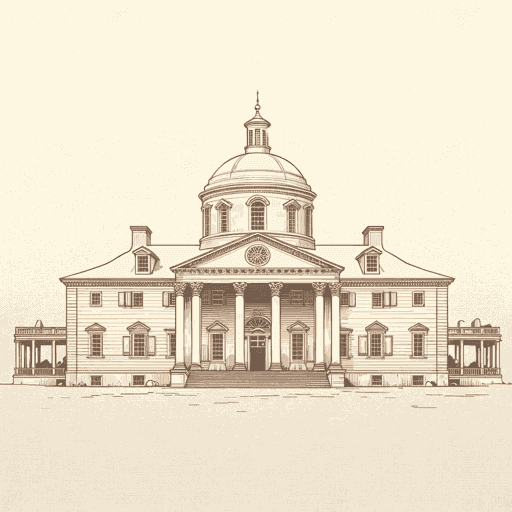
The contradictions were also physically present at Monticello, where the plantation’s design made much of the enslaved workforce less visible while featuring light-skinned enslaved people within the household, many of whom were members of Jefferson’s extended family. Their presence embodied the racial mixing that Jefferson claimed to oppose.
By the end of Jefferson’s life, his debt had reached more than $100,000, the modern equivalent of millions. Shortly after his final eloquent letter marking the 50th anniversary of the Declaration of Independence, 130 enslaved men, women, and children were sold at auction to pay his creditors, breaking up families in a way that Jefferson had always vowed would never happen. Jefferson’s arguments continued to influence Virginia’s debate over slavery after his death. In 1831, the Virginia legislature met in a special session to debate ending slavery. A county-by-county referendum showed that an overwhelming majority of white Virginians opposed any emancipation plan lacking a provision for removing formerly enslaved people. Professor Thomas Dew of the College of William and Mary then provided intellectual justification for this position in a widely circulated pamphlet, using Jefferson’s own arguments—that emancipation required removal and that removal was unfeasible—to declare all talk of emancipation finished. Ellis concludes that Jefferson’s failure to reconcile his egalitarian principles with his racial assumptions helped leave Virginia committed to slavery and contributed to the state’s subsequent economic and political decline.
Part 3 Analysis
By juxtaposing George Washington’s final years with Thomas Jefferson’s, the author constructs a comparison of their responses to the unresolved problem of slavery. The parallel narratives examine how each man confronted the contradiction between revolutionary principles and slavery late in life. Washington’s response developed through what Ellis calls a “long and somewhat tortured process” (172), in which concern for his historical legacy contributed to his eventual decision to emancipate the people he personally enslaved through his will. Ellis complicates the significance of that decision by emphasizing its delay and Washington’s continuing attachment to his authority as “master” of Mount Vernon. Jefferson continued to insist that emancipation depended on the removal of the freed Black population, even after his own calculations demonstrated the practical impossibility of such a program. Ellis uses the comparison to examine how two prominent members of the revolutionary generation confronted contradictions between their principles, racial assumptions, and participation in slavery, demonstrating that recognition of those contradictions didn’t necessarily lead to action.
Ellis makes historical legacy central to his treatment of both men, examining how their actions and ideas would be judged after their deaths. For Washington, who had come to see posterity as the only true form of immortality, Robert Pleasants’s letter presented a direct threat to his place in “the American pantheon” (174). His subsequent struggles with the legal, financial, and emotional obstacles to emancipation are repeatedly connected to his concern about how being an enslaver would affect his historical reputation. The will became his final, personal “farewell address,” allowing Ellis to connect Washington’s emancipation decision directly to how he wished posterity to remember him. Jefferson’s legacy is marked by historical irony. Ellis juxtaposes his final celebration of universal rights on the 50th anniversary of the Declaration of Independence with the subsequent sale of 130 enslaved people at Monticello. The proximity of these events exposes the distance between Jefferson’s language of liberty and the consequences of the slavery system in which his family and estate remained embedded. Ellis extends this irony beyond Jefferson’s lifetime, discussing how Thomas Dew drew upon Jefferson’s reasoning about emancipation and removal to argue that discussion of emancipation should end. Jefferson’s ideas therefore acquired an afterlife that deepens the contradiction between the egalitarian language for which he is remembered and the defense of slavery that his reasoning later helped support.
The plantations of Mount Vernon and Monticello function as physical expressions of the contradictions that Ellis identifies in their owners’ relationships to slavery. At Mount Vernon, the intermarriage of Washington’s enslaved people with Martha’s “dower slaves” and his financial difficulties made the plantation itself part of the obstacles surrounding emancipation. Ellis identifies a deeper obstacle in Washington’s attachment to his authority as “lord and master of his Mount Vernon kingdom” (178). His decision in his will to divide the estate itself is presented as an attempt to prevent Mount Vernon from surviving as a dynastic monument that would keep his identity as an enslaver at the forefront. Ellis uses Monticello’s physical organization to expose Jefferson’s racial contradictions. Its architecture made much of the enslaved workforce nearly invisible while placing light-skinned enslaved people prominently within the domestic setting, making racial mixing visible within the plantation itself. This arrangement exposes the contradiction between Jefferson’s opposition to a biracial society and the racial reality of his own household. It therefore develops White Supremacy as a Foundational Assumption, as Jefferson’s belief in Black inferiority and his rejection of racial coexistence persisted alongside his dependence on an enslaved workforce that visibly challenged the racial distinctions on which those arguments rested.
Ultimately, Ellis connects the final choices of Washington and Jefferson to the larger national failure to resolve slavery during the founding era. Washington’s final act remains limited in its political reach: His will emancipated the people he personally enslaved but didn’t constitute a public intervention against slavery as a national institution. Jefferson’s legacy extended more directly into the subsequent debate over emancipation. His insistence that emancipation depended on “expatriation” provided Dew with an authoritative precedent for arguing that discussion of emancipation should end once removal had been deemed impracticable. Ellis captures the consequence in his description of Dew’s argument as Virginia’s “declaration of dependence on slavery” (190). Jefferson’s private calculations, which showed that removal was financially and logistically unworkable, illustrate Demographic Pressures and the Limits of Reform by exposing the impossibility of the condition he had attached to emancipation: The Black population would continue to grow during the decades required to remove it. Ellis therefore traces the afterlife of Jefferson’s reasoning into the subsequent Virginia debate, where an argument used to defer emancipation became part of the case for abandoning it as a political objective.

Get in-depth, chapter-by-chapter summaries and analysis from our literary experts.
- Grasp challenging concepts with clear, comprehensive explanations
- Revisit key plot points and ideas without rereading the book
- Share impressive insights in classes and book clubs
Related Titles
By Joseph J. Ellis