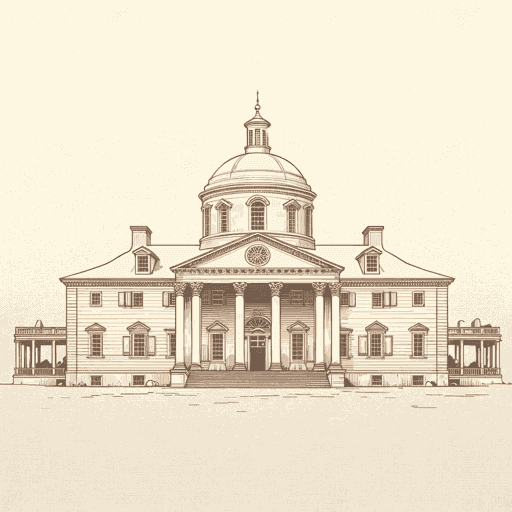
The Great Contradiction: The Tragic Side of the American Founding
A modern alternative to SparkNotes and CliffsNotes, SuperSummary offers high-quality Study Guides with detailed chapter summaries and analysis of major themes, characters, and more.
Summaries & Analyses
Quizzes
NEWReading Tools
Part 2, Chapters 3-5Chapter Summaries & Analyses
Content Warning: This section of the guide includes discussion of illness, death, racism, physical abuse, and emotional abuse.
Part 2: “Contexts”
Part 2, Chapter 3 Summary: “The Contradiction”
Chapter 3 explores the “great contradiction” at the heart of the American Revolution: the colonists’ passionate demand for liberty from British “slavery” while slavery remained embedded in the colonies. The author argues that the American argument, famously summarized as “[n]o taxation without representation” (27), was less about economics and more about power and control. Early revolutionary rhetoric, such as the 1764 pamphlet by Massachusetts lawyer James Otis, expanded the protest from a defense of British rights to an assertion of universal natural rights. Otis directly questioned how, under this new framework, enslaving Black people could be justified, framing British policy as a “plot to enslave [colonists]” (28).
This language was adopted by figures like George Washington. However, it also drew sharp criticism from figures like the English writer Samuel Johnson, who famously asked, “Why is it that we hear the loudest yelps for liberty from the drivers of negroes?” (29). In America, Quaker abolitionist Anthony Benezet confronted Virginia patriot Patrick Henry with the same hypocrisy. Henry admitted that he couldn’t justify slavery but continued to enslave people, which Ellis presents as an embodiment of the contradiction. In 1769, Thomas Jefferson drafted a bill in Virginia to make it easier for enslavers to free their slaves, but he deferred to a senior colleague, Richard Bland, to present it. Bland was buried beneath an avalanche of invective, and his career never recovered—a fate that Jefferson noted he would have shared had he presented the bill himself. The backlash exposed widespread racial prejudice among white Virginians and demonstrated the political danger of publicly advocating emancipation.
The First Continental Congress’s 1774 decision to include the importation of enslaved people in its broader boycott of British goods was, according to the author, a move whose true motives remain unknown—the documentary record is silent, and only plausible guesses can be offered. Ellis concludes that political and economic calculations shaped the decision and describes it as a “sideward step” on slavery. The author presents John Adams as a “prudent revolutionary,” committed to independence but opposed to what he saw as “radical Projects” like eliminating property qualifications for voting and expanding women’s rights, as advocated by his wife, Abigail Adams. Debate over the Dickinson Draft raised the question of whether to count enslaved people as persons or property for taxation. The delegates eventually based tax assessments on land value, removing slavery from the immediate debate and preserving southern support for the war for independence. The debate also revealed an expectation that political power would return to the states after the war.
Finally, the Continental Congress edited Jefferson’s draft of the Declaration of Independence, removing a long, convoluted paragraph that blamed King George III for the trafficking of enslaved people. However, the delegates left untouched the document’s most lasting phrase, “all men are created equal” (44), which Abraham Lincoln later described as intended for “future use.” Jefferson also dropped John Locke’s “property” from the trinity of natural rights, substituting a phrase borrowed from George Mason’s draft of the Virginia Constitution, “the pursuit of Happiness” (45), thereby depriving enslavers of the claim that enslaving people was a natural right protected by law.
Part 2, Chapter 4 Summary: “Unpainted Pictures”
This chapter argues that the popular, romanticized image of the Revolutionary War, shaped by artists like John Trumbull, obscures the conflict’s brutal realities and the essential role of African Americans. The racially integrated American army is often overlooked; for instance, 150 Black soldiers fought at the Battle of Bunker Hill. Although George Washington initially barred Black men from enlisting, manpower shortages forced him to reverse his decision. By the war’s end, African Americans comprised slightly more than 10% of the Continental Army; Ellis notes that Black and white soldiers would not again serve together in integrated American combat units until the Korean War.
In 1775, Lord Dunmore, Virginia’s recently exiled royal governor, sought to exploit Virginia’s vulnerability to its large enslaved population. He issued a proclamation offering freedom to self-emancipated people who joined his forces. This act terrified Virginia’s enslaving class, pushing many toward independence, and more than 800 enslaved people reached Dunmore within three weeks and volunteered to serve in his “Ethiopian Regiment.” However, the refugee camps were ravaged by smallpox; within weeks, over half of Dunmore’s roughly 1,000 “soldiers” were dead, and the other half were dying, establishing a pattern of disease as a primary cause of death for freedom seekers.
At Valley Forge, the weakness of the Continental government led Washington to call for greater federal power, but sovereignty remained concentrated in the states under the Articles of Confederation, making any national initiative against slavery impossible. The war exposed a growing sectional divide. Five northern states began the process of abolishing slavery, while political leaders in Virginia and South Carolina resisted proposals that threatened slavery. When the young officer John Laurens proposed arming enslaved men to defend Charleston in exchange for their freedom, the South Carolina legislature rejected the idea, choosing to protect slavery even at the risk of military defeat. Later, as the British war effort shifted south under commanders including Charles Cornwallis, more than 10,000 enslaved people fled toward British forces, although only about half reached Cornwallis’s army. He never armed them and viewed them as a logistical burden. At the Siege of Yorktown, Washington selected the predominantly African American Rhode Island regiment to lead a key assault on a redoubt; Alexander Hamilton persuaded Washington to let him lead the nighttime attack, with Laurens joining him. Just before his surrender, Cornwallis expelled his Black followers who were sick with smallpox.
At the war’s conclusion, British commanders Guy Carleton and Alexander Leslie defied the terms of the peace treaty, arguing that those who had sought freedom under British protection shouldn’t be returned to their former enslavers, as they allowed many formerly enslaved people to be evacuated to freedom in Nova Scotia and England. Washington sought the return of enslaved people he believed were in New York but recovered only two, and he ultimately chose not to press the matter publicly, unwilling to appear to be acting in his own self-interest and increasingly mindful of his historical legacy. The most immediate and historically significant postwar event was Washington’s resignation of his commission on December 23, 1783—described as perhaps the most consequential moment in American history—after which political power remained concentrated in the states under the Articles of Confederation, leaving antislavery initiatives to proceed at the state level.
Part 2, Chapter 5 Summary: “The Ghost at the Banquet”
Chapter 5 details how the US Constitution was the product of what the author terms a “coup d’état” by a small group of nationalists who, to create a strong central government, had to negotiate with the ever-present but unspoken issue of slavery—the “Ghost at the Banquet” (79). The Treaty of Paris had also given the US a vast western domain, raising the question of whether slavery would expand into the new territories. In the Ordinance of 1784, Jefferson proposed ending slavery in the territories by 1800, but the provision failed in Congress by one vote. After the war, nationalists including James Madison, Alexander Hamilton, and John Jay concluded that the weak Articles of Confederation were failing. To replace them, they helped bring about the Constitutional Convention and recruited a reluctant George Washington, whose presence lent the controversial project legitimacy.
Ellis argues that the nationalists sought to keep slavery off the official agenda because confronting it directly threatened the consensus necessary to create a national government. James Madison’s Virginia Plan set the terms of debate by proposing a complete replacement of the Articles in favor of a new, three-branch national government. The Convention’s first major crisis wasn’t over slavery but over representation, pitting large states against small ones. The resulting Great Compromise created a bicameral legislature—with proportional representation in the House and equal state representation in the Senate—establishing a hybrid government that was partly national and partly federal. Throughout the debates, the delegates feared two “ghosts”: monarchy, which they discussed endlessly, and slavery, which they avoided. Their distrust of direct democracy was evident in their creation of the Electoral College to filter the popular will.
Despite efforts to avoid it, slavery forced four major compromises. First, the Three-Fifths Clause was adopted as a political compromise for counting enslaved people when determining representation in the House. Second, a separate vote occurred not in Philadelphia but in New York, where southern delegates to the Confederation Congress cast votes in favor of the Northwest Ordinance, which prohibited slavery in the Northwest Territory—part of what the author describes as a plausible unspoken understanding that the Southwest would remain open to slavery’s expansion. Third, after delegates from South Carolina and Georgia threatened to walk out, New England delegates accepted the continuation of the Atlantic Slave Trade until 1808, while South Carolina and Georgia accepted a simple-majority requirement for legislation regulating imports and exports. This debate featured moral condemnations of slavery from Gouverneur Morris, Luther Martin of Maryland, and George Mason of Virginia. Fourth, near the end of the proceedings, the Fugitive Slave Clause was passed unanimously and without debate, requiring states where slavery had been abolished to participate in the return of formerly enslaved people.
In his closing speech, Benjamin Franklin urged the delegates to accept the Constitution’s imperfections, acknowledging that he didn’t entirely approve it but regarded a general government as necessary and doubted that any other convention could produce a better one. Years later, Morris captured the same resignation with his metaphor of the Constitution as a sectional marriage, taken “for better or for worse” (106). The resulting sectional compact endured for 74 years, until the Southern states seceded in 1861.
Part 2, Chapters 3-5 Analysis
Ellis locates the “great contradiction” within the expanding rhetoric of the American Revolution. As colonial arguments moved from the rights of Englishmen toward natural rights, the language of liberty created a standard against which American slavery could itself be judged. James Otis’s writings illustrate the implications of this rhetorical expansion, while Ellis’s juxtaposition of patriot claims with contemporary criticism from figures such as Samuel Johnson and Anthony Benezet demonstrates that the contradiction was already visible within 18th-century political and moral discourse. Patrick Henry made this tension especially explicit: Although he acknowledged that he couldn’t justify slavery, Ellis concludes that Henry would “continue to live the contradiction rather than live without his slaves” (29). Henry’s response illustrates how recognition of slavery’s inconsistency with revolutionary principles could coexist with continued participation in the institution. Ellis develops this pattern on a broader political scale through The Deferral of Emancipation for Political Unity, as revolutionary leaders repeatedly confronted the implications of their principles while limiting action that threatened the cohesion of “The Cause.”
The title “Unpainted Pictures” reflects Ellis’s use of historical scenes largely absent from familiar representations of the Revolutionary War. His discussion of John Trumbull establishes this concern with historical memory: Celebrated images preserve a heroic version of the Revolution while leaving Black participation at its margins. Ellis brings that marginal presence into focus, using Black participation on both sides of the conflict to complicate the patriotic meaning attached to revolutionary liberty. The response to Lord Dunmore’s proclamation sharpens this contradiction. The willingness of enslaved people to seek freedom through British lines exposed what Ellis calls the “Achilles’ heel of The Cause” (50): The same claim to freedom used to justify American resistance could support enslaved people’s claims to freedom from American enslavers. The alarm that this generated among Southern enslavers illustrates White Supremacy as a Foundational Assumption since the prospect of Black freedom became politically threatening within a society structured by racial slavery. Ellis also extends this critique to British policy, showing that British resistance to measures with explicit antislavery implications placed racial assumptions on both sides of the conflict under scrutiny.
The author frames the Constitutional Convention of 1787 through the provocative language of a coup d’état to emphasize how a relatively small group of nationalists redirected the existing debate over the Articles of Confederation toward the creation of a stronger national government. James Madison’s extensive preparation and the Virginia Plan reinforce this framing, showing how control of the Convention’s initial agenda gave the nationalists an early tactical advantage. Alongside this effort, Ellis emphasizes the nationalists’ attempt to keep slavery outside the central debate, using the metaphor of the “Ghost at the Banquet” to convey its persistent presence despite efforts to avoid sustained confrontation with it (79). This avoidance is particularly significant because the stronger national sovereignty sought by the nationalists also carried potential antislavery implications. Ellis therefore exposes a central difficulty in the constitutional project: Creating a government with greater authority over the states depended on maintaining the sectional cooperation that an open confrontation over slavery could jeopardize. His contrast between the two “ghosts” of slavery and monarchy further develops this point. Slavery remained threatening enough to suppress, while fears of monarchy generated extensive debate over executive power, revealing how the delegates’ political priorities determined which dangers could be openly confronted.
Ellis treats the four compromises over slavery as evidence of the political limits built into the constitutional project. The effort to keep slavery outside the central agenda couldn’t prevent sectional interests from shaping the final document, and Gouverneur Morris’s “frontal assault” on slavery makes the relative absence of moral argument elsewhere in the debates especially conspicuous. The willingness of South Carolina and Georgia to jeopardize the constitutional project over measures affecting slavery further demonstrates how preserving sectional cooperation restricted the available political choices. Ellis presents the resulting compromises as accommodations required to secure Southern participation in the new national government. The agreement permitting the Atlantic Slave Trade to continue until 1808 also illustrates Demographic Pressures and the Limits of Reform since continued importation contributed to what Ellis calls a “demographic explosion,” increasing both the scale of the enslaved population and the political power of the South. Franklin’s closing speech provides Ellis with a framework for interpreting these compromises as acknowledged imperfections accepted in the interest of securing the national union. Morris’s later description of accepting the Constitution “for better or for worse” extends Ellis’s marriage metaphor (106), presenting the Constitution as a sectional compact whose accommodation of slavery preserved the union while leaving the underlying conflict unresolved.

Get in-depth, chapter-by-chapter summaries and analysis from our literary experts.
- Grasp challenging concepts with clear, comprehensive explanations
- Revisit key plot points and ideas without rereading the book
- Share impressive insights in classes and book clubs
Related Titles
By Joseph J. Ellis