The Hounding
The Hounding
A modern alternative to SparkNotes and CliffsNotes, SuperSummary offers high-quality Study Guides with detailed chapter summaries and analysis of major themes, characters, and more.
Summaries & Analyses
Quizzes
NEWReading Tools
Background
Historical and Medical Context: Dr. John Freind and the Barking Girls
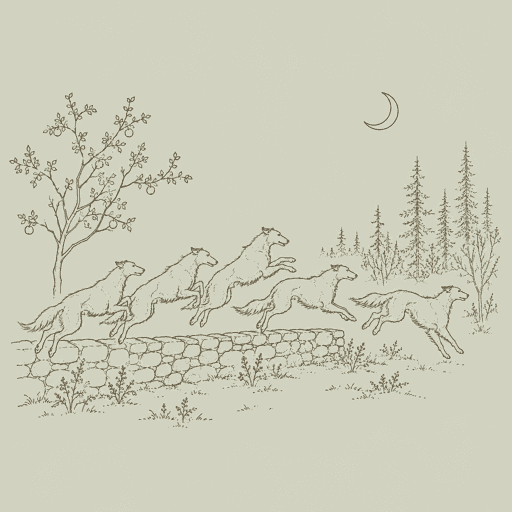
Xenobe Purvis grounds The Hounding in a real medical mystery from early modern England. In 1701, the physician Dr. John Freind (stylized as Dr. Friend in the novel) published a letter in the Philosophical Transactions of the Royal Society, a leading scientific journal, describing a strange case he had investigated in Oxfordshire. There, Freind documented a family in which several sisters were reportedly seized by violent convulsions that caused them to bark like dogs, an affliction that reportedly persisted for weeks and drew the attention of clergy, neighbors, and physicians alike. Freind approached the case with the empirical curiosity typical of Royal Society correspondents, yet his conclusions were shaped by the prevailing medical frameworks of his day. His account provides the novel’s foundational premise about five sisters in a rural English village whose bizarre affliction sparks fear and suspicion.
Central to Freind’s diagnosis, and to the world of the novel, is the early modern theory of animal spirits. When Dr. Friend examines the Mansfield sisters in Chapter 17, he attributes their fits to a “nervous disorder caused by erratic animal spirits” (155). To a modern reader, this may seem absurd, but it reflects mainstream medical thought at the time. Rooted in the work of the ancient Greek physician Galen and revived by 17th-century anatomists, the theory proposed that the nervous system functioned via a fine, vaporous substance produced in the brain. This invisible fluid, or spiritus animalis, was believed to travel through hollow nerves to control sensation and muscular movement. Physicians attributed a wide range of ailments, from convulsions and paralysis to mania, to a disturbance or imbalance of these spirits. It was an especially common diagnosis for women, whose bodies were considered inherently less stable and more susceptible to such disorders.
By drawing from a documented case published in a respected journal, Purvis establishes that the novel’s central conflict, while seemingly fantastical, reflects real anxieties and events of the period. The villagers’ reactions are not entirely baseless; rather, they are responding to a phenomenon that confounded even the medical experts of their time. Dr. Friend’s diagnosis reflects early modern medical thought, situating the events within a pre-scientific framework in which female psychological distress was interpreted through a physiological lens that ultimately failed to address the true causes of the girls’ suffering. The novel thus becomes an imaginative exploration of how a community grapples with the inexplicable, using a real historical footnote to examine the volatile intersection of medicine, superstition, and misogyny. The factual basis of the barking sisters invites readers to consider how easily real, misunderstood phenomena can be interpreted as supernatural threats with destructive social consequences for the socially marginalized.
Literary Context: The Virgin Suicides and the Voyeuristic Narrator
The Hounding employs a narrative strategy that shares a distinct lineage with Jeffrey Eugenides’s 1993 novel, The Virgin Suicides. Both novels center on a group of enigmatic sisters whose lives and eventual tragedies are filtered entirely through the obsessive, voyeuristic gaze of neighborhood boys and men. In The Virgin Suicides, the story of the five Lisbon sisters is told by a collective “we,” a group of men who, decades later, piece together their memories, fantasies, and scavenged artifacts to construct a narrative of the girls they could never truly know. This framing device highlights how the girls are reduced to objects of male fascination and speculation, their inner lives remaining inaccessible. Purvis adopts a similar technique. The villagers, particularly men like Pete Darling and Thomas Mildmay, define the Mansfield sisters through a mixture of desire, fear, and projection. The narrative often adopts a collective perspective, as seen in the Prologue where “the villagers” march toward the sisters, viewing them as a “shared enemy.”
Beyond the collective narrator and the cipher-like sisters, both novels share a preoccupation with confined domestic spaces, the transformation of ordinary girls into local legend, and the retrospective mood of a community attempting to explain what it never understood. The purpose of such a narrative strategy is twofold: It enacts the very silencing it critiques, forcing readers to confront the gaps and distortions produced by the male gaze, and it implicates the reader in the same voyeurism that consumes the sisters. This literary parallel illuminates Purvis’s critique of the male gaze. By framing the sisters through the eyes of the community that both desires and condemns them, the novel explores how misogynistic assumptions and collective fantasy can shape a narrative, ultimately silencing the women at its center and contributing to their destruction. Other works in this tradition include Emma Cline’s The Girls (2016), Megan Abbott’s The Fever (2015), and Lauren Groff’s Matrix (2021), each of which examines how female bodies and desires are refracted, and often deformed, through communal narration.

Get in-depth, chapter-by-chapter summaries and analysis from our literary experts.
- Grasp challenging concepts with clear, comprehensive explanations
- Revisit key plot points and ideas without rereading the book
- Share impressive insights in classes and book clubs