The Hounding
The Hounding
A modern alternative to SparkNotes and CliffsNotes, SuperSummary offers high-quality Study Guides with detailed chapter summaries and analysis of major themes, characters, and more.
Summaries & Analyses
Quizzes
NEWReading Tools
Chapters 6-10Chapter Summaries & Analyses
Content Warning: This section of the guide includes discussion of bullying, gender discrimination, animal cruelty and death, and graphic violence.
Chapter 6 Summary
Robin feels alienated from the other men in his village due to his aversion to their casual violence. To avoid suspicion, he forces himself to go to the Swan alehouse, where he finds the men excited about a “treat” organized by John. The treat is a badger-baiting, a cruel sport where dogs are set upon a cornered badger. Robin watches in horror as several dogs are bloodied as they’re goaded to attack the cornered animal. Pete pushes Robin toward the badger, and Temperance’s pitying gaze threatens to unmask him, so Robin steps forward and joins the men in kicking the badger after it appears to be dead. The animal rallies one last time before a mastiff kills it, leaving the men with an unsatisfied bloodlust.
On his ferry ride home, Pete makes a scornful remark about the badger wanting her liberty before giving Robin a look of suspicion after Robin tries to sound manly. Later, Robin encounters Anne and Elizabeth on the dark road. In an attempt to sound manly, he chastises them about being out so late. He immediately regrets it and, worried for their safety, starts to go back. He hears a disturbing, human-like barking sound and hides as a figure approaches. He is terrified to see it is Pete, coming from the direction the sisters had gone. Robin flees home.
Chapter 7 Summary
Joseph is resting in the orchard when he overhears Hester and Grace speaking in hushed, anxious tones. They discuss a terrible event that has occurred, which they feel powerless to stop. When Joseph confronts them, Hester claims they are merely playing a game about “pirates.” Later, inside the house, Joseph finds Elizabeth making rose water for his eyes, plucking petals from roses she has picked, while Anne is resting. He recalls that Anne and Elizabeth returned home unusually late and silent the previous evening.
Joseph questions Mary, who is pretending to be a cat. Mary confirms that all four of her older sisters have been acting sad and withdrawn, saying the strange behavior started with Anne and Elizabeth and then spread to Hester and Grace. Dropping her cat persona, Mary tells her grandfather that the trouble is “not nothing” but refuses to explain further. Joseph is left deeply unsettled by her cryptic warning, feeling a rising sense of dread.
Chapter 8 Summary
Thomas has developed a secret and intense infatuation with Anne. He resolves to act distant toward her to test if she returns his feelings. While the sisters and Thomas are picking cherries, he tells Mary a playful story about being a moon person, one of a tall, pale race who come down to earth once a month for mischief and revelry. Anne overhears and smiles at him, but Thomas deliberately ignores her. He immediately feels guilty, especially when he notices she looks pale and unwell.
Later, Thomas secretly observes Anne comforting Elizabeth, who is crying inconsolably. He hears Anne ask Elizabeth, “Do you trust me?” and promise that all will be well (75), before distracting her with cherries. Afterward, he watches Anne eat cherries with a wild, ravenous ferocity that he finds both unsettling and thrilling. When Anne catches him staring, he is too transfixed by her raw intensity to look away. He feels completely bewitched by her, realizing he would do anything she asked.
Chapter 9 Summary
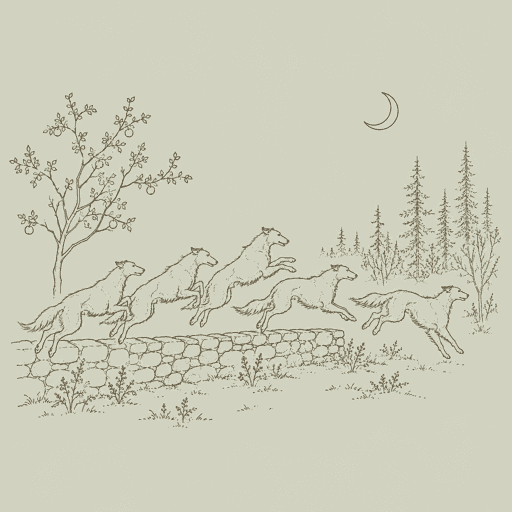
Temperance observes the five Mansfield sisters walking toward the river, noting that their severe expressions make the other villagers uneasy. While she is crossing the river on the ferry, Pete tells her there is something “unholy” and “wicked” about the girls. As dusk settles, they both watch the sisters on the opposite bank. Temperance hears a disturbing sound she forces herself to call “shouting” rather than barking. Pete calls her back, visibly terrified, and swears he has just witnessed the five sisters transform into dogs.
Although shaken, Temperance insists he was mistaken in the dim light and makes him promise not to spread such a dangerous rumor. Back at the alehouse, she tells her husband about Pete’s bizarre claim. Temperance attributes it to Pete’s stress about the drying river and his upcoming wedding, and John echoes her dismissals, calling it drunken nonsense.
Chapter 10 Summary
Pete visits his fiancée, Agnes Bullock, whom he is marrying out of duty and a sense of divine instruction. He dreamed of Agnes as Eve in Eden and interpreted it as God’s command to wed her. Breaking his promise to Temperance, Pete tells Agnes about the Mansfield sisters. He first describes the event as a “trick” but quickly escalates his claim, insisting he saw the girls’ bodies transform into dogs, growing fur and tails. Agnes is skeptical, which infuriates Pete, as he feels she is questioning his sanity and perception. She decides to tell her father, whom she believes “always knows what to do” (90).
On his way home, Pete passes the village women washing clothes at the low river and feels they are mocking him. He connects this feeling of public humiliation to the incident with the Mansfield sisters, believing they intentionally tried to scare and shame him. He concludes that he was right to tell Agnes and becomes determined to make the sisters feel the full force of his anger.
Chapters 6-10 Analysis
In the novel’s second section, Robin’s forced participation in the badger-baiting develops The Dehumanizing Nature of Patriarchal Control by demonstrating the brutal, performative masculinity that governs village life. Robin understands that for the men of Little Nettlebed, the “main god, the one at whose temple they worshipped most frequently, was violence” (51), and the alehouse was their “church” (51). Purvis’s invocation of religious imagery underscores how the characters’ society enshrines this violent, entitled sense of masculinity. Robin, whose gentle nature and affection for animals alienates him from this world, understands that he must mimic the men’s cruelty to avoid becoming a target himself. His reluctant decision to join in kicking the seemingly dead badger is prompted by Temperance’s pitying gaze, which threatens to unmask his softness and expose him to scorn. This public performance of violence illustrates how their society’s rigid, patriarchal codes compel even compassionate individuals to commit acts they abhor and how rigid gender norms harm men as well as women. The scene foreshadows the persecution of the Mansfield sisters; Pete’s scornful remark that the badger “wanted her liberty” links the animal’s female-coded defiance to the sisters’ desire for freedom, framing both as provocations that must be violently suppressed. Robin’s subsequent verbal cruelty toward Anne and Elizabeth is a continuation of this agonizing performance, an attempt to renounce the gentleness that he believes makes him vulnerable.
The narrative tracks how a private, distorted perception escalates into a public threat, laying the groundwork for The Danger of Mob Mentality. The rumor originates with Pete, who, in the deceptive dusk light by the river, claims to see the five Mansfield sisters physically transform into dogs. His account blends genuine fear and misogynistic projection as he has already labeled the girls “unholy” and “wicked” before he formulates his supernatural claim. Temperance’s initial reaction is to suppress the story, recognizing it as dangerous nonsense born of intoxication and stress. However, Pete’s need to reassert his authority, especially after feeling emasculated by his fiancée’s skepticism and the perceived mockery of the village women, compels him to spread the tale. By confiding in Agnes, he consciously unleashes what he knows will spread like “a lit taper into a hayrick” (87), transforming his personal grievance into a public accusation. The process is incremental: He first tells Agnes it was a “trick,” but when that fails to command belief, he claims that they performed “[d]evilry” by undergoing a physical transformation. This sequence reveals how easily a community can weaponize superstition, allowing one man’s insecurity and anger to construct a narrative that justifies collective persecution.
The villagers’ burgeoning anxieties are amplified by the motif of the drought, which creates a fertile ground for Scapegoating Oppressed Communities in Times of Crisis. The dwindling water level of the Thames is a source of deep economic and social stress. For Pete, the low water is a direct threat to his livelihood, a tangible crisis that leaves him feeling powerless. As he walks past the women struggling to wash clothes in the shallow river, he projects his own vulnerability onto them, imagining their expressions as smirks of mockery. His inability to combat the natural crisis of the drought fuels his need for a human target. The Mansfield sisters, already objects of suspicion due to their independence, become the object of his displaced anger and fear. The supernatural story he invents provides a convenient explanation for the unnatural state of the world and offers an enemy that, unlike the weather, can be confronted and punished. The community’s unease about the failing environment is thus channeled into suspicion of the five sisters, whose alleged “unholy” nature is blamed for the land’s suffering.
The author uses Pete and Thomas’s contrasting perspectives to explore the male gaze, revealing how the sisters are consistently defined through lenses of male fear and desire. Pete’s gaze is paranoid and accusatory; he watches the sisters from across the river and interprets their presence as a personal threat, culminating in his vision of their monstrous transformation. His perception turns them into supernatural aggressors who are mocking and testing him. Thomas, in contrast, watches Anne with an obsessive, romantic longing. His gaze is also an act of projection, but it transforms her into an object of intense desire. When he observes her eating cherries with a ravenous “wildness” that both thrills and unsettles him, he is not seeing the real Anne but a fantasy constructed from his own infatuation. The two men’s powerful emotions and biases, one distorted by fear and the other by desire, make them both unreliable narrators. This prevents the reader from knowing the sisters’ true experiences with certainty. Their inner lives remain a mystery, reduced to their grandfather’s overheard fragments and Mary’s cryptic warning that their trouble is “not nothing.” This narrative strategy highlights how the sisters’ reality is overwritten by the powerful and ultimately destructive male-authored stories told about them.
While the men of the village construct narratives of the sisters’ monstrosity and desirability, the Mansfield household becomes a closed space of shared trauma and protective secrecy. In the aftermath of the unspoken event involving Pete on the road, the sisters withdraw into themselves, their bond tightening in the face of a threat only they understand. Their grandfather’s attempts to penetrate their silence are met with deflection and coded language. Hester dismisses their anxious conversation as a game of “pirates,” and Mary refuses to elaborate on their distress because “that’s tattling” (67). The sisters’ individual actions register their shared shock: Elizabeth obsessively plucks rose petals while Anne rests in isolation. Their solidarity becomes a defense mechanism against a world that cannot or will not understand their experience. Anne’s quiet, firm comforting of the weeping Elizabeth reveals the new dynamic of their relationship, centered on survival and mutual reliance. Her question, “Do you trust me, Lizzie?” (75), is a plea for the unity they will need to endure what is coming. The narrative deliberately withholds the specific details of their trauma, focusing instead on its emotional fallout and the way it reshapes their sisterhood into a fortress against an external world that is already beginning to turn against them.

Get in-depth, chapter-by-chapter summaries and analysis from our literary experts.
- Grasp challenging concepts with clear, comprehensive explanations
- Revisit key plot points and ideas without rereading the book
- Share impressive insights in classes and book clubs