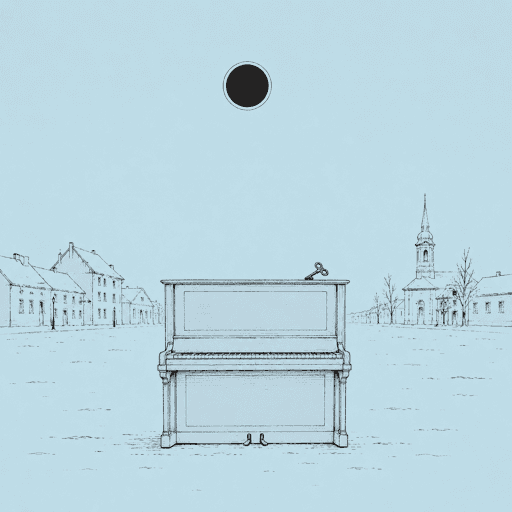
The Melancholy of Resistance
The Melancholy of Resistance
A modern alternative to SparkNotes and CliffsNotes, SuperSummary offers high-quality Study Guides with detailed chapter summaries and analysis of major themes, characters, and more.
Summaries & Analyses
Quizzes
NEWReading Tools
Background
Content Warning: This section of the guide includes discussion of death and graphic violence.
Historical Context: The Collapse of Hungarian Communism
László Krasznahorkai’s novel was first published in Hungary in 1989, a year of monumental political transformation that marked the end of four decades of communist rule. This period, known as the Rendszerváltás (Hungarian for “system change”), was characterized by a rapid unraveling of the state’s authority and a pervasive sense of social and economic instability.
At the end of the Second World War, the Soviet Union exercised strong influence over the Second Republic of Hungary, having occupied it after the Siege of Budapest. From 1945 to 1947, the Hungarian Communist Party gained power in the country’s parliament, allowing them to lock out other parties with the threat of exile. By the time of the next election in 1949, voters could only select candidates from the communist-aligned party, the Independent People’s Front. With their takeover of the government, the new parliament ratified a constitution that mirrored the Soviet Union’s. The Hungarian People’s Republic established itself as a communist state, governed by a single-party system: first, the Hungarian Working People’s Party, and then, later, by the Hungarian Socialist Workers’ Party. The shift in ruling parties occurred in 1956, following an attempted revolution throughout the country that protested the state’s subordination to the Soviet Republic, as well as the Hungarian government’s failure to address key economic issues since the establishment of the republic. The Soviet Union sent soldiers to quell the revolution, and the Hungarian government responded to the call for reforms by instituting the New Economic Mechanism. The Mechanism, however, failed to alleviate social issues and instead led to inflation, a decrease in wages, and widespread poverty. By the 1980s, the Soviet Union was in steep decline, leaving it unable to repress any revolutionary efforts as it had done previously. At the end of the decade, the Eastern Bloc coalition of states that were aligned with the Soviet Union collapsed, allowing Hungary to follow suit. Throughout 1989, Hungary experienced a series of key events that constituted the Rendszerváltás, including the legalization of independent political parties, the ceremonial reburial of Imre Nagy (a leader of the 1956 uprising who had been executed by the communist government), and the opening of its border with Austria, which allowed thousands of East Germans to escape to the West and accelerated the fall of the Berlin Wall. The Hungarian People’s Republic was subsequently replaced by the Third Republic of Hungary.
This context of a collapsing order is the bedrock of the novel’s atmosphere. The text’s opening description of a failing railway system, a town plagued by an “ever-spreading all-consuming chaos,” (3) and a populace seized by a “common sense of foreboding” (4) directly mirrors the existential dread of late-socialist Eastern Europe. The arrival of the circus and the mysterious whale acts as a catalyst, exploiting the power vacuum and escalating anxieties into mob violence. The town’s descent into anarchy, which is marked by random violence, failing infrastructure like the town-wide power outage, and the emergence of silent, menacing crowds, is an allegory for the societal breakdown occurring as the old Soviet-backed regime crumbled, leaving behind a terrifying and uncertain future.
Philosophical Context: Werckmeister and the Critique of Temperament
The novel’s second part is titled “The Werckmeister Harmonies,” directly referencing Andreas Werckmeister, a real 17th-century German music theorist. Werckmeister is best known for his work on well-tempered tuning systems, which were precursors to the modern system of equal temperament. Equal temperament is a method of tuning that adjusts, or “tempers,” the pure mathematical intervals of the harmonic series to divide the octave into twelve equal semitones. This compromise allows music to be played in any key with acceptable, though not perfect, consonance. Before this, systems like just intonation used pure, acoustically perfect intervals, creating sublime harmony in some keys but harsh dissonance in others, severely limiting musical modulation. The Werckmeister temperament is characteristic of the thinking of the Age of Enlightenment, which began in the late 17th century and reached its peak in the 18th. Driven by the ideals of the Scientific Revolution, as well as thinkers like the empiricist Francis Bacon and the rationalist René Descartes, the Enlightenment championed human reason over a natural ideal proposed by religious institutions like the Catholic Church. By creating artificial divisions that resulted in pleasing and equal semitones, Werckmeister essentially showed humanity’s ability to master the modulation of sound in ways that they could perceive as beautiful, even if these divisions were not reflected in nature.
In the novel, the reclusive musicologist György Eszter becomes obsessed with this compromise, arguing that Werckmeister’s system destroyed natural, divine harmony for the sake of artificial human convenience. György’s rejection of temperament is a philosophical critique of the Enlightenment’s faith in rational, man-made systems. He sees it as a foundational error that traded authentic, albeit flawed, harmony for a functional but inherently false order. This critique extends to the social world of the novel. The town’s failing social order, like equal temperament, is a human construct that papers over deep, natural dissonances. The arrival of the whale and the subsequent chaos represent the collapse of this artificial system and the violent return of a more primal, untempered reality.

Get in-depth, chapter-by-chapter summaries and analysis from our literary experts.
- Grasp challenging concepts with clear, comprehensive explanations
- Revisit key plot points and ideas without rereading the book
- Share impressive insights in classes and book clubs