The Melancholy of Resistance
The Melancholy of Resistance
A modern alternative to SparkNotes and CliffsNotes, SuperSummary offers high-quality Study Guides with detailed chapter summaries and analysis of major themes, characters, and more.
Summaries & Analyses
Quizzes
NEWReading Tools
Symbols & Motifs
Content Warning: This section of the guide includes discussion of animal cruelty and death and graphic violence.
The Whale
The giant, taxidermied whale is the central symbol of the novel, representing a mystery whose arrival serves as the catalyst for the town’s collapse. Hauled into the landlocked, frozen town in an enormous, sealed truck, the whale is an object of cosmic absurdity, an inexplicable intrusion that ruptures the fragile routines of daily life. For the naive Valuska, the creature inspires pure awe; he is unable to comprehend its sheer scale, reflecting humanity’s inability to grasp the universe’s indifferent vastness. Upon first seeing it, Valuska understands that “to comprehend the enormous tail fin, the dried, cracked, steel-grey carapace and, halfway down the strangely bloated hulk, the top fin, which alone measured several metres, appeared a singularly hopeless task” (88). This confrontation with an object that defies easy comprehension emphasizes the theme of The Irrepressible Chaos of the Universe, as the whale’s presence exposes the inadequacy of human perception in the face of the truly monumental and strange. It is a piece of a distant, unknowable world inexplicably deposited in the town square, forcing a reckoning with forces beyond understanding.
The whale’s meaning is derived from what the fearful townspeople project onto it. As a dead, passive hulk, it becomes a perfect, blank screen for their collective anxiety and dread. The silent, ominous crowds gather around it, their formless fear making them ripe for manipulation. In this way, the whale becomes an unwilling centerpiece in The Role of Fear in Totalitarianism, providing the pretext for the mob to assemble and await the demagoguery of The Prince. Furthermore, as a “petrified giant” (89), the whale symbolizes the effect that confronting a meaningless universe has on the human will. It is a colossal corpse, an emblem of a world devoid of inherent purpose. Its sheer lifelessness offers no answers or consolation, only a stark reflection of decay and finality. Its presence consequently inspires a stunned fear that soon curdles into nihilistic violence, embodying the theme of The Impact of Futility on Human Agency.
The Circus
The traveling circus is a symbol of a disruptive and predatory external force that exploits a community’s latent fears to deliver chaos under the guise of spectacle. Arriving in a “spectral contraption” (23), the circus is a Trojan horse, entering the town by promising an extraordinary attraction while concealing a nihilistic agenda. Its presence is the result of a deliberate political maneuver by Mrs. Eszter, who pushes for its admission despite knowing that “the weird troupe caused alarm and unrest wherever it appeared” (48). This act demonstrates how ambitious figures can willfully invite destabilizing forces into a society to create an atmosphere of crisis they can then exploit. The circus functions less as public entertainment than it does as an apparatus for social engineering, creating the perfect conditions for the theme of the role of fear in totalitarianism. It transforms the town square from a civic space into a stage for demagoguery, gathering the anxious and disaffected into a volatile mob.
While the whale is the circus’s passive centerpiece, the circus itself, with its mysterious Director and the unseen Prince, is an active agent of disruption. It shows a cynical enterprise that understands how to monetize and manipulate public anxiety. The Director treats the gathering crowd with contempt, intentionally heightening tension by delaying the performance, while The Prince uses the platform provided by the circus to give voice to the mob’s destructive impulses. The circus, therefore, symbolizes the process by which a society’s vulnerabilities, including its boredom, fear, and longing for meaning, are preyed upon by opportunistic forces that promise a spectacle but ultimately unleash anarchy. It is the mechanism that allows the town’s fragile belief in its own order to be shattered, proving that seemingly harmless diversions can become the instruments of a society’s complete unraveling.
Werckmeister Harmonies
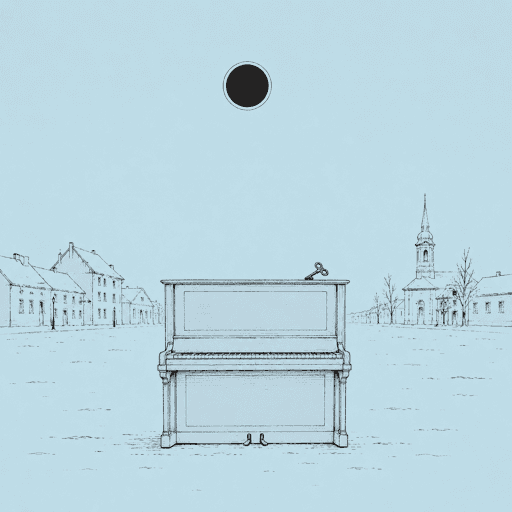
The Werckmeister harmonies are a recurring motif representing humanity’s flawed and artificial attempts to impose a simplified, rational order on the complex, chaotic nature of reality. For the reclusive musicologist György Eszter, the historical shift to Andreas Werckmeister’s system of “equal temperament” tuning is the philosophical root of all modern decay. He comes to believe this system, which compromises pure, natural harmonic intervals for the sake of musical convenience, is a foundational lie that has corrupted civilization. György is horrified to discover that the sublime music he revered was built on a deception, that he had been “merely dallying in the noxious marshes of its simplicity, a simplicity that had in fact turned out to be ‘false to the core’” (115). This obsession directly articulates the theme of the irrepressible chaos of the universe, suggesting that human systems, from musical scales to social structures, are fraudulent constructs that create a comforting illusion of order while fundamentally violating a more complex and authentic natural state.
György’s revelation about the harmonies is the source of his deep disillusionment, illustrating the theme of the impact of futility on human agency. Convinced that Western civilization is based on a lie, he concludes that all action is pointless and retreats into a state of seclusion. His “resistance” is to reject the compromised world entirely. After being forced out of his home and seeing the chaos of nature made manifest, he retreats back into a perfectly isolated aesthetic bubble. He painstakingly retunes his piano away from the Werckmeister system, back to a “pure” scale as an act of complete surrender. He abandons the world and its inherent dissonance to create a tiny, self-contained, and ultimately meaningless pocket of ideal harmony. This act symbolizes the tragic fate of the intellectual who, upon discovering the irreconcilable conflict between human systems and cosmic reality, is rendered incapable of any meaningful action within the world as it is.
Rubbish and Decay
The pervasive motif of rubbish and decay is the physical manifestation of the town’s social, spiritual, and moral collapse. From the opening pages, the narrative emphasizes a world succumbing to entropy, where human maintenance has failed and the environment is reverting to a state of ruin. Mrs. Plauf is forced to tread on the “uneven surface of rubbish frozen to the pavements” (22), and when György ventures outside, he is horrified to realize that the roads are covered with a “seamless, chinkless armour of detritus” (127). This ever-present layer of waste is more than a feature of the setting; it is a symbol of a society that has lost its will to sustain itself. The town is literally being buried under its own neglected filth, which mirrors the breakdown of civic order, social responsibility, and meaning. This motif is the most tangible expression of the theme the irrepressible chaos of the universe, demonstrating the triumph of decay over human systems and the slow, inevitable disintegration of a world abandoned to its own refuse.
The frozen state of the rubbish is particularly significant, suggesting that the decay is a new, permanent state of being. The filth has become solid, fixing itself as though it were one of the buildings and turning the landscape of the town into a geology of failure. This oppressive atmosphere contributes directly to the theme of the role of fear in totalitarianism. The squalor and desolation of the town isolate its citizens, creating a sense of hopelessness and anxiety that makes them vulnerable to the promises of any demagogue who offers a radical, violent cleansing. Consequently, Mrs. Eszter’s social movement is predicated on a slogan that promises widespread cleanliness, a deception necessary for her to consolidate power over the town’s militant and violent elements. The crumbling buildings, failing infrastructure, and accumulating waste create a world that feels fundamentally broken and irrational, a perfect breeding ground for the nihilistic rage that The Prince so expertly manipulates. The physical decay of the town is thus inextricably linked to its political and moral decay, with the landscape of rubbish providing the fertile soil from which the mob’s violence grows.

Unlock the meaning behind every key symbol & motif
See how recurring imagery, objects, and ideas shape the narrative.
- Explore how the author builds meaning through symbolism
- Understand what symbols & motifs represent in the text
- Connect recurring ideas to themes, characters, and events