The Melancholy of Resistance
The Melancholy of Resistance
A modern alternative to SparkNotes and CliffsNotes, SuperSummary offers high-quality Study Guides with detailed chapter summaries and analysis of major themes, characters, and more.
Summaries & Analyses
Quizzes
NEWReading Tools
Important Quotes
Content Warning: This section of the guide includes discussion of graphic violence, animal cruelty and death, sexual harassment, gender discrimination, cursing, physical abuse, substance use, mental illness, and death.
“To tell the truth, none of this really surprised anyone any more since rail travel, like everything else, was subject to the prevailing conditions: all normal expectations went by the board and one’s daily habits were disrupted by a sense of ever-spreading all-consuming chaos which rendered the future unpredictable, the past unrecallable and ordinary life so haphazard that people simply assumed that whatever could be imagined might come to pass…”
(Part 1, Page 3)
This opening passage establishes the novel’s central premise: Society is collapsing into overwhelming chaos. The sentence’s complex structure, which extends beyond the end of this passage, mirrors the suffocating nature of the disorder it describes. People’s passive acceptance of the bizarre and unpredictable enacts the breakdown of external order, leading the people to believe that human agency is futile.
“Go screw yourself, you old whore. You’re not worth breaking down the door for. I wouldn’t even bother to drown you in the slop-pail.”
(Part 1, Page 12)
Spoken by the unshaven man on the train to Mrs. Plauf, this quote exemplifies the complete breakdown of social decency and the rise of raw, contemptuous aggression. The man’s language is an act of psychological violence that strips Mrs. Plauf of her dignity and personhood. His insult derives from a misinterpretation of her actions, which reduce Mrs. Plauf into an object for pleasure, meant to distract him from the despair of the world.
“Down in its depths, around the artesian well, she glimpsed a clotted mass of shadows, a dumb group, who, it suddenly seemed to her, were silently beating someone.”
(Part 1, Page 22)
This image, witnessed by Mrs. Plauf as she walks through the blacked-out town, powerfully conveys the nature of the encroaching violence. The perpetrators are described as a “clotted mass of shadows,” making them anonymous and elemental rather than human. This foreshadows the emergence of the mob that will enact the destruction of the town, as well as Mrs. Plauf’s death.
“Yes, it might all have been a dream, since she, who for years had lived out a routine of spring-cleaning in the spring and jam- and preserve-making in the autumn, of crochet work in the afternoons, and a daily round comprising the usual cares and joys of passionate indoor gardening, had got used to observing the crazy whirlpool, the mad comings and goings of the outside world, from the decent distance and kindly shelter of her inner one, knowing that whatever fell outside its scope was cloudy, formless and uncertain.”
(Part 1, Page 30)
After her harrowing journey, Mrs. Plauf retreats into her meticulously ordered home, a psychological fortress against external chaos. This passage contrasts the tangible reality of her domestic routine with the “cloudy, formless and uncertain” world outside. Her home symbolizes a fragile, artificial order, a desperate attempt to maintain personal meaning amidst societal disintegration.
“[T]his slow decay had, for her, long ceased to signify some terminal disillusion but was instead a harbinger of what would soon replace a world as ripe for ruin as this; not an end then but a beginning, something that would be founded ‘not on sickly lies but on the harsh merciless truth’, something that would place supreme emphasis on ‘fitness of body and a powerful and beautiful desire for the intoxicating realm of action.’”
(Part 1, Page 45)
This quote reveals Mrs. Eszter’s worldview, a stark contrast to Mrs. Plauf’s fear. Where others see terrifying collapse, Mrs. Eszter sees welcome destruction, a necessary cleansing that will precede a new authoritarian order founded on “harsh merciless truth.” Her perspective illuminates how totalitarian ideologies thrive in chaos by framing decay as rebirth.
“For weeks now they had lived in a state between confusion and unease bordering on nervous melancholy, and having, furthermore, taken note of the posters that had appeared this very evening confirming rumours from nearby suburbs that the enormous, almost inevitably ill-omened whale was certain to arrive on the morrow (after all, ‘Who knows what this means? What it will lead to …?’), they were more than a little drunk by the time Valuska had arrived at this particular station of his rounds.”
(Part 2, Page 66)
This passage establishes the novel’s mood of pervasive unease. The townspeople are suspended in “nervous melancholy,” their anxiety amplified by rumors of the whale’s arrival. This impending, “ill-omened” spectacle becomes a focal point for their vague fears, introducing the apocalyptic tone that permeates the narrative and foreshadows the impending chaos.
“Once given the word, the paraphernalia of the sensible universe—of which he had only a somewhat foggy perception in any case—immediately dropped away, he ceased to have any awareness of where he was or whom he was with, a single wave of the magician’s wand admitted him to the magical terrain; he lost sight of earthly things, whatever had weight, colour or shape simply dissolved in an all-pervasive lightness, it was as if the Peafeffer itself had gone up in a cloud of steam, and he was left alone with the brethren under God’s own sky, his gaze absorbed by ‘the marvels’ of which he spoke.”
(Part 2, Page 68)
This quote illustrates Valuska’s unique consciousness, which transcends the grim reality of his surroundings. For him, explaining the cosmos is a transformative act, a magical escape from the mundane world into a realm of pure wonder and lightness. This highlights his role as a visionary, detached from earthly concerns and absorbed in celestial marvels.
“And in this terrible and incomprehensible twilight…even the birds (‘The birds!’ cried Valuska, in rapture, throwing his arms up to the sky, his ample postman’s cloak flapping open like bat’s wings)…‘the very birds are confused and settle on their nests! And then…silence…And every living thing is still…and we too, for whole minutes, are incapable of speech…Are the hills on the march? Will heaven fall in on us? Will earth open under our feet and swallow us? We cannot tell. It is a total eclipse of the sun.”
(Part 2, Page 73)
In the tavern, Valuska uses drunken patrons to perform a solar eclipse. This act reveals his desperate attempt to find and share a vision of cosmic harmony amid encroaching societal chaos. The simile comparing his cloak to “bat’s wings” subtly foreshadows the darkness his innocent performance is trying to hold at bay. At the same time, his comparison to a bat also hints at his obliviousness to the encroaching chaos that everyone else around him can perceive in broad daylight.
“For Valuska, disappointed in his desire to have the dizzying vaults of heaven constantly in view, had got used to staring at nothing but the ground beneath him, and consequently didn’t actually ‘see’ the town at all.”
(Part 2, Page 77)
This quote captures the central paradox of Valuska’s existence. While his mind is consumed with the vastness of the cosmos, he is physically grounded, his gaze fixed on the refuse-strewn pavements below. He navigates his decaying town without truly seeing it, his inner vision of celestial order rendering him oblivious to his immediate surroundings. This explicates the ideas hinted at in the previous passage.
“Seeing the whale did not mean he could grasp the full meaning of the sight, since to comprehend the enormous tail fin, the dried, cracked, steel-grey carapace and, halfway down the strangely bloated hulk, the top fin, which alone measured several metres, appeared a singularly hopeless task. It was just too big and too long: Valuska simply couldn’t see it all at once, and failed even to get a proper look at its dead eyes.”
(Part 2, Page 88)
The whale’s immense, incomprehensible form symbolizes the overwhelming and mysterious nature of the events unfolding in the town. Valuska’s inability to see the creature in its entirety reflects the characters’ limited understanding of the forces at play. The whale is a monstrous, silent testament to a world beyond human grasp, its presence both fascinating and unsettling.
“Despite all this, while Valuska stood surprisingly undisturbed in his happy stupor, the others—who continued trudging compliantly round the whale in the stinking gloom—not only showed no signs of being similarly affected but gave the decided impression that the highly visible object of the advertisements itself was of limited interest.”
(Part 2, Page 89)
This passage highlights the deep disconnect between Valuska and the crowd. While he is lost in wonder at the whale, the others are unmoved, their attention directed elsewhere. Their disinterest in the spectacle itself suggests they are waiting for something more, a hypothetical presence or event that fuels the town’s underlying tension and foreboding.
“The stove with its graceful copper feet was ‘merrily blazing’ as they say, and as it happens, this was the only item in the room which did not immediately betray the fact that time had terminally ravaged it: for the once-splendid Persian rugs, the silk wallpaper, the useless chandelier dangling from the cracked ceiling rose, the two carved armchairs, the settee, the marble-covered smoking table, the etched mirror, the dull, precarious Steinway and the countless cushions, tapestries, pieces of porcelain bric-à-brac, all these inherited memorials of the family drawing room, each and every one of them, had long ago given up the hopeless struggle and the only thing that prevented them from crumbling and disintegrating where they stood was, in all likelihood, the ten years’ worth of dust that thickly insulated them and, perhaps, his own mild, permanent, practically stationary presence.”
(Part 2, Page 100)
György’s drawing room becomes a microcosm of the novel’s world, a space where time has “terminally ravaged” everything. The description of the decaying furniture, held together only by dust and his static presence, symbolizes the fragility of order and beauty. His room is less a sanctuary than it is a museum of disintegration, mirroring the external collapse while also suggesting the tenuous nature of his intellectual resistance to society.
“Reserving to himself the right to change his mind, Werckmeister cut the Gordian knot with a cavalier swish of his sword and, maintaining only the precise intervals between octaves, divided the universum of the twelve half-tones—what was the music of the spheres to him!—into twelve simple and equal parts, so that henceforth, after easily overcoming the feeble resistance of those with a vague hankering after pure tonalities and much to the understandable delight of composers, the position was established.”
(Part 2, Page 115)
This passage introduces the Werckmeister harmonies, a tuning system compromising natural purity for functional simplicity, as a motif representing humanity’s broader tendency to impose artificial, flawed systems on chaotic reality. The allusion to the “Gordian knot” of Greek legend points to the breakthrough that the Werckmeister harmonies and the Age of Enlightenment believed they were reaching. They had resolved the intractable issue of chaos by imposing a new artificial order, which only György can perceive the violence of.
“The world, as Eszter established, consisted merely of ‘an indifferent power which offered disappointment at every turn’; its various concerns were incompatible and it was too full of the noises of banging, screeching and crowing, noises that were simply the discordant and refracted sounds of struggle, and that this was all there was to the world if we but realized it.”
(Part 2, Page 117)
György’s philosophical conclusion strips the world of any inherent meaning or harmony, portraying it as a realm of indifferent, chaotic forces. This bleak worldview, a stark contrast to Valuska’s cosmic wonder, presents existence as a series of discordant struggles and constant disappointment, setting the intellectual and emotional tone for the novel’s unfolding catastrophe.
“Faith, thought Eszter, recognizing his own stupidity, is not a matter of believing something, but believing that somehow things could be different; in the same way, music was not the articulation of some better part of ourselves, or a reference to some notion of a better world, but a disguising of the fact of our irredeemable selves and the sorry state of the world, but no, not merely a disguising but a complete, twisted denial of such facts: It was a cure that did not work, a barbiturate that functioned as an opiate.”
(Part 2, Page 117)
Here, György deconstructs the concepts of faith and music, stripping them of their redemptive power. He concludes that both are forms of self-delusion: opiates that disguise the ugly reality of human existence. This cynical revelation marks the final collapse of his belief system, leaving him in a state of deep despair.
“His ostensible response was a simple, ‘Well, well…’ but he was horrified: It was impossible, you couldn’t throw away, you couldn’t drag here such an enormous volume of it, and, since what he saw far exceeded anything that might have been credibly explained to an individual of normal intelligence, he felt that, taking the scale of this extraordinary and ‘monstrous work of havoc’ into account, he might be justified in risking the opinion that ‘the exclusively human capacity for mind-numbing levels of neglect and indifference was, beyond a doubt, truly limitless.’”
(Part 2, Page 127)
Forced to leave home, György confronts the town’s physical state. The overwhelming presence of rubbish, a “monstrous work of havoc,” horrifies him as proof of humanity’s limitless capacity for indifference. This concretizes the motif of decay as a physical manifestation of the spiritual and social collapse, especially in the context of György’s hyper-aware perception of natural chaos and artificial order.
“His followers will wreak havoc because they understand his vision perfectly. His followers understand that all things are false pride, but don’t know why. The Prince knows: It is because the whole does not exist. The director cannot grasp this, the director is in his way. The Prince is bored with him; he is going out.”
(Part 2, Page 160)
This passage articulates the nihilistic worldview of the mysterious Prince. The idea that “the whole does not exist” is a justification for destruction and chaos. It is a philosophy that negates order and meaning, empowering his followers to wreak havoc by revealing the “false pride” inherent in societal structures. In this way, The Prince’s philosophy articulates Mrs. Eszter’s political opportunism, using the latent patriotic sentiments within the crowd to enact a power vacuum that she can immediately fill.
“A town built on lies will continue to be a town built on lies,’ the factotum spoke for the more agitated chirruping. ‘What they do and what they will do are both based on lies and false pride. What they think and what they will think are equally ridiculous. They think because they are frightened. Fear is ignorance. He says he likes it when things fall to pieces. Ruin comprises every form of making: lies and false pride are like oxygen in the ice. Making is half: ruin is everything. The director is frightened and doesn’t understand: His followers are not frightened and do understand.’”
(Part 2, Page 160)
The aphoristic declaration that “ruin is everything” reveals the ideological engine of the chaos to come. It establishes that the mob’s violence as a pure expression of destruction, embraced as a more authentic state of being. The novel proposes this philosophy as a counterpoint to György’s preference for a natural chaos, underscoring it as a condition that leaves society vulnerable to widespread violence.
“He had spoken up against it and had never ceased interrogating it, wanting to know why it was irrational; like a fly he kept buzzing in its ear and would not be waved away, but now the buzz was out of him, he had no desire left to keep buzzing because he understood that his tireless questioning and rebelling against the nature of things resulted not so much in the world becoming an adjunct to his intellect as in him becoming an adjunct to the world, the world’s prisoner if you like.”
(Part 2, Page 187)
In a moment of deep insight, György recognizes the futility of his lifelong intellectual struggle against the world’s chaos. He realizes that instead of mastering reality through reason, he has become its prisoner, his rebellion merely another facet of the very system he sought to transcend. This is a key shift in his perspective and marks a turning point in his character development as he moves closer to total resignation.
“With his apparently evil escort at his side, an escort who propelled him along with a justifiably relentless pleasure, he was swept with the mob into a little building where things began to happen in extraordinarily slow motion: even the sounds were slow as an old woman stepped in front of them, shouting, and a couple moved towards her with expressions of unbearable indifference on their distorted faces. He could still see the fist of one of them swinging in a relaxed fashion while the woman tried to back away but failed to move an inch—he could still see this—then, with a superhuman effort, as if every movement entailed the shifting of an enormous weight, he turned his head away and fixed his eyes on a corner of the terminally silent room.”
(Part 2, Page 219)
The quote captures the horrifying moment Valuska’s innocence is destroyed. Swept along with a rioting mob, he witnesses an old woman being brutally attacked. The narrative slows down, stressing the unbearable indifference on the attackers’ faces and Valuska’s desperate, superhuman effort to look away, a physical manifestation of his deep psychological trauma. The assault mirrors the two acts of violence that his mother, Mrs. Plauf, witnessed at the beginning of the novel, allowing the narrative to juxtapose them and bring them together in spite of their estranged relationship.
“‘I wish you were dead, the lot of you. Let’s make a bet,’ and here he shook Nadabán by the shoulders, ‘that you don’t even know what I’m talking about!! Because you don’t talk, you “whisper” or “expostulate”; you don’t walk down the street but “proceed feverishly”; you don’t enter a place but “cross its threshold”, you don’t feel cold or hot, but “find yourselves shivering” or “feeling the sweat pour down you”!’”
(Part 2, Page 278)
The army colonel, exasperated by the local burghers’ melodramatic passivity, explodes with contempt. He mocks their flowery, indirect language, seeing it as a symptom of their inability to confront reality. His outburst contrasts the town’s inert state with the military’s brutal pragmatism, showing a central theme: The failure of intellect without will.
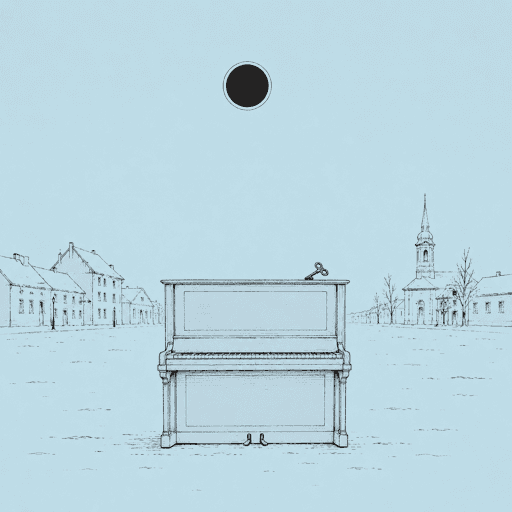
“But the piano was out of tune, and had to be readjusted to the full Werckmeister harmonic scale, so, opening the lid, he found the tuning key, found the frequency modulator in the cupboard, removed the music stand so that he might be able to get to the keys, rested the modulator in his lap and sat down to work.”
(Part 2, Page 282)
Defeated by the new authoritarian order and the loss of Valuska, György returns to his drawing room. His final act is to retune his piano from the divinely “pure” scale he had created back to the “false” Werckmeister system, signaling the resolution of his character arc and his resignation to a world of artificial order.
“Instead of muscles they cultivated rolls of fat and bags of skin; instead of fit bodies they encouraged wasting and excess; instead of clear bold looks they went about with self-centred little squints: to come to the point, they chose saccharine illusions over reality!”
(Part 3, Page 289)
In a recollection of her speech to the Colonel, Mrs. Eszter employs dehumanizing rhetoric that frames the townspeople as physically and morally weak. By creating a binary opposition between her vision of strength and the population’s supposed decay, she justifies her authoritarian impulse to “sweep away” those who choose “illusions over reality.”
“The unchained workers of decay were waiting in a dormant state for the necessary conditions to be established, as soon enough they would be, when they might recommence their interrupted struggle, that predetermined, merciless assault in the course of which they would dismantle whatever had been alive once and once only, reducing it into tiny insignificant pieces under the eternally silent cover of death.”
(Part 3, Page 310)
Following Mrs. Eszter’s cynical eulogy, the narrative voice shifts to a cold, scientific tone, personifying decomposition as an inevitable and “merciless assault.” This sudden transition from human political drama to the impersonal process of biological decay serves to diminish the significance of the town’s events.
“Everything was there, it is simply that there was no clerk capable of making an inventory of all the constituents; but the realm that existed once—once and once only—had disappeared for ever, ground into infinitesimal pieces by the endless momentum of chaos within which crystals of order survived, the chaos that consisted of an indifferent and unstoppable traffic between things.”
(Part 3, Page 314)
This passage offers a final, philosophical reflection on the nature of existence after detailing the body’s decomposition. The imagery of a “realm” being “ground into infinitesimal pieces” is a microcosm for the town’s societal collapse, drawing a comparison between the death of the human body and the death of human society.

Unlock every key quote and its meaning
Get 25 quotes with page numbers and clear analysis to help you reference, write, and discuss with confidence.
- Cite quotes accurately with exact page numbers
- Understand what each quote really means
- Strengthen your analysis in essays or discussions