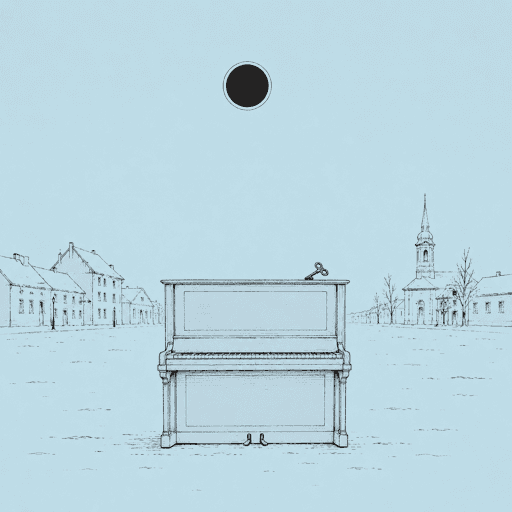
The Melancholy of Resistance
The Melancholy of Resistance
A modern alternative to SparkNotes and CliffsNotes, SuperSummary offers high-quality Study Guides with detailed chapter summaries and analysis of major themes, characters, and more.
Summaries & Analyses
Quizzes
NEWReading Tools
Character Analysis
Content Warning: This section of the guide includes discussion of emotional abuse, sexual content, mental illness, sexual harassment, physical abuse, graphic violence, and death.
Mrs. Eszter
Mrs. Eszter functions as the primary antagonist of the novel, a round and dynamic character who embodies calculating ambition in a world succumbing to futility. She is a pragmatic and ruthless force of will who perceives the encroaching social disintegration as a political vacuum to be exploited. Unlike other characters who retreat from the chaos, she actively engages with it, seeking to harness the public’s anxiety to establish a new, authoritarian order. Her motivations are rooted in a desire for power and a deep-seated resentment of her estranged husband, the respected but reclusive intellectual György Eszter. She understands that his public reputation is the key to her own political legitimacy, and her central conflict involves manipulating those around him, particularly János Valuska, to co-opt his influence and become the town’s de facto leader. Her project, the “A TIDY YARD, AN ORDERLY HOUSE” (138) movement, is a pretense for seizing control, illustrating the theme of The Role of Fear in Totalitarianism by packaging a power grab as a campaign for civic renewal.
Krasznahorkai uses physical description and action to establish Mrs. Eszter’s formidable nature. Described as a woman of “gigantic” (36) physical stature with a “ringing manly tone” (36), she projects an aura of dominance that allows her to intimidate and overwhelm more timid personalities like Mrs. Plauf. Her methods are strategic and manipulative; she skillfully uses flattery, veiled threats, and sexual leverage over the chief of police to advance her goals. She is one of the few characters who interprets the town’s decay with excitement rather than dread, seeing the pervasive filth and disintegration as a necessary cleansing that will sweep away the old, passive order. For her, the spreading chaos is “a harbinger of what would soon replace a world as ripe for ruin as this” (45), clearing the way for a society founded on action and strength. This forward-looking, opportunistic perspective makes her the novel’s most active character, a stark contrast to the intellectual resignation and naive idealism that render other characters ineffective.
Her relationship with György is the central axis of her ambition and resentment. She views him as both “the hopeless and insurmountable walls of hell” (39) and the essential key to her success. He represents the passive, effete intellectualism she despises, yet his social capital is the one thing she cannot generate on her own. Her plan to force him into a public leadership role is a masterstroke of manipulation, designed to neutralize him as an opponent while simultaneously exploiting his name. Her ultimate triumph is thus both political and personal; by installing herself in his house and relegating him to a back room, she physically and symbolically usurps his position, replacing his world of abstract thought with her own sphere of decisive, brutal action. Her rise to power demonstrates how, in a state of societal collapse, a single-minded and amoral will can fill the void left by decaying institutions and paralyzed intellects.
János Valuska
János Valuska is the novel’s protagonist, a round and tragically dynamic character who embodies a pure, childlike innocence in a world collapsing into cynicism and violence. Often regarded by the townspeople as a simpleton or “half-wit” (74), Valuska possesses a deep, almost mystical sensitivity to the universe. His primary motivation is a deep, abiding love for cosmic harmony, which he perceives as an “ineffable intellect” (105) governing the stars. He is a foil to both the nihilistic resignation of his mentor, György, and the ruthless pragmatism of Mrs. Eszter. While others see only decay, Valuska desperately seeks to affirm and share his vision of a perfect, monumental order, most notably through his ritualistic tavern performance of a total solar eclipse. This act is a microcosm of his role in the novel: a fragile attempt to demonstrate transcendent beauty and order to an audience that is largely indifferent or sees it only as entertainment. His naive faith stands in direct opposition to the theme of The Irrepressible Chaos of the Universe, making his ultimate fate proof of the vulnerability of such idealism.
Valuska’s defining traits are his compassion and his utter lack of guile, which render him susceptible to manipulation by nearly every other character. Mrs. Eszter exploits his devotion to her husband to further her political schemes, the regulars at the Peafeffer pub use him for amusement, and his own mother, Mrs. Plauf, rejects him out of shame. He moves through the decaying town as a postman, a role that makes him a central node of communication, yet he remains fundamentally isolated within his own “incurable beauty of his personal cosmos” (79). He does not truly see the filth and ruin around him because his perception is filtered through an unwavering belief in a higher, benevolent order. For him, the arrival of the giant whale is another manifestation of a mysterious and wondrous creation, a “positively regal” (90) spectacle.
Valuska’s character arc is a destructive trajectory from innocence to traumatic enlightenment. His pure vision of the world is unable to withstand a direct confrontation with malice and nihilism. This transformation begins when he overhears the argument inside the circus wagon and learns of the malevolent demagogue known as The Prince, whose philosophy of ruin shatters his belief in a benevolent universe. His subsequent forced participation in the mob’s destructive rampage, where he is dragged along as a horrified witness to their violence, triggers his mental health crisis. The boy who saw harmony in the stars is confronted with an earthly chaos he cannot process or reconcile with his worldview. His final state, living with catatonia in a psychiatric hospital, signifies the complete failure of his innocent idealism. His journey suggests that a spirit as pure as his cannot survive in a world where the forces of chaos and human cruelty hold sway, making him a tragic martyr to the novel’s bleak vision of reality.
György Eszter
György Eszter is the novel’s central philosophical figure, a reclusive and disillusioned musicologist who functions as both a mentor to Valuska and a foil to his own ambitious wife. He is a round character whose development is largely internal, moving from a state of passive nihilism to a different, more isolated form of resignation. Having retreated from the world into a state of seclusion, György intellectually embodies the theme of The Impact of Futility on Human Agency. His core belief is that Western civilization is founded on a fundamental lie: The artificial system of musical tuning known as the Werckmeister Harmonies. For him, this esoteric concept is a grand metaphor for all human attempts to impose a fraudulent, simplified order onto the universe’s naturally chaotic state. This discovery has led him to conclude that all human endeavor is pointless, prompting his complete withdrawal from a society he sees as irredeemably corrupt and “a filthy little sty” (278).
György’s seclusion is a willed act of resistance against a world he finds intellectually and aesthetically unbearable. His cluttered, dust-filled drawing room is a fortress against the “pathetic stupidity of so-called human progress” (99). He represents an intellectual tradition that, having deconstructed its own foundations, finds itself incapable of meaningful action. He is a mentor to Valuska, yet their relationship is built on a fundamental opposition. György’s worldview is one of deep disillusionment, while Valuska’s is one of boundless wonder. György attempts to instruct Valuska in his bleak philosophy, seeing the boy’s innocence as a kind of beautiful but dangerous ignorance. He is fond of Valuska, viewing him as a rare “angelic” being, but ultimately sees his faith in cosmic harmony as a delusion that cannot protect him from the world’s harsh realities. This dynamic positions György as a prophet of despair whose direst predictions are ultimately proven true by Valuska’s tragic fate.
While largely static upon his introduction, György is forced into action by the events of the riot and his wife’s machinations. His brief, horrifying journey through the ruined town confirms his bleakest theories about societal collapse. The sight of the town buried in its own frozen rubbish is a physical manifestation of the spiritual decay he has long theorized. This experience, combined with his terror for Valuska’s safety, marks a shift in his character. After the violence subsides and he learns what has become of Valuska, his final act is to painstakingly retune his piano to standard Werckmeister equal temperament, contradicting the philosophy he espoused at the start of the novel. This gesture can be read as a complete and final retreat from his principles. By creating a tiny, perfect, and isolated pocket of order for himself, he accepts the collapse of the outside world and completes his withdrawal from it, embracing a form of aesthetic solace that is, in the face of the universe’s larger chaos, ultimately sterile and meaningless.
Mrs. Plauf
Mrs. Plauf is a minor but important character who serves as the reader’s introduction to the novel’s atmosphere of fear and societal collapse. As a round but static character, she represents the average citizen clinging to the fragile constructs of social order in the face of encroaching anarchy. Her journey on the malfunctioning train in the opening chapter is a microcosm of the town’s larger collapse. From the delay of the railway schedule to the menacing behavior of her fellow passengers, her experience establishes a world where “all normal expectations went by the board” (3). Her primary motivation is simple and relatable: to return to the safety and predictability of her home, an apartment she has cultivated as an island of pristine order against a chaotic world.
Mrs. Plauf’s character is defined by her class consciousness and her desperate need for propriety and control. She views her “common peasant” (4) fellow travelers with a mixture of fear and contempt, and her sense of violation is as much about the breach of social decorum as it is about physical threat. Her meticulously kept apartment, filled with “carefully tended flowers” and “delicate furniture” (5), symbolizes the human desire to create small pockets of meaning and order. This personal fortress is her only defense against a universe she comes to see as hostile and arbitrary. After the traumatic encounter on the train, where a man sexually harasses her, she concludes that there is “no valid defence” (13) against the world’s absolute chill. Yet, upon returning home, her first instinct is to retreat into denial, reaffirming the security of her orderly life and dismissing the chaos outside as something that does not concern her. This refusal to accept the new reality marks her as a static character; her harrowing experience reinforces her dependence on the illusion of a safe, civilized world. Her eventual fate, revealed secondhand as one of the riot’s first victims, is a grim testament to the futility of such a retreat, proving that no private sanctuary is safe when society itself disintegrates.
The Chief of Police
The Chief of Police is a symbol of failed authority. Affected by alcohol addiction and personal grief, he is an easy pawn for Mrs. Eszter, who exploits his institutional power and personal weakness. His inability to maintain order is an important factor that allows chaos to take root. When Mrs. Eszter secures her authority in the new regime, she quickly discards the chief in favor of her new lover, the military colonel, Peter.
Harrer
Valuska’s landlord, Harrer, nicknamed “the vulture” (50), is a similarly pathetic and morally compromised figure. As a sycophant to Mrs. Eszter, he acts as her informant and enforcer, representing the opportunism and moral decay that thrives in a climate of fear. Though he pathetically begs for her affection at the start of the novel, he secures his role in her new regime by serving as her loyal assistant at the end.
The Director
The Director is a pragmatic businessman who, despite his imposing physical presence, is ultimately powerless over the forces he has unleashed. He treats his mysterious attractions, the whale and The Prince, as mere commodities but is unable to control the nihilistic fervor they inspire.
The Prince
The Prince is the story’s central demagogue, a diminutive and mysterious figure who wields a “magnetic power” (157) over the fearful crowds. He articulates a philosophy of pure destruction, giving voice to the mob’s latent nihilism and directing their formless anxiety into targeted violence.
The Mob
The mob itself acts as a collective character. It is an anonymous, silent, and volatile mass of disaffected citizens, drawn together by the spectacle of the whale but united by a shared sense of dread and alienation. They represent the raw material of totalitarianism: A frightened and directionless populace easily molded into a tool of destruction by a charismatic leader who preys on their deepest fears.

Unlock analysis of every major character
Get a detailed breakdown of each character’s role, motivations, and development.
- Explore in-depth profiles for every important character
- Trace character arcs, turning points, and relationships
- Connect characters to key themes and plot points