Summaries & Analyses
Author Insights
Quizzes
NEWReading Tools
Chapters 14-31Chapter Summaries & Analyses
Content Warning: This section of the guide includes discussion of substance use and death.
Chapter 14 Summary: “It Goes By So Fast”
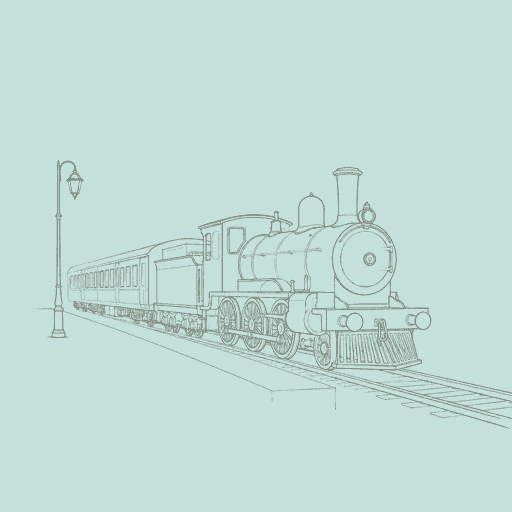
On the Midnight Train, Wilbur’s ghost watches fragmented memories of his childhood flash past the window. He sees his school, himself reading, and brief images of his mother and brother, Dougie. One vivid memory is of watching the Queen’s coronation on television at a neighbor’s house on June 2, 1953. He recalls it as one of the few days in his youth when he did not feel hungry. Worried that the train will not stop again until he is at the end of his life, Wilbur is relieved when it finally comes to a halt.
Chapter 15 Summary: “Dust”
Wilbur finds himself inside Bagdale’s Bookshop, where he sees his 13-year-old self engrossed in Ernest Hemingway’s The Old Man and the Sea. The grumpy owner, Mr. Arthur Bagdale, confronts young Wilbur for reading without any intention to buy. From behind the counter, Mr. Bagdale’s elderly mother, Agnes, tells her son to leave the boy alone, arguing that a bookshop should encourage readers. Mr. Bagdale ignores her and snatches the book away. Agnes then offers to buy the book for Wilbur with her own pension money, but a shamed Wilbur says he can get it from the library and quickly walks out. As he leaves, the Midnight Train appears inside the shop, and Agnes’s ghost leans out, telling Wilbur it is time to be on their way.
Chapter 16 Summary: “Acceptance”
Back on the moving train with Agnes’s ghost, Wilbur watches school day memories pass by. He asks Agnes if she also had to watch her entire life, and she confirms that it is always a difficult experience but one that must be accepted. As the train begins to slow down again, Agnes informs Wilbur that the next stop is an important one: the first time he ever saw the great love of his life.
Chapter 17 Summary: “The First Time He Ever Saw Her”
The train stops on Glossop Road, where Wilbur’s ghost observes his younger self sitting on the front doorstep, absorbed in a Hemingway novel. He reflects on how stories were his primary escape and a source of strength. As he watches, two girls from another school walk by. The first, a girl named Doreen Taylor, mocks him for reading in the street. Her friend, Maggie Shaw, is kinder and starts a conversation with Wilbur about their shared love of books. Wilbur tells them he would like to be a writer. When he mentions that his father died in the war, Maggie flinches with sympathy. She invites him to join them at the Milk Bar.
Chapter 18 Summary: “The Broken Glass”
Wilbur is hesitant to accept Maggie’s offer to treat him at the Milk Bar because he has no money. Before he can decide, a police car arrives, and two officers escort Wilbur’s older brother, Dougie, from the back seat. Overwhelmed with shame, Wilbur pretends not to know his brother, a denial that visibly hurts Dougie. An officer asks Wilbur if his mother is in. When she answers the door, she is red-cheeked from drinking sherry—a new development in her habits. Maggie gently pulls a fascinated Doreen away and gives Wilbur a warm smile before she leaves. The ghost recalls the vicious family argument that followed, which ended with Dougie getting drunk and spitting on Wilbur. The train’s whistle blows, saving him from having to relive the rest of the painful memory.
Chapter 19 Summary: “The Portrait”
Aboard the speeding train, Wilbur notices a painted portrait of himself as a teenager on the carriage wall. He realizes that as the train moves forward in time, the portrait ages along with him. Agnes’s ghost reappears and explains that the portrait acts as a form of navigation, showing him “when” in his life he is. She tells him that the train stops at the most significant moments to provide a full understanding of his existence before he enters eternity. Quoting the philosopher Kierkegaard, Agnes says that “life can only be understood backward” (62-63), and the train’s purpose is to allow him to relive it forward.
Chapter 20 Summary: “The Speed of Friendship”
As months and years fly by the window, Wilbur sees memories of his childhood best friend, Charlie Applewood, a shy and intelligent boy who was often bullied. Wilbur recalls Charlie’s tense home life, where his father was abusive. He remembers getting into a fight to defend Charlie at school. In another flash, he sees Maggie saying hello to him at the library while he studies with Charlie. The montage of his youth continues, showing moments of friendship and quiet pursuits like writing poetry.
Chapter 21 Summary: “The Bookshop”
In 1961, the train stops as Wilbur’s ghost watches his younger self apply for a summer job at Bagdale’s Bookshop. The former owner, Agnes, has recently died, and her son, Arthur, needs help. Mr. Bagdale doesn’t recognize Wilbur and becomes friendlier when he learns Wilbur’s father served in the Royal Air Force. As a test, Mr. Bagdale tells Wilbur to sell a book to a customer. Wilbur approaches a man, correctly deduces he is a jazz musician, and successfully recommends the novel Absolute Beginners. Impressed, Mr. Bagdale remarks that Wilbur has the same natural talent for bookselling as his own mother and gives him the job.
Chapter 22 Summary: “The Big Importance of Small Things”
The ghost follows a jubilant 16-year-old Wilbur, who is on his way to see his friend Charlie after securing the bookshop job. In the park, he encounters Victor Willows, an unhoused man he knows from the area. Wilbur gives Victor all the money he has on him. Victor thanks him, not just for the coins, but for truly “seeing” him as a person when so many others only look past him. He advises Wilbur to always keep that quality. From the future, the ghost sadly mutters that he did not.
Chapter 23 Summary: “The Bench”
In Endcliffe Park, Wilbur sees Maggie sitting on a bench sketching. He almost walks past to avoid disturbing her, but she playfully calls out to him. They sit together and have their first real conversation, discussing books, their shared feeling of being out of place, and their ambitions. Wilbur reveals his dream of attending Oxford University to escape his difficult home life, and then traveling the world, while Maggie talks about wanting a life of art. She also shares that her mother passed away two years prior. After he praises her drawing, she explains the artistic concept of chiaroscuro—the contrast between light and dark. She adds that she dreams of going to Venice to see Titian's work. Just as the conversation deepens, Maggie’s father, Alfred, arrives in his park warden van to pick her up, and a nervous Wilbur quickly departs.
Chapter 24 Summary: “The Blink of an Eye”
The train moves on, and Wilbur sees a rapid succession of images from his late teens. He glimpses himself at 17, in a sunlit Oxford, walking through the garden quad of Balliol College for his entrance exam. In another flash, he is at the Milk Bar with his friend Charlie, talking to a girl who will soon become his girlfriend, Alice Dobson. The memories then fade as the landscape outside the window becomes a dark, desolate desert.
Chapter 25 Summary: “Coles Corner”
The train stops on a cold February evening. Eighteen-year-old Wilbur, dressed in a new suit, meets his girlfriend of two months, Alice Dobson, at Coles Corner, a local landmark. He excitedly shares his news: He has been accepted to Oxford University with a full scholarship. Alice, however, is upset by the news. Her main concern is that she will not see him, and she questions how he will fit in. The tension between them spoils the start of their date.
Chapter 26 Summary: “The Palace”
At the Palace Cinema, Alice is still cold toward Wilbur. She makes a sarcastic comment about his film choice, The Great Escape. They opt to watch The Birds instead. As they sit in the theater, Wilbur’s ghost stands in the aisle and desperately tries to make his presence known, hoping to warn his younger self that he is with the wrong person. For a moment, young Wilbur feels a chill and tells Alice that someone “just walked across my grave” (86), but he fails to see his older self.
Chapter 27 Summary: “The Hidden History”
During the film’s intermission, the usherette selling refreshments is Maggie. She and Wilbur exchange a brief, polite hello. Alice buys a choc ice from Maggie and then complains loudly that it is melting. She insults Maggie by asking where she keeps the ice cream, implying it was stored in her bra. Wilbur tries to defend Maggie, but Alice insists on getting her money back. Maggie calmly gives her a shilling from her tray. Wilbur’s ghost watches the scene, reflecting on how much of life’s true history is made of unspoken feelings and subtle moments.
Chapter 28 Summary: “Silent Words”
After the movie, while Alice is away from her seat, Wilbur approaches Maggie to apologize for his girlfriend’s behavior. Maggie kindly reassures him and tells him he worries too much. He wants to say more, but Alice returns, and the opportunity is lost. As his ghost boards the waiting train outside the cinema, he looks back at Maggie and is overwhelmed by a pure, uncomplicated love for her, silently telling her across time that he misses her.
Chapter 29 Summary: “The Hundred Deaths of Wilbur Budd”
As the journey continues, the ghost reflects on the many small deaths a person experiences in a lifetime: the death of youth, ideals, and love. He realizes that these losses are often the result of choices that seemed logical at the time but, in retrospect, represent lost versions of oneself. He grieves for the person he used to be and the innate goodness he has lost along the way.
Chapter 30 Summary: “A Quick Word”
Agnes’s ghost reappears on the train and sternly reprimands Wilbur for trying to interfere with the past at the cinema. She reminds him that his purpose is only to watch, as meddling with time is extremely dangerous. Wilbur protests, lamenting that he can now see how he squandered love. Agnes agrees that he did but insists he has no choice but to see the journey through as it is preordained.
Chapter 31 Summary: “Miss Graham’s Last Lesson”
Wilbur finds a new visitor in his carriage: the ghost of Miss Graham, his favorite English teacher. She explains that she is not meant to be there, but in eternity she saw he was struggling and found a way to visit. She praises his life’s success, defining it by the distance he traveled from his humble origins. Wilbur confesses his regrets about letting love die. Miss Graham offers a different perspective from Agnes, suggesting that while interfering with the past is risky, sometimes life itself is more important than eternity, and that rules are sometimes meant to be broken. Just then, Agnes appears, dismisses Miss Graham, and tells Wilbur to ignore her “radical ideas.” As the journey continues, Wilbur sees images out the window: Dougie arriving home from prison, and two concert tickets on a table. As the train slows for its next stop—the night of the tragedy that shaped his life—Wilbur protests, refusing to get off. Agnes informs him the train will not move again until he does.
Chapters 14-31 Analysis
Agnes’s explanation of the Midnight Train’s purpose reinforces the novel’s narrative framework as a therapeutic life review. She tells Wilbur that the journey’s function is to help him understand his existence by revisiting its most significant moments, quoting the philosopher Kierkegaard: “Life can only be understood backward; but it must be lived forward” (63). This concept defines the train’s function, positioning it as a supernatural solution to a universal human problem. The train itself, as the central symbol, externalizes the psychological process of confronting one’s past. Its selective stops at key events mirror how memory works, focusing on moments of intense emotional weight. Wilbur’s tour of his choices and regrets suggests that Confronting Pain as a Condition for Healing is the explicit goal of this afterlife experience. The process is painful, but Agnes frames it as a necessary step toward acceptance and peace in eternity.
The recurring motif of books and bookshops highlights the central tension between passion and commerce that will define Wilbur’s life. In his youth, books are an essential escape from the deprivations of post-war Sheffield, giving him “room to grow beyond the world he was given” and making him feel “strong” (51). The conflict between two philosophies of bookselling is established in the scene at Bagdale’s Bookshop. The new owner, Arthur, sees books purely as merchandise and scolds Wilbur for reading without buying, while his mother, Agnes, believes a bookshop’s purpose is to “let people fall in love with books” (47). Wilbur initially embodies Agnes’s view, demonstrating a natural talent for matching a book to a reader, a skill his ghost recalls as a “joy.” This early passion lays the groundwork for the theme of Pursuing Material Ambition at the Expense of Self, as his innate love for literature will eventually become the foundation for a business empire that prioritizes profit over the very human connection he once cherished.
Wilbur’s ambition to attend Oxford University is rooted in the specific sociohistorical context of his working-class upbringing. He tells Maggie that his primary motivation is to “escape” his chaotic family life and the economic precarity of his youth. This desire is framed as a form of social rebellion, with his teacher Miss Graham calling it “an act of revolution” against a class-based education system (82). The novel depicts a post-war Britain still shaped by austerity, an environment of scarcity that fuels Wilbur’s drive for upward mobility. His girlfriend, Alice Dobson, views his acceptance to Oxford as a betrayal of his local identity, questioning how a “lad from Glossop Road” will fit in with the “snobs” (82). Her reaction reveals the social pressures and class anxieties of the period, where ambition could be seen as an abandonment of one’s community. This deep-seated need to escape his origins becomes the driving force behind the material success he will later achieve at great personal cost.
The contrast between Maggie Shaw and Alice Dobson establishes the novel’s definition of genuine connection, introducing the theme of Cultivating Love Through Attention and Care. Maggie’s empathy is evident from her first meeting with Wilbur when, recognizing Wilbur’s poverty, she offers to treat him. Their later conversation on a park bench is built on mutual vulnerability and intellectual curiosity. Maggie’s explanation of chiaroscuro—the artistic use of light and dark—is a metaphor for their dynamic; she intuits that understanding requires acknowledging both the bright and shadowed parts of a person. Alice, on the other hand, is possessive and superficial. She belittles Wilbur’s achievement and publicly humiliates Maggie at the cinema, revealing an inability to see beyond her own insecurities. Wilbur’s immediate, protective instinct toward Maggie, followed by his regret at failing to pursue the unspoken connection, emphasizes that love is nurtured through small acts of kindness and recognition rather than grand romantic gestures.
The conflicting guidance from Agnes and Miss Graham introduces the central question of Wilbur’s agency in his own redemption. Agnes, the official guide, enforces a strict rule of non-interference, insisting that Wilbur’s purpose is only to watch and accept his predetermined path. Her philosophy is one of passive observation as a means to understanding. Miss Graham, arriving as an unsanctioned visitor, offers a “radical” alternative, arguing that “sometimes life is the most important thing” and that rules are meant to be broken (95). She suggests that a single day of lived experience with a loved one is more valuable than an eternity of ghostly observation. This debate between acceptance and intervention forces Wilbur to consider whether his journey is simply a review or an opportunity for change.

Get in-depth, chapter-by-chapter summaries and analysis from our literary experts.
- Grasp challenging concepts with clear, comprehensive explanations
- Revisit key plot points and ideas without rereading the book
- Share impressive insights in classes and book clubs