Summaries & Analyses
Author Insights
Quizzes
NEWReading Tools
Summary and Study Guide
Overview
Matt Haig’s speculative fiction novel, The Midnight Train (2026), follows 81-year-old Wilbur Budd, a wealthy but lonely business magnate who, after his death, finds himself on a ghostly train journey through his own past. Guided by a spirit from his youth, Wilbur must revisit the key moments of his life—from the childhood trauma that shaped him to the relentless ambition that cost him his greatest love—to understand his deep regrets before reaching a final, eternal destination. The novel examines themes of Pursuing Material Ambition at the Expense of Self, Confronting Pain as a Condition for Healing, and Cultivating Love Through Attention and Care. Haig, known for his bestselling memoir Reasons to Stay Alive and his acclaimed novel The Midnight Library, often draws upon his personal experiences to craft narratives that blend fantastical premises with deep psychological insight. The Midnight Train continues the author’s exploration of mental health, regret, and the possibility of redemption.
This guide refers to the 2026 Viking hardcover edition.
Content Warning: The source text and this guide feature depictions of mental illness, suicidal ideation, pregnancy loss, substance use, graphic violence, illness, and death.
Plot Summary
Wilbur Budd, an 81-year-old retired business magnate, lives a solitary life in a large Bedfordshire house. His routine is punctuated by weekly piano lessons. On a Saturday afternoon, his quiet existence is shattered by a phone call from Maggie, his ex-wife, whom he has not spoken to in nearly 30 years. She tells him she dreamed of them together and happy, a call that floods Wilbur with a lifetime of regret. Rummaging through old papers, he finds the last page of the letter Maggie wrote when she left him, proof of a love that endured even as he became emotionally distant. Overwhelmed by the call and a sudden, intense pain in his chest, Wilbur collapses on his lawn while trying to summon his gardener for help.
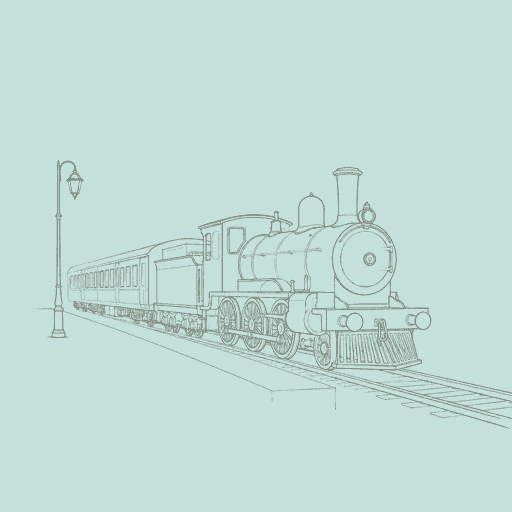
Wilbur dies in the hospital at one minute past midnight. In the afterlife, he finds himself on a desolate platform at a train station bearing a sign with his own name, WILBUR. A magnificent steam engine, The Midnight Train, pulls in. From it steps Agnes Bagdale, the kind woman who owned the Sheffield bookshop Wilbur frequented in his youth. Agnes explains that she is his ghostly guide on a journey through his own life. Wilbur’s appearance transforms—he de-ages to 29, the age he was on his honeymoon. Agnes explains he will travel through his past as an invisible observer, stopping at key moments to understand the full arc of his existence before reaching eternity. There he may eventually be reunited with lost loved ones like Maggie and his brother, Dougie.
Wilbur boards the train, and the journey begins, the landscape outside the window a collage of memory. His first stop is Sheffield in 1945, where he witnesses his seven-year-old brother, Dougie, playing in the post-war rubble. He sees their mother, Edith, embittered by poverty and the loss of her husband in the war. Inside their small home, Wilbur is shocked to learn that his most cherished childhood toy, a model train, was not a gift from his mother but was stolen for him by Dougie.
The train continues, stopping at formative moments. As a teenager, Wilbur is nearly ejected from Bagdale’s Bookshop for browsing without buying, only for the elderly Agnes to intervene and purchase The Old Man and the Sea for him. Later, he has his first real conversation with Maggie Shaw on a park bench, a moment of deep connection that is interrupted by her father's arrival. The journey’s most dreaded stop arrives: the night of July 27, 1964. At a Rolling Stones concert, a resentful Dougie, drunk after learning of Wilbur’s scholarship to Oxford, instigates a fight. When attacked, Dougie pulls a knife, forcing the brothers to flee in a high-speed car chase with the police. In a moment of panic, Dougie swerves to avoid a rabbit, crashing the car into a sycamore tree and dying instantly.
The train travels through the bleak aftermath of the accident. Wilbur, consumed by guilt, gives up his place at Oxford to care for his mother, who is experiencing mental illness. He throws himself into his job at the bookshop, using work as an anesthetic for his grief. Years later, he reconnects with Maggie in a cemetery. After Wilbur’s ghost tries to communicate with his former self, Wilbur and Maggie share a kiss that did not happen at this point in his life’s original timeline.
On the train, Agnes warns Wilbur that his ghostly interference is destabilizing the timeline; if his past changes too drastically, his path to eternity will vanish. The timeline shudders but corrects itself, and his life proceeds as it did before: He and Maggie eventually start a relationship, marry, and embark on their honeymoon in Venice. This is the train’s next major stop, and Wilbur, now a ghost, is filled with a desperate urge to alter the future he knows will unfold. He defies Agnes’s most sacred rule and refuses to re-board the train, choosing instead to remain present until his living, 29-year-old self falls asleep in Venice.
As the living Wilbur dozes in a hotel room, his dreaming consciousness—the Dreamer—is pulled from his body and onto the ghostly platform. The Midnight Train arrives, violently unstable. The Ghost and the Dreamer leap aboard and are confronted by Agnes, who explains the journey is now dangerously unpredictable. Together, the two Wilburs watch the future the Ghost has already lived: the relentless expansion of his bookshop into the Budd Books empire, his growing emotional distance from Maggie, the pregnancy loss she endures while he is away on business, his callous firing of his best friend Charlie, and their eventual, heartbreaking divorce. The journey culminates with the Dreamer witnessing his own death at 81, shortly after receiving Maggie’s phone call. At the end of the line, the Ghost makes the ultimate sacrifice, stepping into a void of nothingness to give his younger self the chance to wake up and live a different life. The train disintegrates, and as it breaks apart, the Dreamer manages to save Agnes before he, too, is engulfed in light.
Wilbur awakens in his hotel bed in Venice, a mere five minutes after he fell asleep. The experience feels deeply real, a conviction solidified when Maggie emerges from the bathroom wearing the exact blue dress he saw her wearing from the train. Convinced of the truth of his experience on the Midnight Train, he tells a stunned Maggie that he is abandoning his plans to expand the business. He wants to preserve the integrity of the single bookshop and, more importantly, their life together. Walking through Venice that night, he is a changed man. He speaks openly of his grief for Dougie and his love for Maggie, vowing to remain present for her and for himself. Embracing the uncertainty of a future he has unwritten, he holds Maggie’s hand.

Get in-depth, chapter-by-chapter summaries and analysis from our literary experts.
- Grasp challenging concepts with clear, comprehensive explanations
- Revisit key plot points and ideas without rereading the book
- Share impressive insights in classes and book clubs