Summaries & Analyses
Author Insights
Quizzes
NEWReading Tools
Symbols & Motifs
Content Warning: This section of the guide includes discussion of death.
The Midnight Train
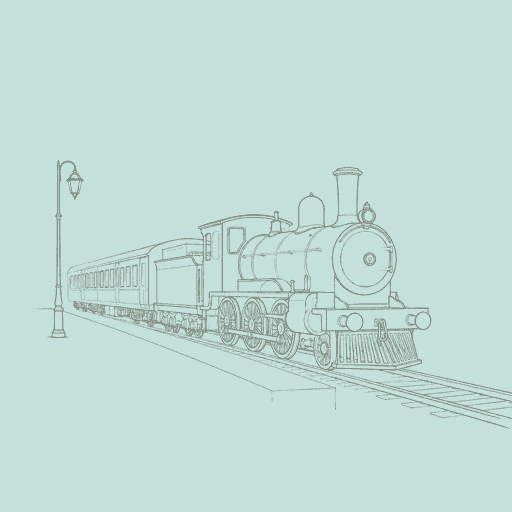
The titular Midnight Train is the novel’s central symbol, representing the difficult journey of self-reflection that must precede acceptance and healing. A liminal space between life and eternity, it carries Wilbur through the memories, regrets, and emotional wounds he avoided confronting while alive. Drawn from the toy steam engine his brother gave him as a child, the train captures how self-understanding is shaped by formative childhood experiences. By forcing Wilbur to stop at the moments that defined him, it illustrates the theme of Confronting Pain as a Condition for Healing. The train’s purpose is explained by its guide, Agnes, who tells Wilbur that “[t]he Midnight Train […] goes to the places that, together, at the end, will give you the truest assessment of your existence” (62). Its journey is carefully constructed to expose the emotional truths of his life. By forcing Wilbur to relive these moments, the train illustrates that understanding oneself requires acknowledging the past's enduring influence.
The Midnight Train also symbolizes the process of moral reckoning. Throughout his life, Wilbur defined himself through achievement, professional success, and outward accomplishment. Yet the train repeatedly redirects his attention toward relationships, losses, and missed opportunities for love. The stops reveal how Wilbur’s pursuit of ambition often came at the expense of emotional connection, gradually dismantling the narrative he had constructed about himself. In this way, the train strips away self-deception, demonstrating that self-knowledge is impossible without acknowledging one's failures alongside one's successes.
By the novel’s conclusion, the Midnight Train has come to symbolize transformation. Wilbur boards it burdened by denial, bitterness, and unresolved grief, but each stage of the journey brings greater understanding and compassion, both for others and for himself. The train therefore functions as a bridge between ignorance and wisdom, regret and acceptance, mortality and peace.
Books and Bookshops
The recurring motif of books and bookshops is a measure of Wilbur’s inner life, charting his spiritual decay. Throughout The Midnight Train, books represent imagination, empathy, wisdom, and the ability to connect with experiences beyond one's own. The evolution of Wilbur’s relationship with them mirrors his movement away from these values and his gradual recognition of what he has lost. In this way, the motif reinforces the theme of Pursuing Material Ambition at the Expense of Self.
In Wilbur’s youth, Bagdale’s Bookshop is a sanctuary and a place of possibility. The shop represents his passion for reading, curiosity, and his connection to others through the world of narrative. However, as Wilbur’s ambition grows, books are transformed from sources of wonder into commodities. His creation of the Budd Books empire from a single shop is a betrayal of the values that inspired it. The chain of stores becomes a symbol of his hollow success, a corporate machine that distances him from the very people and principles he once cherished. His best friend Charlie identifies this contradiction, remarking, “You used to spend your life telling me to read something and now you run the most famous bookshops in the country and you don’t get time to read…Just seems a bit topsy-turvy” (233). The observation highlights how thoroughly Wilbur has substituted success for meaning. He commodifies his passion to such a degree that he loses sight of the imaginative and emotional nourishment they once provided.
The Sycamore Tree
The sycamore tree on Ecclesall Road is a symbol of Wilbur’s unresolved trauma, grief, survivor’s guilt, and the enduring presence of the past. As the site of the car crash that killed his brother, Dougie, the tree acquires immense emotional significance for Wilbur, becoming the geographic nucleus of his suppressed feelings. The tree embodies the theme of Confronting Pain as a Condition for Healing, illustrating how trauma can continue to shape a person’s identity when it remains unacknowledged.
While the tree remains unchanged over the years, Wilbur’s life is distorted by his efforts to avoid it. This is illustrated by his refusal to drive down Ecclesall Road, rearranging his routes to ensure he never has to face the site of the accident. This avoidance is a physical manifestation of his broader emotional strategy as, rather than processing his grief, he buries himself in work and ambition. His mother captures the futility of this approach, noting that although the site is miles from Wilbur’s later home, “he still can’t drive down it or see it or anything else. But it’s still there, just as it was in sixty-four” (208). Edith’s observation emphasizes that avoiding trauma does not diminish its power. The tree’s endurance demonstrates that painful experiences cannot be erased by choosing not to look at them. While the sycamore continues to grow, Wilbur refuses to allow himself the same natural evolution.
Benches
Benches are a recurring motif that represents spaces of genuine connection and emotional honesty, illustrating the theme of Cultivating Love Through Attention and Care. Throughout Wilbur and Maggie’s relationship, key moments of vulnerability and intimacy occur on benches. From their first unguarded conversation as teenagers in Endcliffe Park to their proposal on that same spot years later, benches are where they are fully present with one another, building their love through shared time and attention. These simple, public seats stand in stark contrast to the isolating, opulent rooms and sterile corporate environments of Wilbur’s later life, representing the grounded connection he ultimately sacrifices.
Maggie’s father, Alfred, gives Wilbur the key to understanding this motif when he offers the advice, “Love is a garden. You have to keep tending to it” (166). This metaphor frames love as an act of cultivation. The benches are the plots within that garden, the specific places where Wilbur and Maggie do the work of “tending” to their bond. When Wilbur’s ambition consumes him, he stops spending time in these spaces, both literally and figuratively. Consequently, his relationship with Maggie withers from neglect, reinforcing the novel’s argument that love cannot survive without sustained, active care.

Unlock the meaning behind every key symbol & motif
See how recurring imagery, objects, and ideas shape the narrative.
- Explore how the author builds meaning through symbolism
- Understand what symbols & motifs represent in the text
- Connect recurring ideas to themes, characters, and events