The Same Backward as Forward
The Same Backward as Forward
A modern alternative to SparkNotes and CliffsNotes, SuperSummary offers high-quality Study Guides with detailed chapter summaries and analysis of major themes, characters, and more.
Summaries & Analyses
Quizzes
NEWReading Tools
Symbols & Motifs
The Ocean
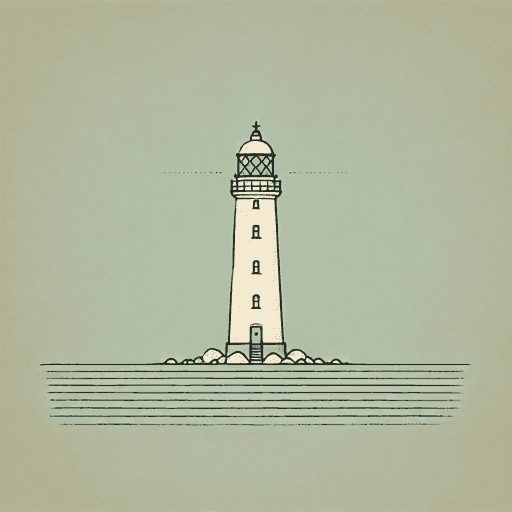
The ocean is a recurring motif throughout the narrative. It mirrors the characters’ emotional states and foreshadows impending danger while also serving as the setting for the romance. Its storms parallel conflict and moments of crisis, and the calm stretches lead to intimacy and understanding. The ocean’s violence also emphasizes how powerless the characters are in the face of forces beyond their control, thus hinting at the theme of Inheritance and the Choice to Be Different. At the same time, as an inherently liminal environment, the seaside becomes a place for the reflection and transformation that underpin the theme of How Love Reshapes Identity; many of the pivotal moments in Hannah and Toby’s relationship and character development occur near the shore or in the lighthouse.
The lighthouse itself also holds symbolic significance. As Toby states, “[T]here’s something beautiful about anything built for one purpose that refuses to die, even once that purpose is gone” (101). This frames the lighthouse as a metaphor for resilience; like the lighthouse endures the sea, the characters endure trauma and grief.
Fairy Tales
The novel repeatedly contrasts the idealized world of fairy tales with the harsh truths of real life. Both Hannah and Toby refer to fairy tales, the motif functioning as both a way of escaping their circumstances and reflecting on them. For example, Toby uses a well-known fairy-tale opening to capture his longing for a narrative that is cohesive and has a happy ending, in contrast to the real-life grief and moral ambiguity that he and Hannah face: “[O]nce upon a time, I thought, there was us” (167). The wistful tone suggests the impossibility of his dreams of a life together; such things are possible only in stories, he implies. At the same time, the fact that fairy tale motifs, such as castles and magic, often appear in Toby’s word games or imaginative exercises suggests that there is value in such escapism as a tool for coping. In the end, Toby and Hannah do not get their fairy tale ending, but this tension also reinforces the characters’ growth, as they reconcile desire and fantasy with lived experience.
Word Games
Word games function as a central motif that mediates Hannah and Toby’s relationship. From the outset, Toby engages Hannah through games like folded-paper challenges, where he asks her to unfold his creation without breaking it. This then evolves into more complex word games that allow Toby to test Hannah and reveal what he knows about her. These games extend to writing palindromes with lemon juice, the circle on Hannah’s hand, and the two-line game, all of which allow Toby to express himself indirectly, thus respecting Hannah’s boundaries while also gently challenging them.
Word games also provide a source of light in a dark and dangerous setting. They are used for play and testing boundaries, and these exchanges develop intimacy. They also show both characters’ perception and insight. They require the participants to notice detail and understand each other’s perspectives, thus mirroring the emotional and psychological attention needed in their interactions.
One kind of wordplay that bears special consideration is the use of palindromes, which Toby draws attention to with his nickname for Hannah: “Hannah the Same Backward As Forward.” The description evokes the book’s structure, which tells the same story from two points of view. It also echoes the novel’s interest in agency and inevitability, raising the question of whether the characters’ efforts to disentangle themselves from their families and build a life together are doomed from the start.

Unlock the meaning behind every key symbol & motif
See how recurring imagery, objects, and ideas shape the narrative.
- Explore how the author builds meaning through symbolism
- Understand what symbols & motifs represent in the text
- Connect recurring ideas to themes, characters, and events